


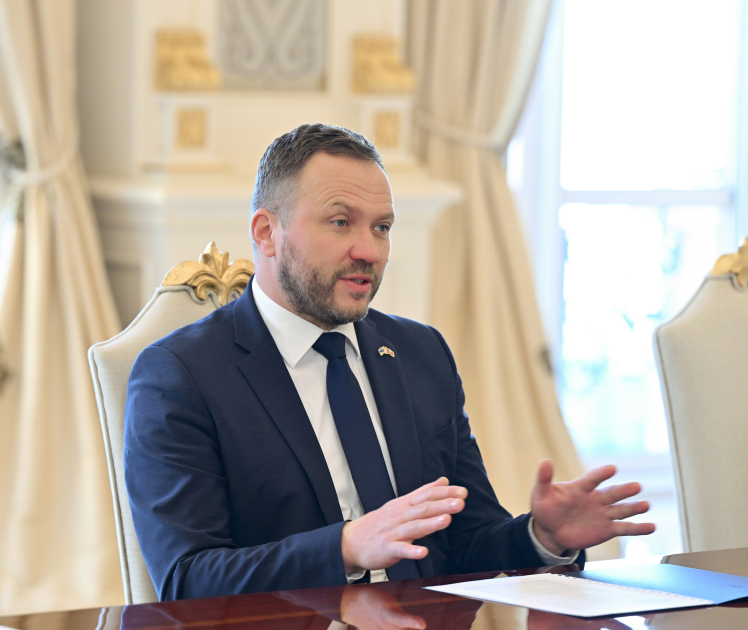

BAKU, Azerbaijan, November 28. Estonian technologies could support Azerbaijan’s green energy transition, Estonian Minister of Foreign Affairs Margus Tsahkna said in an exclusive interview with Trend, as he visited Baku on November 27.
Talking about the purpose of his visit to Azerbaijan, the minister noted that the primary objective is the official opening of the Estonian Embassy in Baku.
“When I visited Azerbaijan last autumn, I told President Ilham
Aliyev that I would propose opening an Estonian embassy here, and I
am delighted that one year later that commitment has been
fulfilled.
The opening of our embassy is a clear sign of the growing
partnership between Estonia and Azerbaijan. Over the past years, we
have significantly expanded cooperation in areas such as trade,
digital development, innovation, education and green energy.
Establishing a permanent diplomatic presence in Baku will enable us
to deepen political dialogue, support business contacts more
effectively and create new opportunities for cooperation between
our countries,” said Tsahkna.
He believes that the embassy is not only an investment in bilateral
relations but also a reflection of Estonia's long-term commitment
to the South Caucasus region.
“We want to continue building a practical and forward-looking
partnership that delivers benefits to both our countries,” the
minister added.
Promising sectors for Estonian businesses in
Azerbaijan
Tsahkna noted that Interest among Estonian businesses in Azerbaijan
has been steadily growing.
“This was clearly demonstrated during the fourth meeting of the
Estonia-Azerbaijan Intergovernmental Commission on Economic
Cooperation held in Tallinn earlier this month and my visit to Baku
with a 15-member business delegation last October,” the Estonian FM
said.
He pointed out that information and communication technologies
(ICT) remain one of the strongest areas of cooperation.
“Estonian companies have already established a presence in
Azerbaijan's digital sector, and there is considerable interest in
contributing to the country's ongoing digital transformation.
Estonia has internationally recognised expertise in e-governance,
digital identity, cybersecurity, artificial intelligence and
e-learning, all of which offer promising opportunities for
practical cooperation,” he added.
At the same time, as Tsahkna noted, Estonia sees significant
potential in the energy sector, particularly in renewable energy
and green-transition projects.
“Estonian companies can contribute innovative technological
solutions, digital tools and specialised expertise,” the minister
said.
Cooperation n renewable energy, energy efficiency, digital
energy solutions
“We see substantial opportunities for cooperation in all of these
areas. The green transition is one of the defining economic and
technological transformations of our time, and both Estonia and
Azerbaijan are actively pursuing ambitious goals in this field,”
said Tsahkna.
He noted that Estonia is home to a growing ecosystem of
clean-technology companies that combine digital innovation with
sustainable solutions.
“Our expertise ranges from energy-efficiency technologies and smart-grid solutions to digital monitoring systems and data-driven energy management. Azerbaijan's investments in renewable energy create considerable opportunities for partnerships. We believe that combining Azerbaijan's energy potential with Estonia's digital expertise can create innovative solutions that support sustainability, energy security and economic growth. The opening of our embassy in Baku will help facilitate these connections,” he explained.
Estonia’s perspective on Middle Corridor’s strategic importance
The foreign minister noted that Azerbaijan is a strategically important partner for Estonia and for Europe more broadly.
“Due to its geographic location, Azerbaijan plays a key role in
strengthening connectivity between Europe, the South Caucasus and
Central Asia.
The development of the Middle Corridor has the potential to
diversify trade routes, improve supply-chain resilience and create
new economic opportunities for businesses across our regions. As a
member of the European Union, Estonia welcomes initiatives that
strengthen cooperation between the EU and Azerbaijan and enhance
regional connectivity,” Tsahkna added.
Estonia’s view on peace and connectivity in the South Caucasus
The minister pointed out that Estonia consistently supports efforts to advance peace and normalise relations between Azerbaijan and Armenia.
“A lasting and sustainable peace agreement would benefit not
only the two countries directly involved but also the wider South
Caucasus region. Estonia welcomes the progress made in implementing
the 2025 Washington agreements, including the opening of trade with
Armenia.
Greater stability in the region strengthen links between the South
Caucasus and Europe, creating opportunities across a variety of
areas. We hope that the current momentum towards normalisation
continues,” Tsahkna concluded.


