


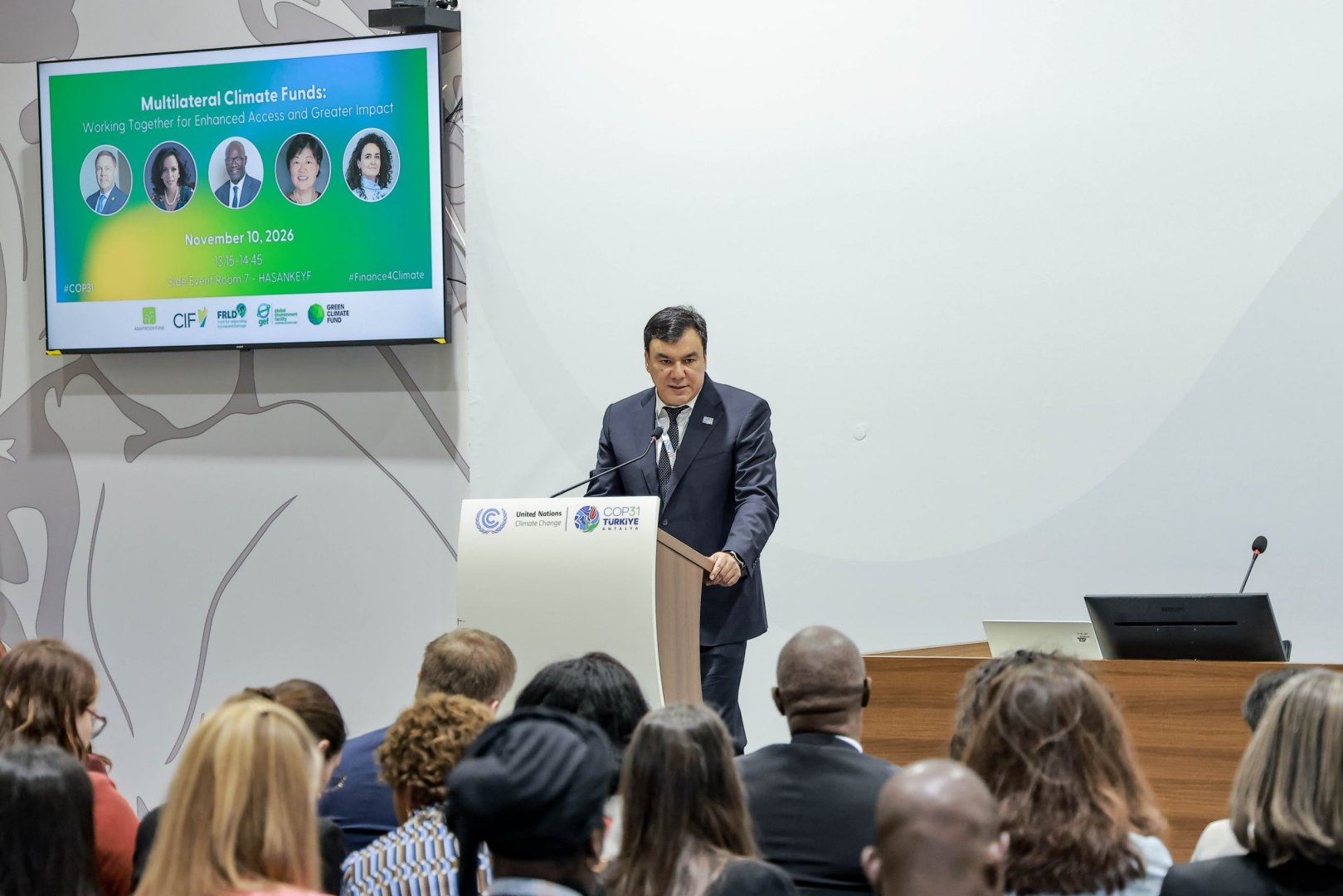

BAKU, Azerbaijan, November 11. Uzbekistan has called for the establishment of a regional climate finance dialogue bringing together five Central Asian countries and five international climate funds to coordinate investments and improve access to funding for climate-related projects during a high-level dialogue held on the sidelines of the 31st UN Climate Change Conference (COP31) in Antalya, Türkiye on Wednesday, November 11.
According to Uzbekistan's National Committee on Ecology and Climate Change, the initiative was presented by Aziz Abdukhakimov, adviser to the Uzbek president on environmental issues and chairman of the National Committee on Ecology and Climate Change.
The proposed Central Asian Climate Finance Dialogue would operate in a "5+5" format, bringing together representatives of the five Central Asian countries and five international climate funds: the Adaptation Fund, Climate Investment Funds, Fund for Responding to Loss and Damage, Global Environment Facility and Green Climate Fund.
The platform would aim to align investment priorities, coordinate project portfolios and ensure that financing from different institutions complements rather than duplicates existing initiatives. Uzbekistan has offered to host the dialogue's first meeting in Tashkent in 2027.
Abdukhakimov emphasized that the effectiveness of climate finance depends not only on the amount of funding mobilized but also on how investments are coordinated to address interconnected environmental and climate challenges.
He highlighted the Aral Sea region as an example of an area requiring a comprehensive approach, including early warning systems, water-efficient agriculture, ecosystem restoration, resilient infrastructure and sustainable livelihood opportunities for local communities.
Additionally, Uzbekistan proposed a second initiative focused on integrating climate data and forecasts into long-term investment planning. The approach would take into account projections on water availability, droughts, extreme heat, glacier retreat and sand and dust storms when planning agricultural activities, irrigation systems, infrastructure, renewable energy projects and ecosystem restoration.
Under the proposed framework, climate information and early warning systems would inform risk assessments and investment decisions, helping strengthen resilience and support sustainable development. The five climate funds could contribute at different stages through their respective financing instruments, in cooperation with scientific organizations, including the World Meteorological Organization.
The dialogue brought together the heads of the five international climate funds, as well as representatives of donor and recipient countries. Discussions focused on improving coordination among climate financing institutions, simplifying developing countries' access to resources and increasing the effectiveness of climate investments.
Moreover, Uzbekistan called for the development of a coordinated regional investment approach and the launch of pilot projects in areas most vulnerable to climate change.
The country said the success of climate finance should be measured not only by the number of approved projects or the amount of funding mobilized, but also by tangible outcomes, including water conservation, land restoration, improved livelihoods and stronger community resilience.


