


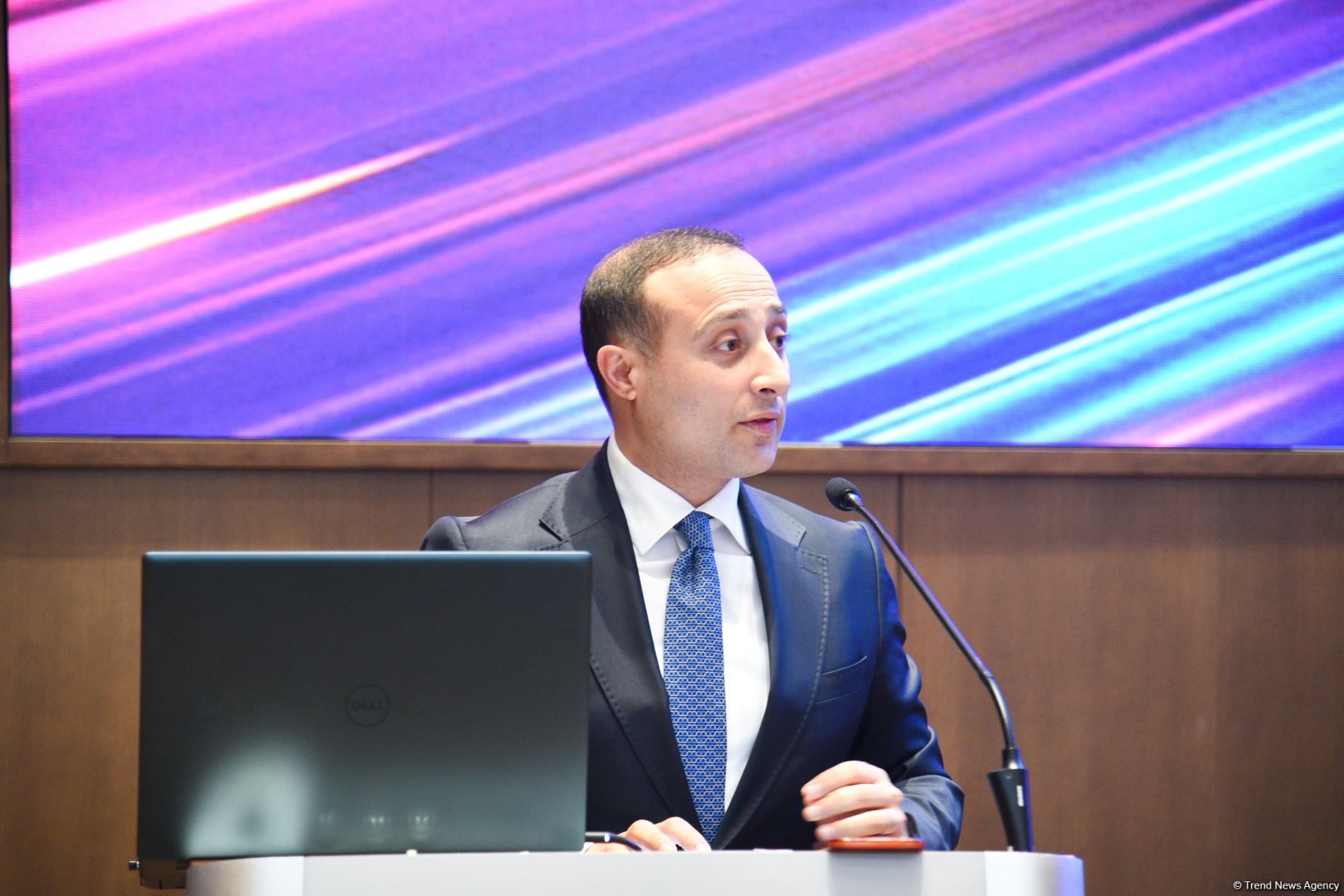

BAKU, Azerbaijan, October 1. The total population of the CAMCA region is approximately 150 million people, and its gross domestic product (GDP) potential is approximately $700 billion, the Executive Director of the Center for Analysis and Coordination of the 4th Industrial Revolution (C4IR), Fariz Jafarov, said at the CAMCA regional forum held in Baku on Thursday, Trend's correspondent reports from the event.
He noted that this potential creates broad opportunities for countries in the region in the fields of artificial intelligence (AI), digital transformation, and the development of new technologies.
“The region as a whole has a population of about 150 million people, and its GDP potential is approximately $700 billion. Although we cannot compete with the United States and China in the development of artificial intelligence, we can apply it in everyday life,” Fariz Jafarov noted.
According to him, countries in the region can expand cooperation in the application and development of artificial intelligence technologies.
“In the field of artificial intelligence, there are ‘creators,’ ‘users,’ and ‘shapers.’ The creators are the United States and China, which produce a wide range of AI products. We can be good users and play the role of ‘shapers’ in this field by studying and creating our own large-scale language models and global tools,” he said.
Fariz Jafarov noted that energy supply is one of the key factors in the development of the artificial intelligence ecosystem.
“The energy aspect is of vital importance. Every country needs a sufficient amount of electricity to build artificial intelligence infrastructure. This is necessary, first and foremost, for the operation of data centers, as well as to power cooling systems. This requires a large amount of energy,” emphasized the executive director of C4IR.
He noted that countries in the region, such as Azerbaijan, Kazakhstan, and Kyrgyzstan, have extensive opportunities in this area thanks to their diverse energy sources.
“Today, we in Azerbaijan have fully focused our attention on this. Even our state-owned oil company, SOCAR, does not want to sell oil and gas to various markets merely as raw materials; instead, it is investing in the creation of data centers. In essence, it is transforming the energy sector into an artificial intelligence business. Currently, this is one of Azerbaijan’s main areas of activity,” noted Fariz Jafarov.
According to him, Kazakhstan and Uzbekistan are also implementing projects to build data centers.
“Kazakhstan plans to build a data center with a capacity of about 400 megawatts. Uzbekistan also has similar plans in the energy and investment sectors. Azerbaijan is taking steps to attract foreign investment to establish data centers. A major contract was recently signed with Oracle and Haymaker,” he said.
Fariz Jafarov emphasized that Azerbaijan’s regional role is strengthening not only in the areas of logistics and energy interconnections but also in the field of digital transformation.
“Azerbaijan serves not only as the Middle Corridor for logistics, energy, and freight transportation, but also as a hub for digital transformation in the region,” he noted.
He noted that digital connectivity is one of the main pillars in the development of an artificial intelligence ecosystem.
“We are fulfilling this role through the ‘AzInConnect’ and ‘Silk Road’ digital connectivity projects, which we are implementing jointly with Kazakhstan. I hope the project will be ready by the end of this year. This opens up great opportunities. Because without connectivity, it is impossible to provide any artificial intelligence-based solutions or data processing services,” the executive director of C4IR said.
“This could create the conditions to attract large, hyperscale companies to Azerbaijan, have them locate their data centers in our country, and provide services on both a regional and global scale. This is because electricity in this region, at least for now, is cheaper than in Europe. Once high-speed connectivity is in place, this is a very attractive model for European markets to turn to Azerbaijan,” he added.
Fariz Jafarov noted that another important element of the artificial intelligence ecosystem is computing power.
“We recently signed a contract with Dell, and we have two supercomputers in Azerbaijan. Other countries in the region are also competing for these capabilities. Because without computing power, it is impossible to run any artificial intelligence model,” he emphasized.
He noted that data and human capital are also important for the development of artificial intelligence.
“Building a data center requires not only engineers but also people who build and manage these centers, as well as those who develop AI-based solutions. According to the World Economic Forum, artificial intelligence will lead to the loss of more than 90 million jobs, while creating about 170 million new ones,” Fariz Jafarov said.
According to him, developing people’s skills in line with the changing demands of the labor market is one of the key issues.
“The main challenge facing us as a government is how to enhance and adapt people’s skills so that they can turn knowledge into business using artificial intelligence,” he noted.
Fariz Jafarov also spoke about the education and skills development programs being implemented in Azerbaijan in this area.
“We have programs with Coursera. For three years now, we have been providing free access to more than 70,000 Azerbaijanis. There are over 21,000 online courses on the platform, and most of them are related to artificial intelligence. We’ve even translated more than 3,000 courses into Azerbaijani using artificial intelligence. This is one of the positive aspects of artificial intelligence,” he said.
He added that Azerbaijan is also focusing on developing human capital in the field of artificial intelligence through cooperation with international technology companies.
“We recently signed an agreement with OpenAI to train more than 500,000 Azerbaijani students in artificial intelligence skills. We have also signed an agreement with SpaceX/Grok, and new partners are coming to the region,” emphasized Fariz Jafarov.
According to him, school curricula are being updated, and educational programs are being implemented in collaboration with various universities.
The executive director of C4IR noted that the “SABAH.HUB” innovation center will also play an important role in this area.
“Recently, with the participation of the President, we opened the ‘SABAH.HUB’ innovation center. Here, we are striving to build Azerbaijan’s ‘Silicon Valley’ on a 20-hectare site. Three universities, more than 30 laboratories, more than 100 startups, and more than 100 IT companies will operate here. This will be a collaboration between industry and academia,” he said.
Furthermore, Fariz Jafarov noted that the main goal is to connect universities and startups with the needs of industry and to strengthen the transfer of scientific knowledge and expertise to the business sector.



