



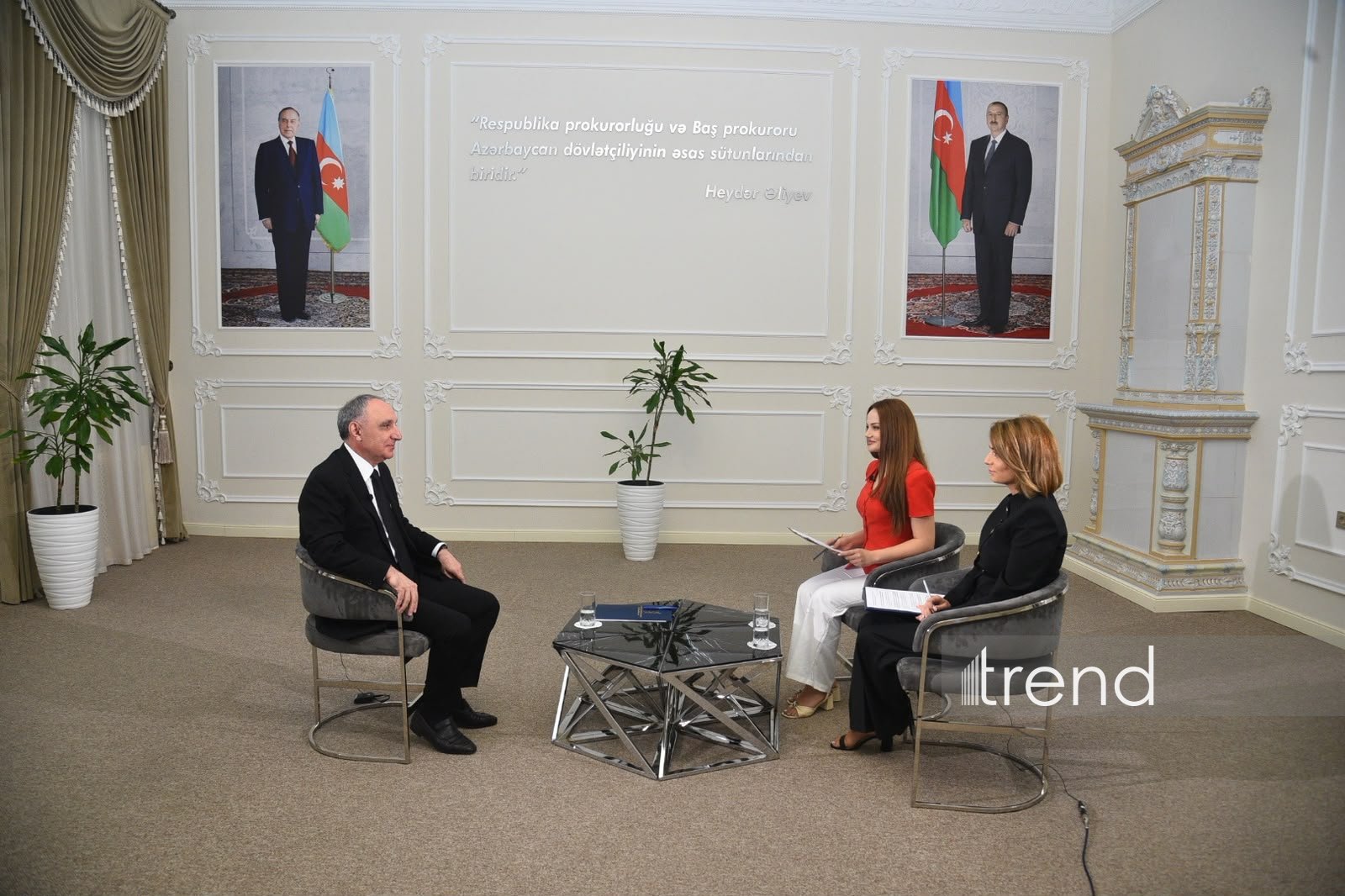
BAKU, Azerbaijan, September 30. Approximately 40–50% of crimes are committed using new information technologies, the Prosecutor General of Azerbaijan, Kamran Aliyev, said in a joint interview with Trend News Agency and REAL TV.
According to him, a decrease in the number of crimes is being observed in Azerbaijan. The number of crimes recorded in 2025 fell by about 4.6% compared to 2024. A significant decrease was also recorded in the first half of 2026 compared to the same period of the previous year.
At the beginning of the interview, the Prosecutor General expressed his gratitude to the management and staff of the Trend News Agency and REAL TV. During the interview held on the eve of the professional holiday for prosecution service employees, he answered questions regarding the tasks facing the institution and the dynamics of crime in the country.
What primary task of the Azerbaijani Prosecutor's Office today?
Aliyev said that the Prosecutor's Office faces numerous tasks, all of which are enshrined in the Constitution and other laws. According to him, while the essence of these tasks remains constant, they may evolve in form to align with the demands of the times and the dynamic processes unfolding within society.
Key tasks of the Prosecutor's Office
"To provide a comprehensive and detailed answer to this question, we must first consider what the Prosecutor's Office is and what role and position it holds within society and state governance. In addressing this, it's essential to note that the most apt definition of the Prosecutor's Office as a state institution was provided by the National Leader and founder of the modern Azerbaijani state, Heydar Aliyev. As you may recall, in 1994, the National Leader described the prosecution authorities as one of the fundamental pillars of the state," he said.
The Prosecutor General noted that the duties of the Prosecutor's Office encompass a wide range of areas, extending from maintaining stability within the state and society to ensuring the rule of law.
"In this regard, the tasks facing the prosecutor's office include serving to maintain stability within the state and society, ensuring the rule of law, protecting the rights and freedoms of citizens, ensuring a vigorous fight against crime, overseeing the implementation of laws in the cases and forms prescribed by law, and performing other functions. There are specific methods, approaches, means, and mechanisms for carrying out these functions, and they are enshrined in legislation," emphasized Aliyev.
Decline in crime rates and new types of crime
Addressing the general crime landscape in the country, the Prosecutor General noted that while this is a broad topic, the primary trend is a decrease in the number of crimes.
"In short, a downward trend in crime is being observed in Azerbaijani society, and this is certainly gratifying. This is primarily the result of successful reforms and, in my view, the effective work of law enforcement agencies," he stated.
Aliyev also disclosed figures regarding crime rates.
"I would simply note that a decrease of approximately 4.6% in the number of crimes was observed in 2025 compared to 2024. If we compare the first half of 2026 with the first half of 2025, we see a significant decline there as well," he said.
According to the Prosecutor General, the state and dynamics of crime are being monitored by law enforcement agencies. At the same time, however, certain changes have recently occurred regarding the nature and types of crimes being committed.
"As I mentioned, as a result of processes unfolding in society, the incidence of certain types of crime is rising slightly, and new forms of crime are emerging. These trends are observed not only in Azerbaijan but worldwide, and we are keeping a constant watch on the situation," Aliyev added.
Combating illicit drug trafficking
Prosecutor General Kamran Aliyev stated that illicit drug trafficking is a widespread crime of concern to Azerbaijani society. According to him, figures for 2026 show a degree of stabilization and even a trend toward a slight decline compared to 2025.
"However, this mustn’t lead to any complacency," he emphasized.
Aliyev pointed out that the primary danger lies in the transnational nature of the problem. He stated that illicit drug trafficking is not a challenge faced by Azerbaijan alone, and that joining forces, particularly with countries in the region, is essential to combat it effectively.
"The cross-border nature of illicit drug trafficking, the buying and selling of drugs via the internet using new information technologies, as you noted, and the spread of new, synthetically produced varieties of dangerous narcotic substances pose a threat to the health of our youth. In this regard, we face numerous tasks," the Prosecutor General said.
He noted that law enforcement agencies have carried out extensive work in this area. Aliyev emphasized the critical importance of the operations conducted by internal affairs bodies, the State Customs Committee, and the State Border Service, given that narcotics are trafficked across borders into the country. The Prosecutor General identified the fight against illicit drug trafficking as one of the most important tasks ahead.
Cooperation with regional countries
Responding to a question regarding cooperation with neighboring states, Kamran Aliyev stated that work in this area is proceeding effectively. According to him, issues related to the illicit drug trade and strategies to combat it are being discussed both among regional countries and at the international level.
"Our cooperation is effective. These issues and the ways to combat them are discussed both among regional countries and internationally. However, in terms of practical cooperation, ties with the region and neighboring countries naturally hold greater significance. I must say openly that every country is quite willing to cooperate in this field," the Prosecutor General added.
Crimes committed using new information technologies
Responding to a question about the changing methods and forms of crime in the era of digitalization, the fight against such crimes, and the future role of artificial intelligence in this sphere, the Prosecutor General said that the illicit drug trade via the internet and crimes committed using new information technologies require special attention.
"The term 'new types of crimes' refers specifically to the illicit online sale of narcotics, cybercrime, and other offenses committed through the use of new information technologies.
Unfortunately, from a philosophical perspective, any innovation that emerges for the advancement of society can play both a positive and a negative role. New information technologies, including the application of artificial intelligence, which you mentioned, represent a new step in human progress. Regrettably, criminals also exploit the capabilities of these technologies, including artificial intelligence. In this regard, we must approach the issue with great seriousness.
"Unfortunately, the number of cybercrimes is increasing day by day. Chapter 30 of the Criminal Code of Azerbaijan is dedicated to cybercrimes and comprises three articles. These articles cover acts such as unauthorized access to and interference with information systems.
In reality, approximately 40–50% of all crimes currently being committed involve the use of new information technologies. This necessitates that personnel from the prosecutor's office and other law enforcement agencies further enhance their knowledge and skills in this area. Naturally, we are working in this direction," Aliyev said.
Human trafficking, domestic violence, and environmental crimes
The Prosecutor General also addressed other types of crime that require a concerted response:
"In line with the demands of the times, we have highlighted digital crimes, illicit drug trafficking, and crimes committed using information technologies. I also wish to place special emphasis on the fight against human trafficking and domestic violence; we bear significant responsibilities in these areas. Combating environmental crimes is also a highly pressing issue at this stage. Furthermore, the fight against money laundering is one of the most critical tasks facing us," he said.
Aligning legislation with modern requirements
Responding to a question regarding the areas where legislation needs to be improved as new forms of crime emerge, the Prosecutor General said that amendments have already been made in several areas and that this process is ongoing.
"Improving legislation is a dynamic process. At the same time, maintaining its stability is crucial, as stability is essential for the effective application of laws.
On the other hand, rapid development and scientific progress across various sectors of society necessitate the updating of legislation. These changes must be implemented carefully. While preserving legislative stability, amendments and additions should be made in key areas. We are continuing our work in this direction with the relevant state agencies," the Prosecutor General noted.
Aliyev emphasized the importance of having solid grounds for amending legislation. According to him, these grounds stem from practical experience, including judicial and investigative practice.
"There must first be compelling grounds for amending the legislation. These grounds stem from necessity as well as from judicial and investigative practice. We first study that practice and substantiate the need for changes. When we determine that amending the legislation is necessary, we appeal to the relevant state bodies regarding the matter," he noted.
New rules regarding digital evidence
The Prosecutor General said that the amendments concerning the activities of the Prosecutor's Office encompass both procedural legislation and substantive legal norms. He addressed the incorporation of provisions from international conventions on combating cybercrime into Azerbaijani legislation.
"As you know, the United Nations Convention on Combating Cybercrime has been adopted, and Azerbaijan was among the first countries to sign it. At the same time, the Council of Europe's Budapest Convention on Cybercrime also exists.
We have already incorporated the provisions of both conventions into Azerbaijani legislation. It is essential to establish new rules regarding the acquisition, protection, storage, and use of digital evidence in criminal cases," said Aliyev.
According to him, the acquisition and use of digital evidence in criminal cases require rules that differ from those applicable to traditional forms of evidence.
"Unlike traditional, classical evidence, specific rules had to be established for the collection, inclusion in criminal case files, use, and evaluation of digital evidence. We submitted proposals to the relevant state agencies regarding this, and the appropriate law was adopted. At the same time, there was a need to amend the Criminal Code, and those amendments have already been made. We can state that, following these changes, our norms of criminal procedural and substantive law fully comply with the requirements of international conventions," the Prosecutor General added.
Solving crimes committed years ago
Speaking about the results achieved in the investigation of long-unsolved crimes, Prosecutor General Kamran Aliyev stated that, regardless of how much time has passed since a crime was committed, it is essential to solve it in full detail.
"If a crime has been committed, it's crucial to solve it in full detail. Perpetrators cannot go unpunished. Impunity leads to the commission of new crimes. In this regard, it's essential to solve every crime, whether 30 or 40 years have passed since it occurred. We must also approach this issue from the perspective of the victims' loved ones," Aliyev noted.
Aliyev pointed out that during meetings with citizens, he had received appeals regarding unsolved murder cases from previous years.
“The relatives and family members of murder victims from previously unsolved cases attend public reception sessions. They express their hope that the crimes will be resolved. "They want to know what happened, and why and by whom their loved ones were killed. This is a natural desire, and we are constantly working in that direction," he explained.
According to the Prosecutor General, the Prosecutor General's Office's Department of Criminalistics and Information Technologies, the Investigation Department, and district prosecutor's offices are working on such cases in collaboration with relevant state agencies. Joint investigative-operational groups have been established for this purpose.
57 criminal cases dating back to previous years solved
Aliyev announced that 57 previously unsolved criminal cases have been resolved. According to him, 17 of these cases were solved in 2022, while seven have been resolved between the first half of 2026 and the present.
"Significant work has also been done towards solving several cases. I believe that their resolution will be secured in the near future, and the public will be informed about it," the Prosecutor General said.
He stressed that the prosecutor's office works alongside relevant state agencies on such cases.
"In fairness, I must say that the prosecutor's office is not the only body involved in these activities. We cooperate quite effectively with law enforcement agencies, the State Security Service, and the Penitentiary Service of the Ministry of Justice. We coordinate these efforts," he said.
Determining fate of missing persons
Speaking about the significance of mass graves discovered in the liberated territories, the fate of missing persons, and the evidence gathered regarding crimes committed during the First Karabakh War, Prosecutor General Kamran Aliyev stated that these matters hold both historical and procedural importance.
"These matters are of great historical and procedural significance. Unfortunately, a total of 4,010 Azerbaijani citizens went missing during the First and Second Karabakh Wars. Of these, 4,004 went missing during the First Karabakh War, and six during the Second Karabakh War," he said.
According to Aliyev, the state is actively working on issues concerning missing persons. In this regard, the State Commission on Prisoners of War, Hostages and Missing Persons and the prosecution authorities are collaborating closely.
"To date, if I am not mistaken, the remains of more than 900 missing persons have been identified. Prosecution authorities have collected DNA samples from all close relatives of the missing persons. As new remains are discovered, they are being identified in the relevant laboratories," the Prosecutor General pointed out.
Remains of identified individuals handed over to their relatives
Aliyev said that analyses are ongoing to determine the identities of the discovered remains.
"Work has been carried out to identify missing persons. The identities of 328 persons have been established, while analyses regarding others are continuing. The remains of slightly more than 270 persons have already been handed over to their relatives and buried," he said.
The Prosecutor General emphasized that, despite the passage of many years, the families of missing persons continue to await information regarding their loved ones' fates.
"This is a very important issue. Even after a long time, the families remain concerned about the fate of the missing persons. As I mentioned, this is natural. We strive to ensure that the families of these individuals find at least some measure of solace," he clarified.
Aliyev said that cooperation with international organizations is also underway in this regard. According to him, the State Commission on Missing Persons primarily handles organizational matters, while the prosecution authorities deal with the procedural aspects of the cases.
"We are cooperating with international organizations on this matter, particularly the United Nations Committee on Missing Persons. As I noted, the State Commission on Missing Persons focuses largely on organizational issues, whereas the prosecution authorities—specifically the Investigation Department of the Prosecutor General's Office—handle the procedural aspects of the cases," the Prosecutor General added.
Holding individuals abroad accountable
Responding to a question regarding the role of international law in bringing to justice individuals currently abroad who are accused of committing particularly grave crimes against the state and the people, Prosecutor General Kamran Aliyev said that cooperation with the relevant authorities of other states is essential and yields concrete results.
"It’s not just about those specific individuals. In general, relations within the framework of international law and cooperation with the relevant agencies of other states are crucial and yield tangible results. It's indeed possible for persons falling into the category you mentioned to be held criminally liable, either now or in the future. We are carrying out the necessary work in this direction," he noted.
The Prosecutor General pointed out that some of the individuals in question have already been held accountable. He linked the holding of these legal proceedings to the conditions that emerged following the liberation of the territories.
"Some persons falling into that category have been held accountable. I must particularly note that the measures implemented by President Ilham Aliyev - and his leadership as Commander-in-Chief in achieving the complete liberation of the territories and securing this victory - made it possible to conduct those court proceedings," said Aliyev.
Circumstances arising for use of collected evidence
Aliyev said that the conduct of the investigation and the trial also depended on prevailing circumstances.
"In legal science, there is a concept known as 'investigative situations.' This means that investigative tactics and the course of the investigation, as well as the conduct of court proceedings, depend on specific conditions arising within society.
Since the onset of the Karabakh conflict, prosecution officials had been gathering evidence over a long period. This work was carried out by staff serving during both earlier and later periods. An evidentiary base existed, but the conditions were not yet favorable for utilizing that evidence," he recalled.
According to the Prosecutor General, the opportunity to utilize the gathered evidence and hold individuals accountable arose following the military operations.
He expressed hope that other persons wanted in connection with the criminal case would also be held accountable in the future.
"As you know, there are other participants in that criminal case who are currently wanted. I hope it will be possible to hold them accountable in the future as well," he noted.
Aliyev also touched upon the experience of other states. According to him, although law enforcement agencies in some countries have gathered evidence regarding war crimes, they lack the conditions to utilize that evidence in court proceedings.
"Such crimes have occurred in other states as well. I do not wish to name specific countries, but if we look at our immediate neighborhood, we see that the law enforcement and prosecutorial authorities of those states have collected a great deal of evidence regarding war crimes. However, they lack the capacity and conditions to use this evidence and conduct the relevant court proceedings. This is the point I want to convey," the Prosecutor General added.
Preventive measures to combat corruption
Responding to a question about the prompt elimination of circumstances that create conditions for corruption, the Prosecutor General described the establishment of ASAN service centers as an important preventive measure.
“Corruption crimes have always plagued humanity. In the modern world, both in Europe and in other regions of the globe, these crimes remain a serious problem for society and the state. I believe that our country’s political leadership is doing very successful work in this area.
I would like to specifically highlight the establishment of ASAN service centers as a preventive measure. This was an important preventive step. As a result of establishing these centers, the number of corruption crimes in our country has decreased significantly. Today, we continue to focus our efforts primarily on preventing such crimes,” the Prosecutor General said.
Aliyev pointed out that, in addition to preventive measures, criminal prosecutions for corruption offenses must be carried out. According to him, the Main Directorate for Combating Corruption under the Prosecutor General is working toward this goal.
“We constantly try to keep the public informed in this area. Every criminal prosecution can also be viewed as an educational and preventive measure. This is because an uncompromising approach to such cases is one of the most important preventive measures carried out by the prosecutor’s office and other law enforcement agencies,” he emphasized.
Analysis of reports and notification of state agencies
The Prosecutor General stated that information received by the Prosecutor's Office regarding corruption-related crimes and offenses is being analyzed. This includes information received via the hotline of the Main Directorate for Combating Corruption under the Prosecutor General, as well as through other channels.
"We analyze information received by the Prosecutor's Office concerning corruption crimes and other offenses. Where necessary, we forward information received, whether through the hotline of the Main Directorate for Combating Corruption under the Prosecutor General or via other channels, to the relevant agencies," said Aliyev.
He emphasized that the forwarding of information to the relevant agencies should not be interpreted as simply passing on details about criminal offenses without investigation.
"This doesn’t mean that we are reporting information about individuals who have committed crimes to their employers. Not every violation of the law constitutes a crime. We forward information regarding other infractions, those not of a criminal nature, to the relevant agencies. They conduct investigations and, where necessary, hold their employees administratively liable. We also inform these agencies about any identified shortcomings so that they can take preventive measures," he said.
Development of entrepreneurship and oversight of legal compliance
Responding to a question regarding the balance between protecting the rights of law-abiding entrepreneurs and combating illegal activities, Aliyev described the issue as both sensitive and important.
"This is an interesting and sensitive issue. The economy is of vital importance to the development of any society. For the economy to develop successfully, entrepreneurial activity must be conducted freely, yet within the framework of the law," he said.
Aliyev noted that oversight measures should not hinder the development of entrepreneurship or the economy.
"We believe that law enforcement agencies, including the prosecutor's office, should structure their activities in such a way that, alongside combating unlawful practices, they foster the economic reforms and economic development being implemented in the country.
Our primary role is precisely this: not to impede economic development, but rather to boost it. Therefore, we strive to structure the Prosecutor's Office's cooperation with relevant state agencies and the private sector in a way that ensures our activities yield positive results," Aliyev added.
Human trafficking and proceeds of crime
Assessing the fight against corruption and crimes related to human trafficking, the Prosecutor General noted that one aspect common to these crimes, as well as drug trafficking, is the generation of illicit income.
“One of the factors linking corruption, human trafficking, drug trafficking, and other similar crimes is the generation of illicit income. The funds obtained as a result of these crimes are subsequently laundered and used,” Aliyev said.
According to him, government agencies are coordinating their efforts to combat human trafficking. The Prosecutor General also addressed the issue of the national program for 2026–2030 and the activities of the relevant department of the Ministry of Internal Affairs in this area.
“Our country is waging a resolute fight against human trafficking. In this regard, there is a state program for 2026–2030. The relevant department of the Ministry of Internal Affairs is also carrying out work, and government agencies are coordinating their efforts in this area. One of the main issues is combating both these crimes and the laundering of funds obtained as a result of their commission,” he said.
Aliyev emphasized that the fight must address both the crimes themselves and the laundering of proceeds derived from them:
“If we don’t combat the crimes themselves and the laundering of proceeds derived from them effectively enough, we will not achieve results. At the same time, if we focus only on the laundering of illicit funds and ignore the crimes from which those funds were derived, the fight will still not be effective. We are striving to make our efforts effective in both areas,” he said.
Impact of electronic prosecution system on operations
Discussing the impact of the Electronic Prosecution system on daily operations and citizens' ability to submit inquiries, Aliyev recalled that the Electronic Prosecution Information System was established in 2021 and implemented shortly thereafter.
"First of all, this system enhances the efficiency of the prosecution staff's work. It also plays a vital role in solving murder cases that were remaining unresolved for years. In such cases, the prompt acquisition of evidence and information, as well as agile action, are crucial. In this regard, the system is of great importance to our staff," he said.
According to the Prosecutor General, citizens can use the system to submit complaints to the prosecution service and receive updates on the outcomes of their inquiries. Options to submit inquiries via email and social media are also available.
"Citizens can file complaints and receive information regarding the results of their inquiries through the Electronic Prosecution Information System. Additionally, it is possible to submit inquiries via our email addresses and social media channels," Aliyev pointed out.
Electronic oversight of investigative proceedings
Aliyev said that the Electronic Prosecution Information System includes modules covering investigations, criminal case materials, state prosecution, and the execution of sentences. According to him, these modules facilitate more effective prosecutorial oversight.
"As Prosecutor General, I can review criminal cases currently being handled by district prosecutor's offices at any time. I can see how many criminal cases are under their jurisdiction and access the files to review witness testimonies and other documents electronically, without needing to make separate inquiries to the staff members involved. These capabilities assist in the work of prosecution officials and help improve working conditions," the Prosecutor General added.
Digital evidence and the right to privacy
Responding to a question about how the balance between the use of digital data in investigations and the right to privacy is maintained, the Prosecutor General said that while new technologies enable the acquisition of more information, the protection of personal data remains a fundamental requirement.
"On the one hand, new information technologies enable access to more information. This is important because everyone has the right to access information. On the other hand, everyone's private life and personal data are inviolable. This right is protected by the Constitution, international conventions, and the laws of Azerbaijan. The matter is also of great importance from the perspective of ethical standards," he said.
According to Aliyev, access to data within the Electronic Prosecution Information System is restricted, and each employee can access only the information relevant to their specific area of work.
"The Electronic Prosecution Information System contains various types of data, and we strive to ensure their confidentiality. Strict rules govern access to information within the system: individuals can only access data relevant to their specific area of work. We monitor who accesses what information and how. This entails a significant responsibility toward our citizens and society.
We also receive complaints from citizens regarding violations of their right to privacy or the unlawful acquisition of their personal data. These rights are strictly protected by law, and law enforcement agencies take decisive action against such violations," the Prosecutor General noted.
Detecting delays through electronic monitoring
Answering the question of whether he encountered situations requiring intervention while reviewing cases from the regions via the Electronic Prosecutor's Office Information System, Aliyev said that the system most frequently reveals instances of materials not being reviewed on time, prolonged investigations, and unjustified delays.
"I will try to answer your question candidly. When reviewing cases through the Electronic Prosecutor's Office Information System, I most often observe failures to review materials on time, prolonged investigations, and unjustified delays. Sometimes, issues regarding the legal classification of the offense also catch my attention. Such instances have occurred, and we have intervened immediately," he said.
According to the Prosecutor General, the reasons for investigations exceeding the prescribed timeframe are examined in every instance. He noted that while there may be objective reasons for delays, employees are held accountable when subjective factors are identified.
"To be frank, our staff members are highly professional and organize their work efficiently. Nevertheless, whenever an investigation exceeds the scheduled timeframe, we immediately ascertain the reason. Each case is examined individually. Sometimes, delays arise from objective factors inherent to the nature of the work. However, when subjective factors are identified, we hold our employees accountable," Aliyev stressed.
International legal cooperation in investigations
Assessing the outcomes of extradition and mutual legal assistance regarding individuals who have left the country to evade accountability, Aliyev said that international legal cooperation is required in approximately half of the investigations conducted at the level of the Prosecutor General's Office.
"At the level of the Prosecutor General's Office, i.e., within the Investigation Department, the Main Directorate for Combating Corruption, and other bodies, international legal cooperation is required in approximately half of the ongoing investigations. This encompasses the submission of requests for legal assistance and extradition. Therefore, such cooperation is crucial," he explained.
According to Aliyev, Azerbaijan has established close cooperation with the prosecution and law enforcement agencies of both regional and other states. He emphasized that concrete actions underpin these contacts.
"We cooperate closely with the prosecution and law enforcement agencies of both regional and other states. At first glance, one might view these contacts merely as symbolic meetings and visits. However, serious work lies behind each of them. We sign memoranda with the prosecution authorities of various countries and establish effective cooperation," the Prosecutor General noted.
He said that, given the time required for legal assistance requests to move through various stages, direct and close ties with the relevant agencies of other countries are of particular importance.
"Preparing a request for legal assistance, navigating the various stages of the process, and ensuring its delivery takes time. In this area, the prosecution authorities coordinate the activities of other law enforcement agencies. Therefore, close relations between the relevant bodies of different countries are crucial.
This cooperation often enables us to intervene promptly. We maintain contact with our foreign counterparts and also receive numerous requests for legal assistance from those countries," said Aliyev.
Extradition of 65 people to Azerbaijan in 2025
The Prosecutor General said that extradition is part of the Prosecutor's Office's routine operations and that the public is informed about both the transfer of individuals to Azerbaijan and their extradition from the country to other states.
"Our Press Service regularly provides information regarding the extradition of individuals to our country or from Azerbaijan to other countries. This is part of our daily operations.
The Prosecutor's Office of Azerbaijan and the Ministry of Justice are the central executive bodies responsible for legal assistance and extradition. Both institutions operate in this area," the Prosecutor General said.
According to Aliyev, 65 persons were extradited to Azerbaijan from other countries in 2025. He noted that he mentioned this figure based on his memory.
"In 2025, 65 persons were extradited to Azerbaijan from other countries. Every extradition is a complex process. Whether we request a person's extradition or another country submits a request to us, all stages of the process are scrutinized. There are quite stringent legal requirements in this area.
"We review all legal aspects of the matter before extraditing any individual to another country. I believe that cooperation in this area needs to be further improved and made more agile in the future," the Prosecutor General added.
Investigation of environmental violations
Addressing issues such as illegal tree felling, the pollution of water resources, and damage to land, Prosecutor General Kamran Aliyev stated that the illegal use of natural resources and environmental damage are significant matters.
"Environmental crimes, the improper use of forest resources, the illegal exploitation of subsoil, land, and other natural resources, and damage to the environment are critical issues. These problems are coming to the forefront globally, including in Azerbaijan," he said.
According to Aliyev, the Ministry of Ecology and Natural Resources refers cases falling into these categories to the Prosecutor's Office. The Prosecutor General's Office operates a Department for Proceedings Outside Criminal Prosecution that handles such matters.
"Considerable effective work is being carried out in our country in this regard. The Ministry of Ecology and Natural Resources regularly refers such cases to the Prosecutor's Office. When the new structure of the Prosecutor General's Office was approved in 2020, a Department for Proceedings Outside Criminal Prosecution was established. That department deals directly with cases of this and other categories," he noted.
Protection of public interests and compensation for damages
Aliyev said that the activities of the Department for Proceedings Outside Criminal Prosecution are sometimes not correctly understood. According to him, the department's work can also be characterized as the protection of public interests.
"I follow the media and see that the activities of the Department for Proceedings Outside Criminal Prosecution are sometimes misinterpreted. What does 'outside criminal prosecution' mean? In fact, this department could also be called the Department for the Protection of Public Interests. It is about protecting the interests of society," he said.
The Prosecutor General noted that, in addition to environmental issues, the department is involved in matters concerning domestic violence, violence against minors and within the family, and the deprivation of parental rights, as well as in the process of ensuring that the objectives of punishment are achieved in correctional facilities.
"The department investigates cases related to environmental crimes, domestic violence, violence against minors and within the family, and the deprivation of parental rights. Unfortunately, such incidents do occur. At the same time, the department is closely involved in the process of ensuring that the aims of punishment are realized within correctional institutions," said Aliyev.
He added that in cases involving environmental offenses, the primary focus is placed on compensating for the damage caused. In instances where the extent of the damage is significant, steps are taken to hold the individuals criminally liable.
"We receive materials from the Ministry of Ecology and Natural Resources regarding the illegal use of subsoil and other natural resources, the felling of trees, and the destruction of forest resources. In such cases, our primary focus is on ensuring compensation for the damage caused. However, in instances where the extent of the damage is significant, we ensure that the responsible individuals are held criminally liable," the Prosecutor General emphasized.
Warning signs associated with domestic violence
Responding to a question about the warning signs that precede acts of domestic violence and crimes against women and children, Aliyev said that intervention in this area requires particular sensitivity.
"That is absolutely correct. I must openly admit that this is a very sensitive area. One cannot excessively interfere in family life. However, situations sometimes arise where we are compelled to intervene.
Unfortunately, many cases of intentional homicide stem from domestic issues. Our analysis shows that such crimes are often preceded by warning signs, such as acts of violence. While these incidents do not always result in criminal prosecution, it is crucial to pay attention to them," the Prosecutor General noted.
Aliyev pointed out that some women are reluctant to report violence or cooperate with law enforcement agencies because they wish to prevent the breakdown of the family. According to him, such situations require a sensitive approach.
"Sometimes, women do not wish to report violence or cooperate with law enforcement agencies in order to prevent the family from falling apart. This is understandable. Therefore, we approach such matters with great sensitivity," he noted.
The Prosecutor General emphasized that the deprivation of parental rights is a measure of last resort. At the same time, he noted that, based on received complaints, it sometimes becomes necessary to petition the court to deprive a parent of their rights or to restrict those rights.
"Regarding issues involving children, the deprivation of parental rights is a last resort. Neither the prosecutor's office nor the state desires for anyone to be deprived of this right. However, based on complaints received, we are sometimes compelled to petition the court to seek the deprivation or restriction of parental rights. Such cases do occur, and as a rule, these claims are granted," Aliyev said.
Legal awareness and communication with citizens
Speaking about the Prosecutor's Office's legal awareness activities and the strengthening of public trust, the Prosecutor General noted that modern information technologies enable the use of various tools in this area. He said that raising legal awareness is a significant area of activity that yields concrete results.
"Modern information technologies enable us to conduct public awareness activities using various resources. Some might view public awareness as a general concept, but in reality, it plays a crucial role. In this regard, a relevant action plan has been drawn up at the Prosecutor General's Office," noted Aliyev.
According to him, the areas requiring greater public awareness efforts have been identified. The primary goal of this work is to explain both rights and responsibilities to citizens.
"We have identified the specific areas where public awareness activities need to be conducted. There are various methods and means to achieve this. The main objective is to explain citizens' rights and responsibilities to them.
People sometimes believe they are familiar with the laws and their own rights. However, a closer look reveals that their knowledge is often superficial, and they are unaware of important nuances," the Prosecutor General said.
Aliyev noted that prosecution officials participate in television programs and round-table discussions, addressing both general legal topics and specific cases. Information regarding matters of public concern is spread through the press and social media.
"Our staff members participate in television programs and round-table discussions. They speak on both general topics and specific cases. When issues of public concern arise, they also provide information via the press and social media," he said.
The Prosecutor General said that senior officials and department heads of the institution answer citizens' questions online. Inquiries submitted to the Prosecutor's Office electronically are also addressed.
"Senior officials and department heads of the Prosecutor General's Office regularly answer citizens' questions online. We also respond to inquiries received electronically. I believe all of this is essential," Aliyev added.
What issues are most frequently raised during meetings with citizens?
Speaking about the nature of appeals received during meetings with citizens, the Prosecutor General said that the complaints include both well-founded demands and those lacking sufficient grounds. According to him, the demands of the parties involved in some appeals are contradictory.
"First of all, I should note that appeals are reviewed within the framework of the law. They include demands that are well-founded, those lacking sufficient grounds, and sometimes even mutually contradictory demands.
The interests of victims and accused persons in criminal cases do not always align; sometimes they conflict. We examine all such appeals," the Prosecutor General said.
Aliyev noted that some appeals relate to the charges brought, while others concern the legal classification of the accused's actions and the punishment imposed.
"For instance, an accused person might claim they have been charged under a more severe article than warranted by their actions. Conversely, a victim might believe the accused received a lighter penalty than the law requires or that the offense was not correctly classified.
Sometimes, appeals also state that not all perpetrators have been identified and that some individuals have escaped liability; complaints of this nature are also received," he said.
According to the Prosecutor General, there has recently been a high volume of appeals regarding instances of fraud and the initiation of criminal proceedings. He noted that when assessing such cases, it's essential to distinguish between criminal-law and civil-law relationships.
"Recently, there has been a high volume of appeals regarding the initiation of criminal proceedings, particularly concerning instances of fraud.
We strive to approach such appeals objectively. In some cases, the nature of the relationship between the parties may be civil rather than criminal; disputes involving the lending of money, for instance, fall into this category. If the relationship is civil in nature, the individuals involved should seek redress through the civil courts. We also instruct and advise prosecutors to operate strictly within the framework of the law," said Aliyev.
State interests and citizens' rights
Responding to a question about how the balance between state interests and citizens' rights is maintained, the Prosecutor General said that, in his view, there is no conflict between the interests of the state and those of its citizens.
"There is no conflict between the interests of the state and the interests of citizens; they complement each other. If we fully secure the state's interests, it means the citizens' interests are also being secured. At the same time, fully upholding the lawful interests of citizens is a duty the state has assigned to the prosecution authorities," he noted.
Aliyev added that the prosecution service must be guided by the requirements of the law when various situations arise.
"Various situations do arise, and in such cases, we strive to be guided solely by the requirements of the law. One of a prosecutor's primary duties is to protect the interests of the state and society. The interests of a specific individual may not always align with the public interest. For us, the interests of the state, society, and all its members are paramount. Naturally, society itself is composed of individual citizens," the Prosecutor General emphasized.
Accountability of prosecutors for violating the law and ethical standards
Responding to a question about how accountability is enforced when a prosecution service employee violates the law or ethical conduct rules, Aliyev said that such an employee bears a heightened level of responsibility due to the position they hold.
"If a prosecution service employee violates the law, I believe they bear a double responsibility compared to employees of other agencies. The position they hold does not absolve them ethically or morally; on the contrary, it increases their accountability," he noted.
According to Aliyev, employees receive regular instructions and recommendations to prevent violations of the law and ethical standards.
"We are waging a vigorous campaign in this area. First and foremost, we constantly instruct our employees and provide them with guidance. They strive to serve the state, society, and every individual citizen in accordance with the requirements of the law," the Prosecutor General pointed out.
He mentioned that whenever a potential violation is identified, an investigation is conducted by the Department of Internal Investigations of the Prosecutor General's Office, which was established in 2020. A Disciplinary Commission and an Ethical Conduct Commission also operate within the institution.
"When such instances are identified, the Department of Service Investigations, established within the Prosecutor General's Office in 2020, conducts an inquiry. Two commissions, the Disciplinary Commission and the Ethical Conduct Commission, also operate within the Prosecutor General's Office," said Aliyev.
Disciplinary and criminal liability
The Prosecutor General explained that violations of the law and breaches of ethical conduct rules are investigated by separate commissions.
"A prosecution service employee may violate ethical conduct rules without necessarily violating the law. Based on the results of official investigations, materials concerning violations of the law are referred to the Disciplinary Commission, while materials concerning breaches of the Code of Ethical Conduct are referred to the Ethics Commission. Appropriate measures are taken in these areas, and employees who commit such violations are held accountable," he explained.
According to Aliyev, in the period spanning slightly over eight months of this year, there have been instances where prosecution service employees received reprimands, were dismissed from their positions, or were placed in the personnel reserve. One individual was dismissed from the prosecution service. He also noted that some employees have faced criminal liability.
"In the period of just over eight months this year, there have been instances where employees received reprimands, were dismissed from their positions, or were placed in the personnel reserve. One individual was dismissed from the prosecution service. Recently, there have also been cases where we have held prosecution employees criminally liable.
Unfortunately, such incidents do occur. Working in the prosecution service grants no privilege of exemption from criminal liability. On the contrary, I believe this role demands a higher level of responsibility," the Prosecutor General emphasized.
Information on investigations and confidentiality
Responding to a question regarding the balance between promptly informing the public about criminal incidents and protecting the secrecy of investigations and the presumption of innocence, the Prosecutor General noted that this issue is also linked to the confidentiality of citizens' personal data.
"In fact, we have already touched upon the matter of not disclosing citizens' personal data and keeping it confidential. The protection of investigative secrecy is also related to this," he said.
Aliyev addressed the cooperation between the Prosecutor General's Office Press Service and media outlets, thanking media professionals for their collaboration with the prosecution service.
"We strive to ensure that our Press Service operates effectively and engages in active cooperation with media outlets. I would like to take this opportunity to thank all media organizations and professionals for their cooperation with the prosecution service. I state with full confidence that the prosecution service cooperates with all media outlets on an equal basis. This is of great importance," the Prosecutor General noted.
According to him, the media plays a vital role in crime prevention, as well as in raising legal awareness and implementing preventive measures. At the same time, a balance must be struck between the public's right to information and the need to protect the integrity of investigations and the rights of persons.
"The media plays an indispensable role in crime prevention, as well as in the implementation of the awareness-raising and proactive measures we just discussed. It’s indispensable. At the same time, a balance must be struck between two principles: on one hand, the right of citizens and society to be informed, and on the other, the protection of investigative secrecy, the presumption of innocence, and the rights of persons," said Aliyev.
The Prosecutor General emphasized the importance of verifying the accuracy of information before releasing it and ensuring that the presumption of innocence and investigative secrecy are not compromised.
"We strive to fully maintain this balance in accordance with legal requirements. Sometimes, media representatives obtain information from other sources and approach us. We can disclose such information only when we are absolutely certain of its accuracy and confident that doing so won’t violate the presumption of innocence or investigative secrecy," he said.
According to Aliyev, it may not be possible to disclose information regarding cases where intensive investigative and operational measures are currently underway. The consequences of making personal information public are also taken into account.
"There are cases, as I mentioned earlier, where very intensive investigative and operational measures are being conducted to solve several criminal cases that had remained unresolved for years. Naturally, we cannot disclose information regarding these cases. We must also consider the potential consequences of a citizen's personal information leaking to the press or being made public. We take all of this into consideration.
This is a sensitive matter requiring a high sense of responsibility. In every instance, we make the decision regarding the disclosure of information based on the specific circumstances of the case," the Prosecutor General added.
Professional and ethical qualities of the modern prosecutor
Answering a question about the qualities a modern prosecutor or lawyer should possess, the Prosecutor General said that, alongside legal knowledge and experience, integrity and fairness are essential prerequisites.
"That is a challenging and interesting question. I will try to give a brief and concise answer. Being a knowledgeable lawyer, possessing a strong grasp of the law and practical experience, is very important. However, first and foremost, one must be principled, conscientious, fair, and honest. Those working in the prosecution service must be upright persons. That is the most important aspect," he said.
According to Aliyev, a prosecutor's knowledge should not be limited solely to the field of law. He also highlighted a broad worldview, political vigilance, patriotism, and a commitment to statehood as essential qualities.
"A modern and knowledgeable prosecutor must possess not only legal expertise but also broad general knowledge. They must be politically astute. Morality is a broad concept, and patriotism is one of its most vital components. A prosecutor must love their state and statehood, their people, history, culture, and language. These are matters of great importance," the Prosecutor General noted.
He said that legal knowledge and moral qualities should complement one another:
"Let us imagine a prosecutor who is educated and knowledgeable, and who also possesses the moral qualities I mentioned earlier. I would like to draw a parallel here with the philosophical categories of form and content. Their moral qualities, understanding of statehood, patriotism, and attitude toward their people constitute the content," Aliyev added.
Importance of experience for young staff members
Kamran Aliyev noted that even if young staff members possess the necessary knowledge and moral qualities, they still require time to gain practical experience in the work of the prosecutor's office.
"At the same time, I believe that experience within the prosecutor's office and law enforcement agencies in general is a crucial factor. Young staff members join the service; while they are patriotic, responsible, conscientious, and fair, and possess deep legal knowledge, they require some time to gain experience," he said.
According to the Prosecutor General, the work of the prosecutor's office entails not only the application of the law but also interacting with people. Therefore, staff members must also possess knowledge regarding psychology and other aspects of the job.
"After all, our work involves both applying the law and working with people. Psychological and other factors come into play here, and our staff need to be well-versed in these areas. Certain skills develop over time, based on the experience gained during the work process," Aliyev added.
Recruitment to Prosecutor's Office and training of young staff members
Responding to a question about the priorities of the Prosecutor's Office's personnel policy, Prosecutor General Kamran Aliyev stated that experienced staff and supervisors bear significant responsibility for the professional development of young employees.
"Experienced staff, and especially those in leadership positions, bear a great responsibility for the professional development and experience-building of young prosecutors. The law and ethical standards require this of them. It is their duty to teach young employees how to work correctly, assist them in employing proper methods, and guide their activities in the right direction. This is crucial," he said.
According to Aliyev, recruitment for the prosecution service is conducted via a testing process established by law. Applications are accepted electronically from April through October 1, followed by testing, a written examination, and an interview.
"I would also like to touch upon the organization of personnel management. Recruitment for the prosecution service is conducted via a legally mandated testing process, and we issue announcements regarding this annually. Applications are accepted electronically from April through October 1. The testing phase, followed by the written exam and interview stages, takes place between October 1 and January 1. We select candidates after they complete these stages," the Prosecutor General noted.
He said that there is a large number of young lawyers wishing to work in the prosecution service. Applications for the 30 vacancies announced for this year were still being accepted at the time of the interview.
"We have many young lawyers who want to work in the prosecution service, and this pleases and encourages us. We announced 30 vacancies for this year. The acceptance of applications for these positions is still ongoing, and a significant number of young lawyers have already applied," Aliyev said.
93.2% of staff recruited via testing method
According to the Prosecutor General, 93.2% of current prosecution service employees were recruited through the testing method introduced after 2002. He said that during the selection process, attention was paid not only to lawyers' knowledge of the law but also to their understanding of its essence and their creative approach to its application.
"Currently, 93.2% of prosecution service employees were recruited via the testing method introduced after 2002. Prior to that time, this method hadn't been used. The fact that approximately 93% of the staff were recruited through testing represents a notably high figure.
We strive to select the most competent, educated, and knowledgeable legal professionals for the prosecution service. For us, it's important not only to understand the law from a technical standpoint but also to grasp its philosophy and essence, and to possess the ability to apply it creatively," he emphasized.
Aliyev expressed his belief that, building upon the prosecution service's existing personnel potential, the institution's professionalism and operational efficiency would continue to grow in the future.
"I consider our personnel policy to be highly effective and successful. The current potential of the prosecution service and the professionalism of its staff give me every reason to believe that the institution's professionalism and operational efficiency will rise even further in the near future," the Prosecutor General noted.
Number of female employees in prosecutor's office rises
Touching upon the issue of gender equality, Aliyev said that the number of women interested in legal education and careers in the prosecutor's office is increasing. According to him, more women have recently been recruited into the prosecution service and appointed to independent positions.
"I would like to take this opportunity to address the issue of gender equality. I closely observe the students in university law faculties. We maintain close ties with the law faculties of universities in Azerbaijan. I see that women are showing great interest in the study of law. The number of women wishing to work in the prosecutor's office is also growing day by day. Recently, we have been recruiting more women into the service and appointing them to independent positions," he said.
The Prosecutor General noted that four female employees serve as district prosecutors. There is a female department head at the Prosecutor General's Office, and the number of women serving as deputy department heads has also increased.
"We have four female employees serving in responsible positions as district prosecutors. There is also a female department head at the Prosecutor General's Office, and the number of women serving as deputy department heads has increased. This number is steadily rising, and I believe this is one of the key factors ensuring the modern prosecutor's office operates in the right direction," added Aliyev.
Future of Azerbaijani Prosecutor's Office
Responding to a question about how he envisions the future of the prosecutor's office amidst the backdrop of cybercrime, artificial intelligence, and transnational criminal networks, the Prosecutor General said that he views the institution as an agile structure composed of legal professionals who are loyal to the state and possess a broad worldview.
"I envision the future of the Azerbaijani Prosecutor's Office as an institution composed of legal professionals who are loyal to the state and statehood, highly competent, and possess a broad worldview. Their primary objective should be to serve society and the state, contributing through their work to ensuring national security, protecting state interests and the rights and freedoms of citizens, and fostering economic development. I see the Prosecutor's Office as an institution that operates proactively and agilely in these areas," the Prosecutor General said.
Prosecutor General's message to citizens
Delivering a message to prosecution staff and citizens in need of legal protection on the eve of the professional holiday, Aliyev emphasized that the Prosecutor's Office stands at the service of the citizens.
"I would like all citizens to know that the Prosecutor's Office is at their service. As President Ilham Aliyev has noted, we, as civil servants, serve the state and the people.
Prosecution bodies are institutions that serve the state, society, and every single citizen. Rest assured that the Prosecutor's Office is ready to fulfill the duties incumbent upon it by law. We’ll continue our activities in this direction," the Prosecutor General concluded.



