


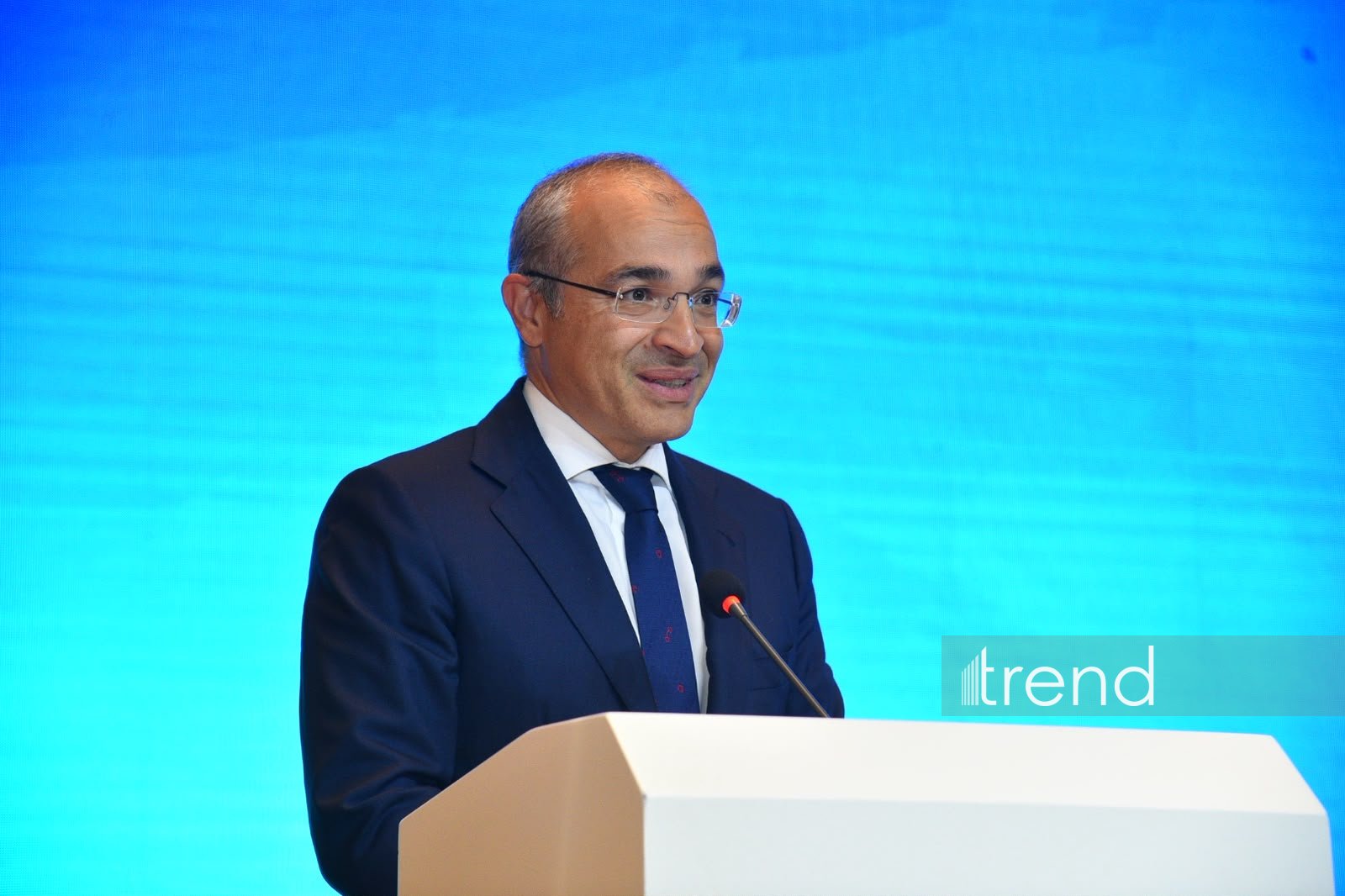

BAKU, Azerbaijan, October 1. Azerbaijan’s Minister of Economy Mikayil Jabbarov highlighted digital transformation, energy, and “green” investments as the three main areas offering the greatest opportunities for cooperation in the region at the CAMCA regional forum in Baku, Trend’s correspondent reports from the event.
The minister stated that countries in the region should expand joint production in areas where their economies have complementary advantages and build regional value chains.
“We must cooperate more and more, building regional value chains in areas where our economies have complementary advantages. Our major companies and financial institutions are already operating and are represented in each other’s markets,” Mikayil Jabbarov said.
He emphasized that trust in a partnership is measured not only by signed documents but also by the results achieved.
“We believe that trust is measured not by signatures, but by results achieved. Last week, the 2nd Azerbaijan International Investment Forum was held in this city. During the forum, 23 contracts and agreements totaling $10.8 billion were signed in areas such as artificial intelligence, renewable energy, the digital economy, industry, agriculture, pharmaceuticals, finance, and water management,” the minister noted.
According to him, countries and companies from Central Asia, as well as American companies and corporations, actively participated in the forum.
“The forum brought together investors with total assets worth $30 trillion. Among them were companies such as BlackRock, Global Infrastructure Partners, and Brookfield Asset Management. This is a clear indication of growing confidence among international investors in Azerbaijan,” Mikayil Jabbarov said.
The minister noted that Azerbaijan is striving to turn the signed commitments into actual production and economic activity.
“We are striving to translate our commitments into concrete action. We support investors through a unified coordination mechanism. An intergovernmental commission headed by the Deputy Prime Minister has been established to implement strategic projects,” he emphasized.
Mikayil Jabbarov noted that the focus is on public-private partnerships in Karabakh and East Zangezur.
“Infrastructure is being built here, and the next step is to ensure economic activity,” the minister noted.
He noted that the greatest opportunities for regional cooperation lie in the areas of digital transformation, energy, and “green” investments.
“In our view, the greatest opportunities for cooperation lie in three areas: digital transformation, energy, and ‘green’ investments,” said Mikayil Jabbarov.
The minister noted that Azerbaijan has approved the National Strategy on Artificial Intelligence for 2025–2028.
“The strategy focuses on data infrastructure, skills, business applications, and ethics. A competitive energy sector and high-speed connectivity provide a natural foundation for data centers and artificial intelligence infrastructure,” he said.
Mikayil Jabbarov emphasized that new opportunities are also emerging in the energy sector.
“Wind and solar power plants are already operational in Azerbaijan and the region, and new projects are being implemented in cooperation with international partners,” the minister noted.
According to him, hosting COP29 in Baku in 2024 has left a practical legacy in terms of “green” investments.
“Hosting COP29 in Baku in 2024 has left a very practical legacy. Green corridors across the Caspian and Black Seas open up opportunities for investors seeking to invest in energy production, energy transmission, energy storage systems, and energy-intensive industries,” said Mikayil Jabbarov.
The minister noted that Azerbaijan’s role in the region is based on the principle of fulfilling specific commitments and creating opportunities for cooperation.
“Azerbaijan’s role in this region is based on a simple principle: we fulfill the commitments we have made and open the door to cooperation. The Baku-Tbilisi-Ceyhan Pipeline and the Southern Gas Corridor were implemented at a time when many considered their implementation unrealistic,” he said.
Mikayil Jabbarov described the infrastructure projects along the Middle Corridor as a sign of Azerbaijan’s commitment to its future development.
“Investments in the Middle Corridor’s infrastructure are the best example of our commitment to future development. The development of ‘green’ energy corridors and the Black Sea cable with our partners in the region is another indication of this,” the minister noted.
He said that the world is becoming an important asset for regional economic development.
“We view peace as a very obvious economic asset. In our view, as a result of this process, the market capitalization of the region as a whole and of each country in the region has increased significantly. The peace process transforms regional interconnections into opportunities that can benefit the entire South Caucasus and Central Asia. Because a more connected region is a more stable region,” Mikayil Jabbarov emphasized.
The minister concluded his remarks by stating that human capital is the region’s most important asset.
“We believe that human capital is our greatest asset. Infrastructure and energy alone cannot create prosperity; it is people who create it. In each of the sectors I have described, the limiting factor is not a lack of capital or mineral resources, but skills,” he said.
“Our approach is to link education to the economy and, of course, the labor market. Our strategy in the field of artificial intelligence includes training programs and the AI Academy. The Digital Development Action Plan for 2026–2028 aligns education in information and communication technologies, artificial intelligence, and cybersecurity with market needs,” the minister said.
He called on international partners not only to invest capital but also to contribute to the training of local engineers and specialists.
“We ask our partners not only to invest capital but also to contribute to the training of local engineers and specialists. We encourage more active collaboration between our universities, vocational training centers, and businesses. Because a region that jointly trains talent and creates conditions for their mobility develops together,” added Mikayil Jabbarov.



