


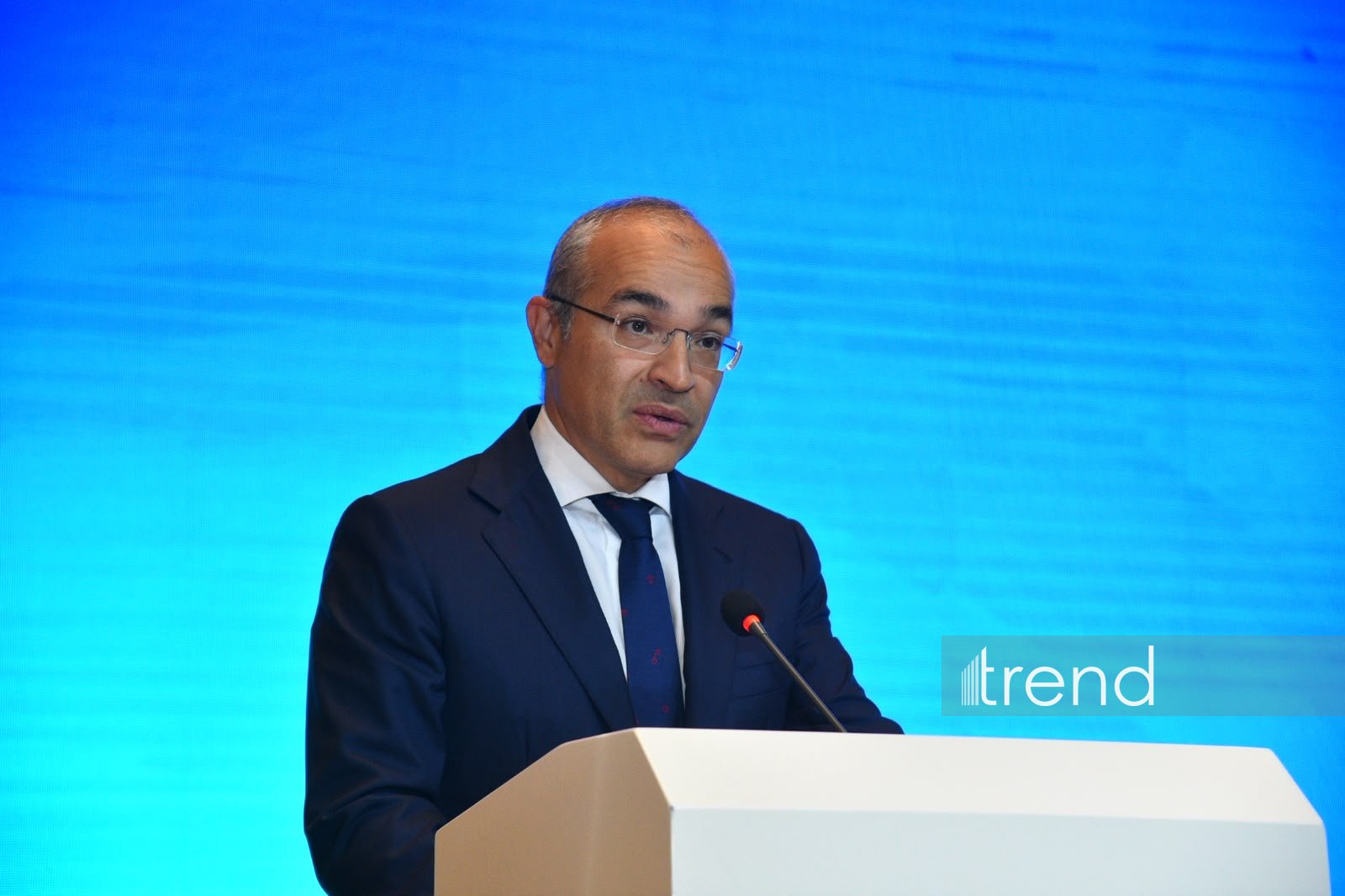

BAKU, Azerbaijan, October 1. Trade along the Middle Corridor could triple and transit times could be cut in half by 2030, Azerbaijan's Minister of Economy Mikayil Jabbarov said at the CAMCA Regional Forum in Baku on Thursday, Trend's correspondent reports from the event.
Jabbarov said a major stage in Azerbaijan's modern economic history began with the signing of the "Contract of the Century."
“The forms of energy consumed are changing, but oil played the main role initially, followed by gas. Today, we are talking about a green energy corridor for the same customers and the same markets. The difference is that this time we are cooperating more closely with our neighbors and our region, particularly the countries east of the Caspian Sea. Our partners in the west of Azerbaijan continue to participate in and support this process,” he said.
According to the minister, Azerbaijan's lack of direct access to the sea has prompted the country to pay particular attention to connectivity.
“On the one hand, Azerbaijan is a landlocked country, but on the other hand, this characteristic has created a certain natural selection. This choice has been to attach great importance to connectivity to reduce our geographical vulnerability and not shy away from investments in this area,” Jabbarov said.
He noted that the development of the Port of Alat, the Baku-Tbilisi-Kars railway, Azerbaijan's shipbuilding facility, as well as investments in ports and relevant terminals outside the country, are part of this policy.
“Energy infrastructure, pipelines and fiber-optic connections serve the same function and, in our view, have even greater potential. According to the World Bank's 2023 assessment, if the necessary investments are made and efficiency measures are implemented, it is possible to triple trade along the Middle Corridor and halve transit times by 2030, provided connectivity efforts continue,” he emphasized.
Jabbarov said Central Asia has remained Azerbaijan's most dynamically developing region of trading partners over the past five years.
According to him, the establishment of peace in the region is adding a new dimension to connectivity opportunities.
“The agreements reached in Washington in August 2025 opened a new chapter for the South Caucasus as well. The Zangezur Corridor, or the TRIPP route, will connect mainland Azerbaijan with Nakhchivan and become another link in the Middle Corridor,” Jabbarov said.
He noted that Central Asian countries are also interested in expanding these additional opportunities.
“We see how peace turns connectivity from an aspiration into a real project that can be financed. The ambassador has already spoken about both the TRIPP initiative and the Trans-Caspian Enterprise Fund,” the minister added.
Jabbarov emphasized that modern corridors are not limited to cargo transportation.
“We believe that modern corridors are a broader concept than cargo transportation. In the energy sector, the Southern Gas Corridor is already operational. The next stage is electricity. The Black Sea submarine electricity cable, recognized by the European Union as a Project of Common Interest, and the Caspian Green Energy Corridor involving Azerbaijan, Kazakhstan, Uzbekistan and Georgia are important projects in this area,” he said.
The minister noted that the relevant agreement on establishing the Caspian Green Energy Corridor was signed by the presidents of Azerbaijan, Kazakhstan and Uzbekistan on the sidelines of COP29.
He also described digital connectivity as an important area of regional cooperation.
“The Trans-Caspian fiber-optic line between Azerbaijan and Kazakhstan is expected to become operational in less than a month. This line will create a new high-capacity connection between Europe and Asia,” Jabbarov emphasized.
According to the minister, the prospect of a common future is particularly clear in relations between the South Caucasus and Central Asia.
“We have been part of this regional architecture for many years. As I mentioned, the political dimension deepened further in November 2025 in Tashkent. Azerbaijan became a full-fledged participant in the Consultative Meeting of the Heads of State of Central Asia, becoming the first country from outside Central Asia to do so,” he said.
Jabbarov said that several days earlier, the trade and investment ministers of the Central Asian countries and Azerbaijan had met for the first time in this format.
“Our goal is to bring the volume of regional trade to $20 billion and establish joint production under the ‘Made in Central Asia’ brand,” the minister said.
He noted that Azerbaijan has established joint investment funds with Kazakhstan, Uzbekistan and Kyrgyzstan in the economic and financial sectors.
“These funds bring several mid-sized markets together into a single investment portfolio. Azerbaijan's share in each of these funds is at least 50 percent. Thus, Azerbaijan and Central Asia, together with Türkiye and subsequently with Europe on one side and Asia on the other, are forming a unified economic space,” Jabbarov added.



