


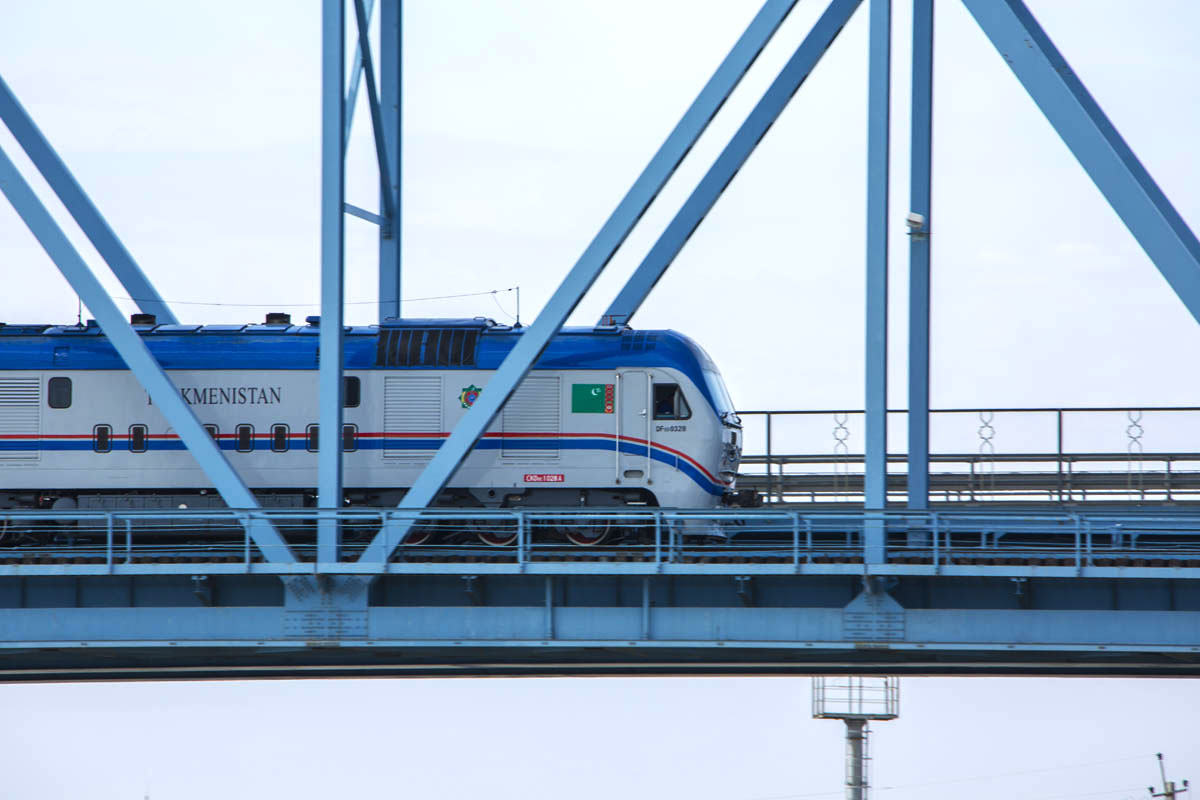

BAKU, Azerbaijan, November 12. Iran, Turkmenistan, and Kazakhstan reached a preliminary agreement in early November on the establishment of a joint digital corridor aimed at connecting Central Asia with the Persian Gulf and neighboring countries. According to the Iranian government's press service, the agreement was reached in Doha during a meeting between Iran's Minister of Information and Communications Technology, Sattar Hashemi, and his Turkmen and Kazakh counterparts. The initiative is intended to complement the existing railway link connecting Kazakhstan, Turkmenistan, and Iran, which was launched in December 2014. It also aligns with Ashgabat's broader efforts to strengthen transport connectivity with neighboring countries and markets in South Asia and the Middle East.
In 2026, this policy acquired an additional institutional dimension through Turkmenistan's chairmanship of the Commonwealth of Independent States (CIS). At the beginning of the year, Ashgabat identified transport connectivity and economic cooperation as key priorities of its agenda within the Commonwealth. The chairmanship concept, presented in March, outlines plans to advance economic cooperation and transport connectivity among CIS member states, with particular emphasis on the North-South and East-West international corridors, multimodal transportation, and the digitalization of transit procedures. This agenda is of particular significance to Ashgabat given the country's geographical position at the intersection of routes connecting the Caspian region, Central Asia, the Middle East, and European markets.
Throughout the year, these priorities have gradually translated into practical initiatives. At the September meeting of the CIS Economic Council in Ashgabat, the Turkmen side once again emphasized the importance of the North-South and East-West corridors, as well as the transit potential of the Caspian Sea. Turkmenistan also proposed designating 2029 as the Year of CIS Transport Connectivity. In October, the Commonwealth's heads of state endorsed the proposal and incorporated it into the final decisions of the summit in Awaza.
At the same time, Ashgabat continues to develop its own transport infrastructure. In early November, a 44-kilometer section of the Turkmenbashi-Garabogaz-Kazakhstan border road, which forms part of the North-South international corridor, was commissioned. Construction of the new 546-kilometer Ashgabat-Dashoguz highway also began during the same period. These projects complement the Mary-Turkmenabat section of the Ashgabat-Turkmenabat highway, which was commissioned in 2026. As Eurasian countries seek to diversify transport routes and strengthen supply chain resilience, Turkmenistan's geographical position and continued infrastructure development create additional opportunities for the country to consolidate its role as a regional transit hub.
Central Asia already has operational digital transit mechanisms that enable national transport systems to be integrated into international routes. In July 2026, the first shipment using the eTIR system was carried out, with customs transit formalities across Azerbaijan, Turkmenistan and Uzbekistan processed under a single electronic procedure, eliminating the need to reprocess paper documents at each stage of the route. A truck traveled from Azerbaijan through the port of Turkmenbashi and across Turkmenistan to the Farap border crossing in Uzbekistan. In the opposite direction, four shipments from Turkmenistan completed customs procedures at the port of Turkmenbashi before crossing the Caspian Sea to Azerbaijan's Alat port.
In an exclusive interview with Trend, Tatiana Rey-Bellet, Director of TIR and Transit Systems at the International Road Transport Union (IRU), said the organization expected to expand the use of eTIR to Kazakhstan, Türkiye and Georgia this year. In October, the IRU clarified that Kazakhstan was preparing to launch electronic transit operations on the route with Uzbekistan. Currently, eTIR is already operational on several corridors connecting Azerbaijan, Kyrgyzstan, Tajikistan, Turkmenistan and Uzbekistan.
This development has direct economic significance for Turkmenistan, positioning the country as a transit link between Central Asian markets and Caspian ports, through which cargo can continue to the South Caucasus and Europe. In an exclusive interview with Trend, Eric Livny, Head of the European Bank for Reconstruction and Development's (EBRD) office in Turkmenistan, noted the potential for investment in the country's railway infrastructure and logistics services along the Trans-Caspian Transport Corridor. Combining such infrastructure projects with operational digital customs procedures increases the practical value of the Turkmen route for international carriers.
The existence of these operational routes and cooperation mechanisms gives practical context to Iran's interest in transport cooperation with its northern neighbors. These developments have also gained additional significance amid mounting US pressure on Iran. Iranian President Masoud Pezeshkian, commenting on the country's economic situation, described it as a full-scale economic war and said that the United States had restricted maritime routes and imposed restrictions on land routes. His remarks came as Tehran was taking steps to strengthen transport links with neighboring countries.
In particular, on November 6, it became known that the remaining land section for construction of the 162-kilometer Rasht-Astara railway had been handed over to the Russian side. The railway is expected to become a key link in the western route of the North-South International Transport Corridor. The corridor's eastern branch, meanwhile, runs through Turkmenistan and other Central Asian countries. This means that US measures targeting Iran's logistics channels and Tehran's efforts to develop alternative routes are unfolding in the immediate vicinity of the Caspian region, where Turkmenistan's geographical position is gaining particular significance.
Amid the changing regional landscape, Turkmenistan continues to strengthen transport links with neighboring countries, develop its infrastructure and participate in the establishment of new logistics mechanisms. Its geographical position enables it to connect Central Asia with the Caspian region, Iran and, further, the South Caucasus. For Tehran, developing these routes offers additional opportunities to engage with its northern neighbors and access regional markets. Further expansion of transport connectivity could therefore enhance Turkmenistan's role as one of the key nodes in the regional logistics network.


