


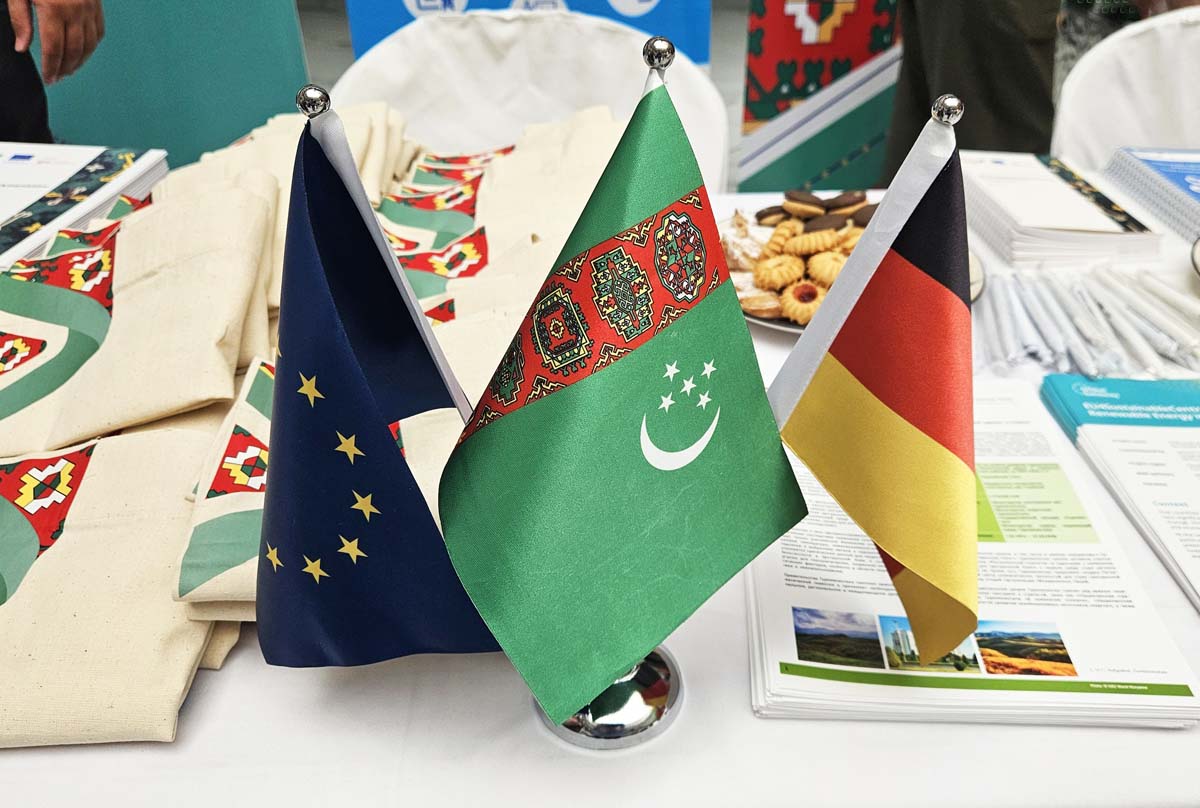
BAKU, Azerbaijan, November 12. Turkmenistan has highlighted the importance of energy resources and transport transit corridors in expanding economic cooperation with the European Union and its member states, the press service of Turkmenistan's Mejlis (parliament) reported.
The issues were discussed during a meeting between representatives of the Mejlis of Turkmenistan and German Ambassador to Turkmenistan Petra Dachtler.
According to the report, the sides focused on resolutions initiated by Turkmenistan concerning energy resources and the establishment of transport transit corridors. They also discussed the contribution of dialogue and neutrality principles to regional peace, security and mutual trust.
“It was also noted that our country's bilateral and multilateral cooperation with the European Union and its member states, including the Federal Republic of Germany, has been developing positively in the political-diplomatic, trade-economic, cultural-humanitarian spheres,” the report says.
The Central Asia-Germany format was highlighted as an important platform for strengthening regional cooperation in the economy, energy, transport and environmental protection.
Meanwhile, the European Union and Turkmenistan are developing cooperation in trade, transport connectivity, energy, environmental protection and digitalization. The framework for bilateral trade relations is the EU-Turkmenistan Interim Agreement on Trade and Trade-related Matters, which has been in force since 2010.
In 2024, EU exports to Turkmenistan amounted to €700 million, while imports from Turkmenistan reached €400 million. The EU is also supporting the development of the Trans-Caspian Transport Corridor, including infrastructure modernization, logistics improvements and trade facilitation. Other areas of cooperation include renewable energy, methane emissions reduction, water management and access to critical raw materials.
Relations between the EU and Central Asia were upgraded to a strategic partnership at the first EU-Central Asia Summit, held in Samarkand, Uzbekistan, on April 4, 2025, with the participation of the leaders of all five Central Asian countries, including Turkmenistan. The summit identified trade and investment, energy, climate action, transport connectivity, security and people-to-people contacts as key areas for further cooperation. The meeting followed the 20th EU-Central Asia Ministerial Meeting, held in Ashgabat in March 2025, which reviewed progress under the Joint Roadmap for Deepening Ties between the two regions.
Germany is pursuing its own Strategic Regional Partnership with Kazakhstan, Uzbekistan, Turkmenistan, Kyrgyzstan and Tajikistan under the Z5+1 format, established in 2023. The first summit was held in Berlin in September 2023, followed by a second meeting in Astana in September 2024. In February 2026, Germany hosted a meeting of foreign ministers from all five Central Asian countries in Berlin, accompanied by an economic forum involving nearly 30 German business representatives. The discussions focused on energy, raw materials, transport connectivity, security and regional economic cooperation.
Germany has also indicated its interest in hosting another summit with the participation of Central Asian heads of state and government in Berlin. German Ambassador to Turkmenistan Petra Dachtler said in October 2026 that Germany was looking forward to welcoming regional leaders for a new high-level meeting. For Turkmenistan, the Z5+1 format provides an additional channel for developing economic ties with Germany, particularly in energy, industry, transport, logistics and climate cooperation.


