


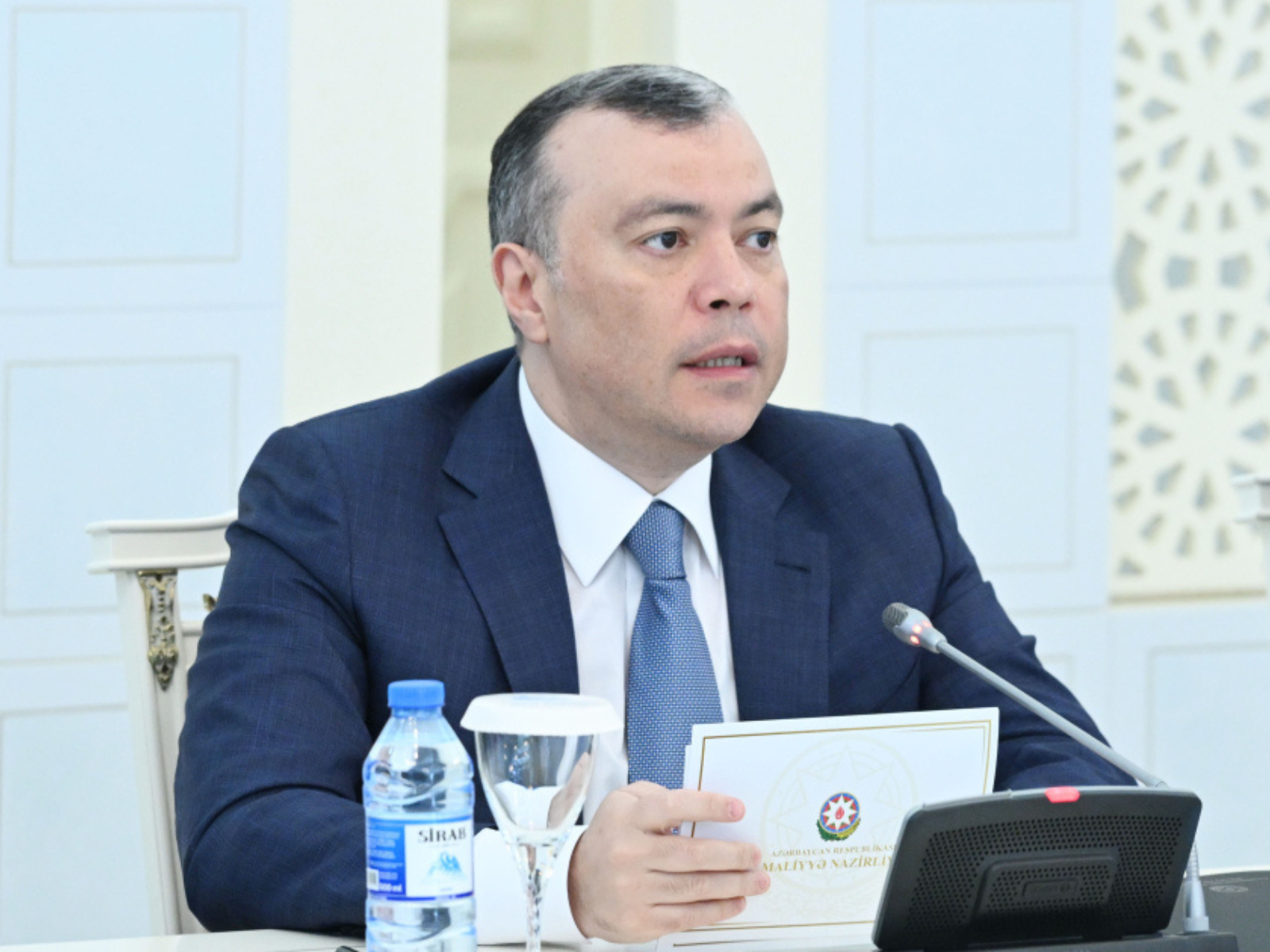

BAKU, Azerbaijan, November 11. Azerbaijan's state budget revenues in 2027 are projected to come 60.6% from the non-oil sector, Finance Minister Sahil Babayev said during a discussion of the draft law "On the State Budget for 2027" at a joint meeting of the Parliamentary Committees on Legal Policy and State Building, Defense, Security and Anti-Corruption, Human Rights, and Regional Affairs today.
According to him, state budget revenues are expected to total 39.3 billion manat ($23.1 billion) next year, while expenditures are projected at 42.4 billion manat ($24.9 billion).
The minister said that Azerbaijan's nominal GDP is projected to reach 141 billion manat ($82.9 billion) in 2027, with real GDP growth forecast at 2.7% compared to 2026.
"We project non-oil GDP at 109.1 billion manat ($64.2 billion), with real growth of 4.4% compared to the current year," Babayev noted.
According to him, over the five-year period covering 2023–2027, nominal non-oil GDP will increase by 30.1 billion manat ($17.7 billion), or 38.1%. The minister described this as an important indicator of economic diversification and the expansion of revenue sources.
For 2027, the average annual price of crude oil is projected at $65 per barrel, average annual inflation at 5.3%, and the manat exchange rate at 1.7 manat per US dollar.
Public debt-to-GDP ratio not to exceed 20.4%
Babayev noted that the public debt-to-GDP ratio is expected to reach 19.5% by the end of 2026 and 20.4% by the end of 2030.
"This means that the public debt-to-GDP ratio will remain stable over the medium term, and Azerbaijan will continue to rank among the countries with the strongest performance worldwide in this indicator," the minister emphasized.
He pointed out that the public debt portfolio includes 16.2 billion manat ($9.5 billion) in domestic debt and 7.7 billion manat ($4.5 billion) in external debt. Thus, domestic debt accounts for approximately 68% of total public debt.
According to the minister, the predominance of domestic debt reduces the sensitivity of public debt to exchange rate fluctuations and developments in international financial markets.
"The average maturity of bonds has already reached 3.6 years. Seven-year and 10-year bonds account for 44% of our portfolio. One of our main objectives is to gradually extend the average maturity to optimize public debt in terms of both market risks and overall liquidity indicators," Babayev said.
Strategic foreign exchange reserves exceed external public debt 20 times
The minister noted that Azerbaijan's strategic foreign exchange reserves amounted to $89 billion as of October 1.
"This is approximately 20 times higher than our external public debt," he noted.
According to Babayev, the State Oil Fund of Azerbaijan (SOFAZ) is projected to generate $7.8 billion in revenues and spend $7.1 billion in 2027. These estimates are based on an oil price of $65 per barrel.
The minister said that SOFAZ is expected to record a surplus of at least 1.2 billion manat ($706 million) next year.
SOFAZ's transfer to the state budget is projected at $7 billion in 2027, down $550 million from this year's forecast.
"Overall, by the end of the medium-term period, we plan to reduce the annual transfer to $5.5 billion. This is $2 billion below this year's figure of $7.5 billion," the finance minister emphasized.
Non-oil sector to account for 60.6% of budget revenues
State budget revenues in 2027 are projected at 39.3 billion manat ($23.1 billion), up 645 million manat ($379 million) from the 2026 forecast.
Babayev said that 23.8 billion manat ($14 billion) of revenues would come from the non-oil and gas sector, while 15.5 billion manat ($9.1 billion) would be generated by the oil and gas sector.
"Thus, starting next year, we will ensure that more than 60% of total state budget revenues come from the non-oil sector," the minister said.
According to him, non-oil revenues will increase by 1.6 billion manat ($941 million) compared to 2026. Non-oil revenues are expected to account for 21.8% of non-oil GDP.
Consolidated budget revenues are projected at 47.6 billion manat ($28 billion), up 5.19% from the current year. The non-oil sector is expected to account for 64.5% of consolidated budget revenues.
Consolidated budget expenditures will amount to 50.4 billion manat ($29.6 billion), up 1.5 billion manat ($882 million), or 3.1%, from 2026.
44.2% of state budget expenditures to be allocated to social spending
State budget expenditures in 2027 are projected at 42.4 billion manat ($24.9 billion), up 696.4 million manat ($409.6 million) from the 2026 forecast.
Current expenditures are set at 26.4 billion manat ($15.5 billion), while capital expenditures are projected at 13.8 billion manat ($8.1 billion). Thus, 32.5% of state budget expenditures is planned to be allocated to investment and capital spending.
The minister emphasized the investment-oriented nature of Azerbaijan's budget.
"Azerbaijan's budget will remain one of the most investment-oriented budgets in the region next year. Capital expenditures account for 32.5% of the state budget," Babayev said.
According to him, these funds will be directed toward strengthening defense capabilities, implementing the Great Return program, developing the regions, and financing other infrastructure projects.
Social spending is expected to total 18.7 billion manat ($11 billion), accounting for 44.2% of state budget expenditures.
"Compared to 2026, our social spending will increase by 9.2%. In absolute terms, this amounts to 1.6 billion manat ($941 million). Over the five-year period, social spending has increased by 30%," the minister noted.
5.4 billion manat ($3.2 billion) to be allocated to education and science, 2.1 billion manat ($1.2 billion) to healthcare
Education and science expenditures are projected at 5.4 billion manat ($3.2 billion) in 2027, up 538 million manat ($316 million), or 11%, compared to actual spending in 2025.
The minister said education spending would account for 3.6% of GDP, while combined education and science expenditures would represent 3.8%.
Healthcare spending in the state budget is expected to reach 2.1 billion manat ($1.2 billion), up 808 million manat ($475 million), or 63%, from the actual figure for 2025.
Babayev pointed out that funding for the healthcare sector should also take into account allocations through compulsory health insurance.
"Consolidated healthcare expenditures are projected at 4 billion manat ($2.4 billion) next year. This represents an increase of 1 billion manat ($588 million), or 36%, compared to 2025," the minister said.
State budget expenditures on social protection and social security are expected to total 4.9 billion manat ($2.9 billion). Under the consolidated budget, spending in this area is projected at 12.9 billion manat ($7.6 billion).
According to the minister, consolidated social protection expenditures will increase by 2.2 billion manat ($1.3 billion), or 21%, compared to 2025.
8.8 billion manat ($5.2 billion) to be allocated to defense and national security
Defense and national security expenditures are projected at 8.8 billion manat ($5.2 billion) in 2027, accounting for 20.8% of state budget expenditures.
Babayev said spending in this area would increase by 748 million manat ($440 million) compared to actual expenditures in 2025.
"Looking at the five-year period as a whole, defense and national security spending increased by 3 billion manat ($1.8 billion), or approximately 50%, between 2023 and 2027," he noted.
Expenditures on judicial, law enforcement, and prosecutorial authorities are expected to reach 3.4 billion manat ($2 billion).
Economic activity expenditures are projected at 8.9 billion manat ($5.2 billion), accounting for approximately 21% of state budget spending. Of this amount, 5.3 billion manat ($3.1 billion) is envisaged for public investment under the economic activity expenditure category.
Agricultural support to increase, Nakhchivan's subsidy to decline
The minister said allocations to the agricultural sector in 2027 are projected to reach 15.8% of agricultural GDP.
"We are approaching the 16% mark. This is a high indicator compared to other countries in the region and also a clear demonstration of the government's attention to agriculture," Babayev emphasized.
He also said that the regions' dependence on the state budget was declining and districts were no longer dependent on subsidies.
The subsidy allocated to the Nakhchivan Autonomous Republic is projected at 198 million manat ($116.5 million), down 6.4% from the current year.
According to the minister, this decline is primarily due to the autonomous republic's increased capacity to cover its expenditures through local revenues.
Non-oil primary deficit to decline to 17.1%
One of the key targets of the 2027 budget policy is to reduce dependence on oil revenues and strengthen fiscal sustainability.
Sahil Babayev said the non-oil primary deficit is projected at 17.1% of non-oil GDP next year, down 1.7 percentage points from 2026.
"If we achieve a non-oil primary deficit-to-non-oil GDP ratio of 17.1%, this will be the best result recorded since the introduction of the fiscal rule," the minister said.
According to him, the target is to reduce this indicator to 13% in 2029 and 12% in 2030.
Another important priority is financing current expenditures through non-oil revenues. The coverage of these expenditures by non-oil revenues is projected to reach 90.1% in 2027.
"One of our main targets by the end of the medium-term period is to ensure that current expenditures are fully covered by non-oil revenues. This will be a significant achievement in terms of budget sustainability, fiscal discipline, and macro-fiscal stability," Babayev stressed.
Budget deficit projected at 3.1 billion manat ($1.8 billion)
The state budget deficit in 2027 is expected to reach 3.1 billion manat ($1.8 billion), while the consolidated budget deficit is projected at 2.8 billion manat ($1.6 billion).
The state budget deficit is forecast at 2.2% of GDP, while the consolidated budget deficit is expected to account for approximately 2%.
The minister said the draft budget is designed to financially support the country's socioeconomic priorities, defense and security needs, investment programs, and measures aimed at improving public welfare.
"Overall, the figures and trends show that the 2027 state and consolidated budgets have been shaped in full alignment with the government's priorities. Both social protection spending and investment expenditures are being significantly increased," Babayev added.



