


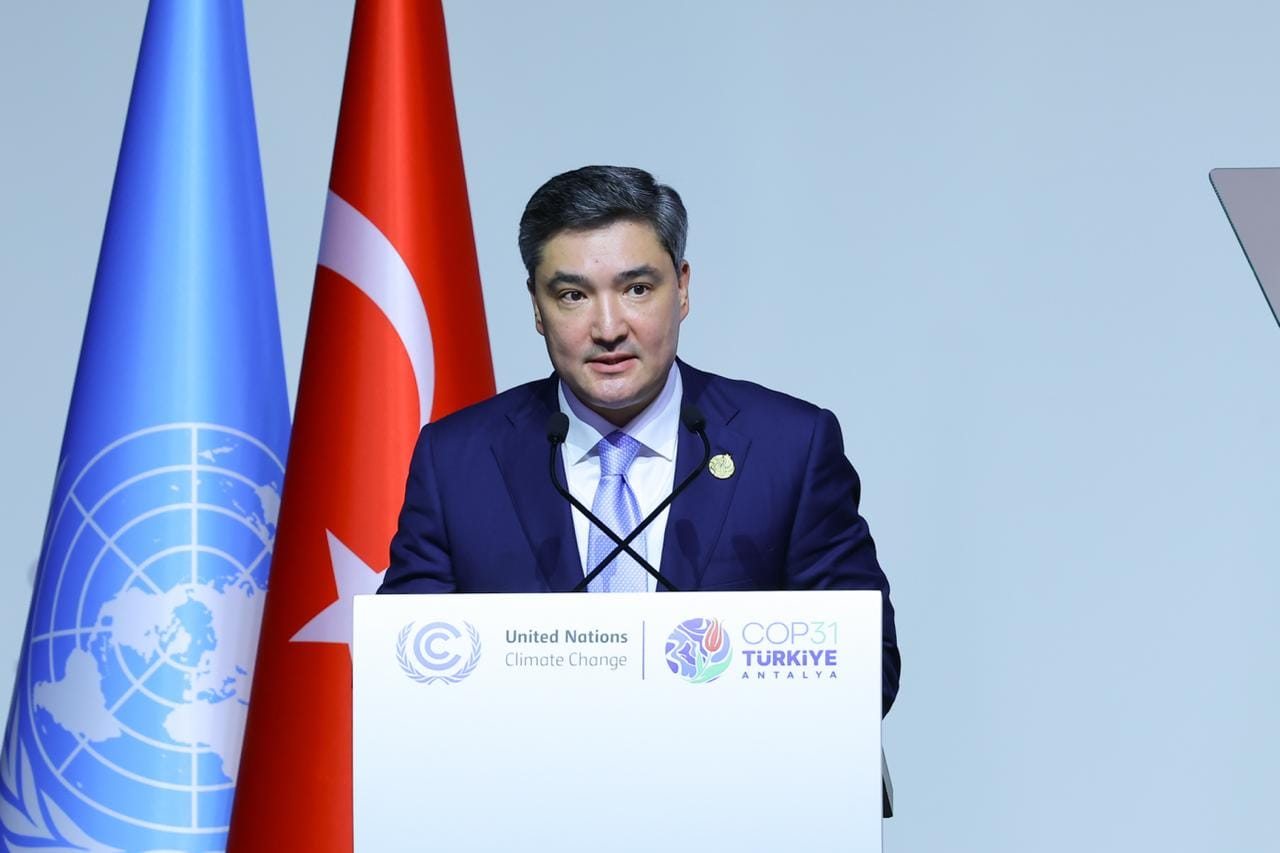

BAKU, Azerbaijan, November 11. Kazakhstan, Azerbaijan, and Uzbekistan are advancing a joint project to create a green energy corridor for the export of clean electricity, Prime Minister of Kazakhstan, Olzhas Bektenov, said at the 31st session of the Conference of the Parties to the UN Framework Convention on Climate Change (COP31) in Turkish Antalya.
According to the government of Kazakhstan, Bektenov took part in the summit on the instruction of President Kassym-Jomart Tokayev.
The Prime Minister noted in his remarks that Kazakhstan is consistently developing renewable energy sources. Over the past six years, their share in the country’s energy mix has quadrupled, reaching 8 percent in 2026. The target is to increase this figure to 15% by 2030.
Alongside this, Kazakhstan is developing nuclear energy, wind and solar power generation projects, as well as green hydrogen production.
Bektenov separately highlighted the trilateral project involving Kazakhstan, Azerbaijan and Uzbekistan to establish a green energy corridor designed to export clean electricity.
Speaking about regional cooperation in the environmental sphere, the Prime Minister stressed the need for joint efforts to address pressing challenges, primarily ensuring water security.
"Addressing environmental challenges requires closer cooperation. In April this year, Astana hosted the first Regional Environmental Summit. The Declaration on Environmental Solidarity of Central Asia, adopted following the summit, laid the foundation for joint action. At the heart of this shared commitment is one of our most pressing priorities – ensuring water security," Bektenov noted.
In this regard, he recalled the initiative of the President of Kazakhstan to establish an International Water Organization under the auspices of the United Nations.
"We invite all interested partners to join this process," the Prime Minister added.
Bektenov also spoke about the national environmental initiative "Taza Kazakhstan", which, according to him, has evolved into a nationwide movement and has been enshrined in the country's Constitution.
Today, more than 6 million Kazakh citizens participate in environmental protection activities. Over the past five years, approximately 1.7 billion trees have been planted across the country. In 2027, another 270 million seedlings are planned to be planted, bringing the country closer to the target set by the President of planting 2 billion trees.
Among other priorities on Kazakhstan's climate agenda, the Prime Minister highlighted the Alatau City project, which envisages the development of a low-carbon city. In addition, the country is introducing artificial intelligence and satellite monitoring to forecast natural hazards and prevent emergencies.
Concluding his remarks, Bektenov reaffirmed Kazakhstan's readiness to expand international cooperation in combating climate change.


