


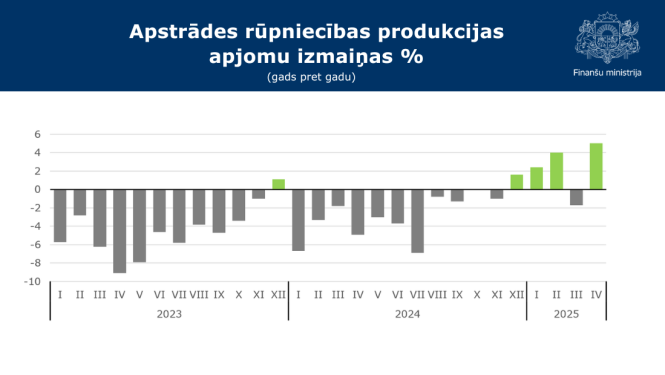

BAKU, Azerbaijan, June 5. In April 2025, Latvia’s manufacturing sector experienced a remarkable 5 percent year-over-year increase, marking the swiftest annual growth since May 2022.
Data obtained by Trend from the country's Central Bureau of Statistics reads that despite this indicator, overall industrial production rose by just 1.9 percent, weighed down by a 12.2 percent drop in electricity and gas supply and an 11.7 percent decline in mining and quarrying.
The rebound was supported by stronger demand across the eurozone, where manufacturing activity has reached its highest levels since mid-2023. As a result, Latvia saw notable growth across several key manufacturing subsectors, including:
Wood processing: up 8.3 percent
Food production: up 13.8 percent
Construction materials (non-metallic minerals): up 15.8 percent
Rubber and plastics: up 15.2 percent
Automotive, trailers, and semi-trailers: up 8.3 percent
Machinery and equipment repair/installation: up 15.7 percent
Meanwhile, the most significant declines were reported in:
Chemical products: down 9 percent
Computers and electronics: down 6 percent
Other unclassified machinery: down 11.8 percent
On that account, between January and April 2025, manufacturing volumes rose 2.4 percent compared to the same period in 2024. However, total industrial production increased just 0.4 percent, due to a 7.2 percent decline in electricity and gas supply.
Confidence in the sector is also showing signs of recovery. The European Commission’s manufacturing confidence index hit its highest point since mid-2022 in May, driven by rising order volumes in both export and domestic markets and decreasing inventories. Similarly, the S&P Global Manufacturing PMI for the eurozone continues to trend upward, with business confidence reaching levels last seen in February 2022 — prior to Russia’s full-scale invasion of Ukraine.
Electricity and gas supply volumes in April 2025 were 12.2 percent lower than in April 2024, largely due to a 45.5 percent drop in electricity output. This was primarily driven by a 65.6 percent decrease in hydropower generation. The sharp decline is attributed to an unusually rainy April in 2024, which had created an artificially high baseline for comparison.
By contrast, cogeneration plants increased their electricity output by 32.1 percent year-over-year. Latvia also imported twice as much electricity as it exported in April. Natural gas consumption rose by 8 percent during the same period.
Manufacturing output in Latvia has grown in three of the first four months of 2025, indicating a broader recovery across the sector. Combined with steady growth across the European Union, this suggests that the prolonged stagnation in the industry may be easing.
Projections for 2025 estimate manufacturing growth of 2 to 3 percent, though a stronger-than-expected demand could result in even faster expansion. However, downside risks remain — particularly the threat of new, severe U.S. import tariffs, which could significantly disrupt trade with the United States and negatively impact Latvian industry.


