


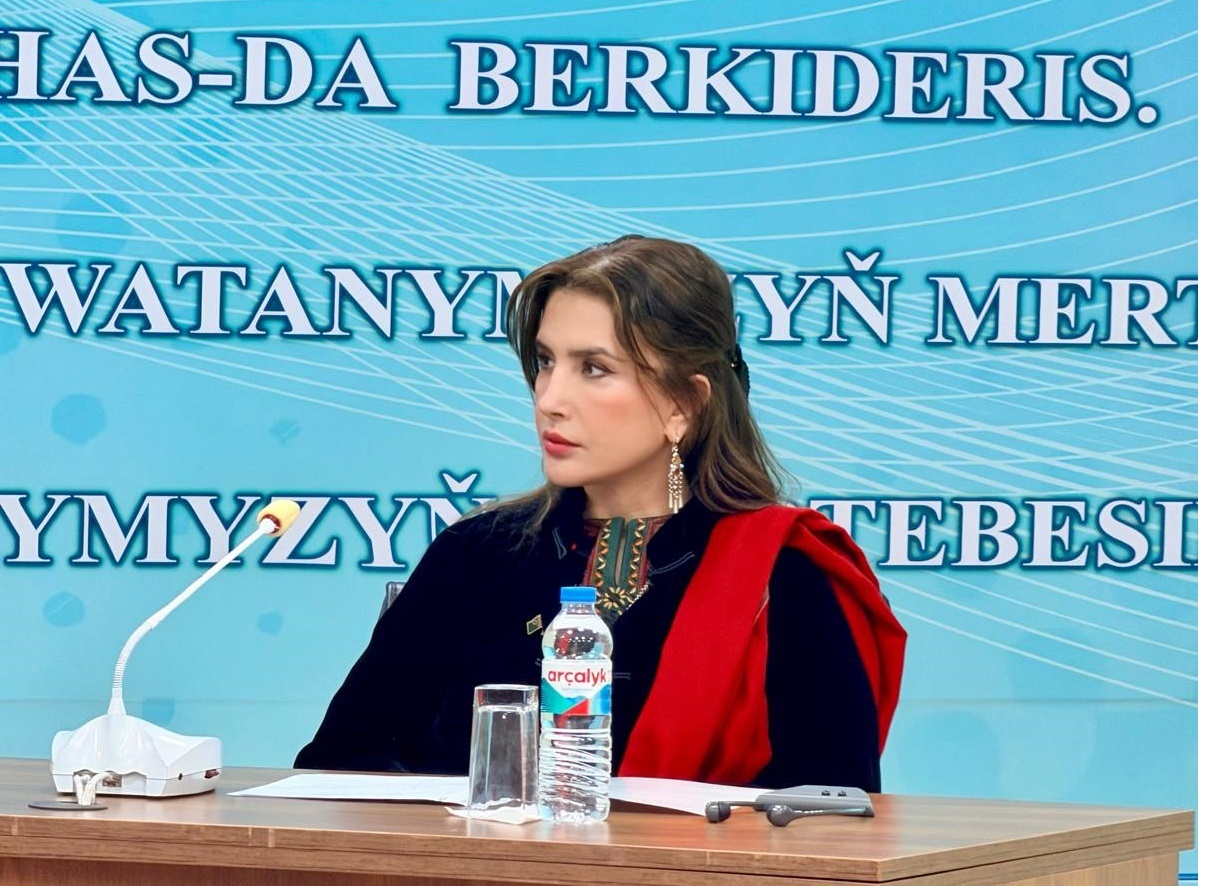

BAKU, Azerbaijan, September 25. Pakistan's Ambassador to Turkmenistan Faryal Legari highlighted the TAPI gas pipeline's role in regional energy integration in a message published today.
Legari made the remarks in a congratulatory message to Turkmen President Serdar Berdimuhamedov on his birthday, according to the press service of the Turkmen government.
“Turkmenistan-Afghanistan-Pakistan-India (TAPI) gas pipeline has long become a symbol of the prospects for regional energy integration,” Legari said.
She noted that the project was particularly important amid heightened risks to vulnerable maritime routes against the backdrop of conflicts in the Middle East.
According to the ambassador, Turkmenistan's large natural gas reserves and Pakistan's growing demand for reliable, diversified and affordable energy supplies create a basis for mutually beneficial energy cooperation.
Legari also said greater energy interconnection with Turkmenistan could support Pakistan's industrial growth, reduce its dependence on volatile international markets and strengthen long-term energy security.
In parallel, earlier in September, Ambassador of Turkmenistan to Islamabad Atajan Movlamov stated that Ashgabat expects to create conditions for the start of natural gas supplies to Pakistan through the TAPI pipeline in 2027. Movlamov made the remark during his address at the Ambassadors’ Dinner 2026, hosted by the Lahore Chamber of Commerce and Industry (LCCI) at the Serena Hotel in Islamabad.
Growing concerns among South Asian countries over the vulnerability of gas supplies to disruptions along maritime routes, as well as efforts to diversify supplies and reduce reliance on vulnerable segments of the global LNG market, were highlighted by Trend in its January article, “Asia needs gas: TAPI steps in.” Those concerns have since gained a new dimension following the U.S. and Israeli attacks on Iran in February and the subsequent closure of the Strait of Hormuz, through which almost 20% of global LNG trade, or around 110 billion cubic meters, passed in 2025, according to the International Energy Agency. Against this backdrop, Pakistan's Ambassador to Turkmenistan Faryal Legari's emphasis on TAPI as an alternative to vulnerable maritime supply routes comes amid heightened attention to the security of gas supplies to South Asia.
Meanwhile, the Turkmenistan-Afghanistan-Pakistan-India (TAPI) pipeline is a planned 1,800-kilometer natural gas pipeline designed to transport up to 33 billion cubic meters of gas annually from Turkmenistan’s giant Galkynysh field to Afghanistan, Pakistan, and India. Ashgabat views the project as one of the main routes for diversifying gas exports and strengthening regional economic integration.
The gas resource base for TAPI is the Galkynysh field, one of the world's largest gas deposits with estimated reserves exceeding 27 trillion cubic meters. In April 2026, Turkmengaz and China's CNPC launched the fourth phase of the field's development. The project involves the construction of new production facilities and the drilling of wells, which will enable the additional production of up to 10 billion cubic meters of commercial gas per year.
In early June, the Belfer Center for Science and International Affairs at Harvard’s Kennedy School noted in its analysis that the TAPI gas pipeline is being re-anchored in regional energy discussions as a structured mechanism for regional energy flows, connecting Turkmenistan’s gas resources with demand centers in South Asia.



