


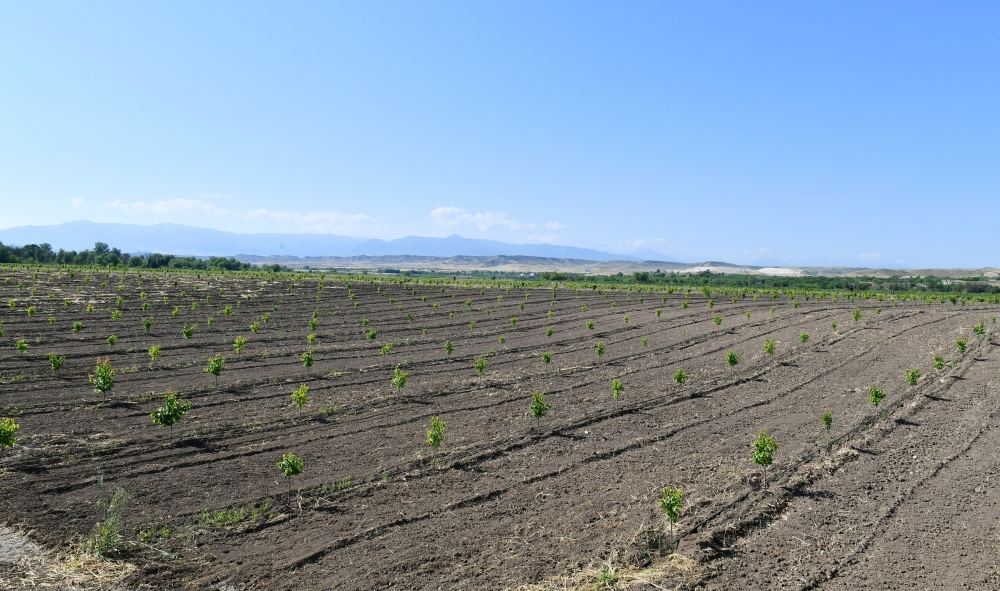

BAKU, Azerbaijan, October 24. Azerbaijan's Agricultural Insurance Fund has thrown its hat in the ring, kicking off the fruit orchard insurance period for the 2025-2026 crop season.
The data obtained by Trend from the fund shows that the affordable agricultural insurance mechanism supported by the government covers a total of 41 types of plants and crops.
In recent years, the growing interest in agriculture in Azerbaijan has led to the planting of thousands of hectares of fruit orchards annually.
These fruits are not only crucial for supplying the domestic market but have also become an important export product, bringing significant revenue to the country.
A multitude of farmers and locals are toiling away in this field.
The Agricultural Insurance Fund insures fruit orchards against various risks, including hail, hurricanes, storms, floods, drought, frost, excessive snowfall, wild animal attacks, actions of third parties, fires, and quality losses due to hail.
Furthermore, agronomic risk management solutions encompass
contingencies related to phytopathological threats, entomological
infestations, seismic activities, geomorphological shifts, and
atmospheric electrical discharges.
In the occurrence of any adverse event, the assessment of damages
is conducted by autonomous agricultural risk management
specialists, and the Agricultural Insurance Fund provides
indemnification to the producer for the incurred losses.
The out-of-pocket threshold is also factored into the calculation
of the insurance disbursement.
Underwriting agricultural assets, specifically pomological
enterprises, demonstrates significant fiscal efficiency.
The insurance premium depends on the type of fruit, the region, and the insurance package. Furthermore, due to the government’s 50 percent subsidy on insurance premiums, farmers only pay half of the insurance cost, with the other half covered by the government.
Consequently, to underwrite horticultural assets valued at 1,000
manat ($588), agricultural producers must allocate a premium
ranging from 10 to 25 manat ($5.88 - $14.7), contingent upon the
varietal classification of the fruit and the geographical
jurisdiction.
For an orchard valued at 10,000 manat ($5,880), the associated
insurance premium would range between 100-250 manat ($58.8-$147)
for the agricultural producer.
Agricultural producers have the option to underwrite supplementary
perils, including but not limited to frost-induced damage, quality
degradation attributable to hail events, adverse impacts from
excessive precipitation, as well as phytopathological threats and
pest infestations, contingent upon an additional premium
payment.
In conjunction with the cultivation of fruit-bearing species,
proprietors of orchards have the capability to underwrite
individual arboreal specimens and juvenile plants
independently.
In the event that a tree is rendered nonviable as a consequence of
any of the previously delineated occurrences, the agriculturalist
shall receive remuneration equivalent to the projected market value
of the tree's yield for a subsequent period of three years.
The premium assessment for this particular coverage is a mere 0.83
percent.
For instance, underwriting a botanical asset that yields an annual
output of 50 manat ($29.4) in fruit would incur a premium of merely
62 gapik ($0.36) for the agricultural producer.
Farmers can calculate the insurance fees for their fruit orchards independently using the "Crop Calculator" on the official Agricultural Insurance Fund website (https://asf.gov.az/bitkicilik-kalkulyatoru).
There has been a significant escalation in indemnity
disbursements pertaining to arboreal cultivation and pomological
specimens.
In the fiscal year 2023, an aggregate disbursement of 39,000 manat
(equivalent to $22,941) was allocated for the cultivation and
maintenance of fruit orchards.
By the year 2024, the figure escalated to 720,000 manat ($423,529),
and within the initial three quarters of 2025, it surged to 159,000
manat ($93,529), with the trajectory indicating ongoing
expansion.
The predominant phenomena precipitating detriment to pomological
systems encompass tempestuous conditions, hailstone impacts, frost
events, and hydrological inundations.
For comprehensive insights regarding the underwriting parameters
and premium structures associated with agrarian commodities, you
may navigate to the official digital platform of the Agricultural
Insurance Fund or engage with their social media channels for
real-time updates.



