


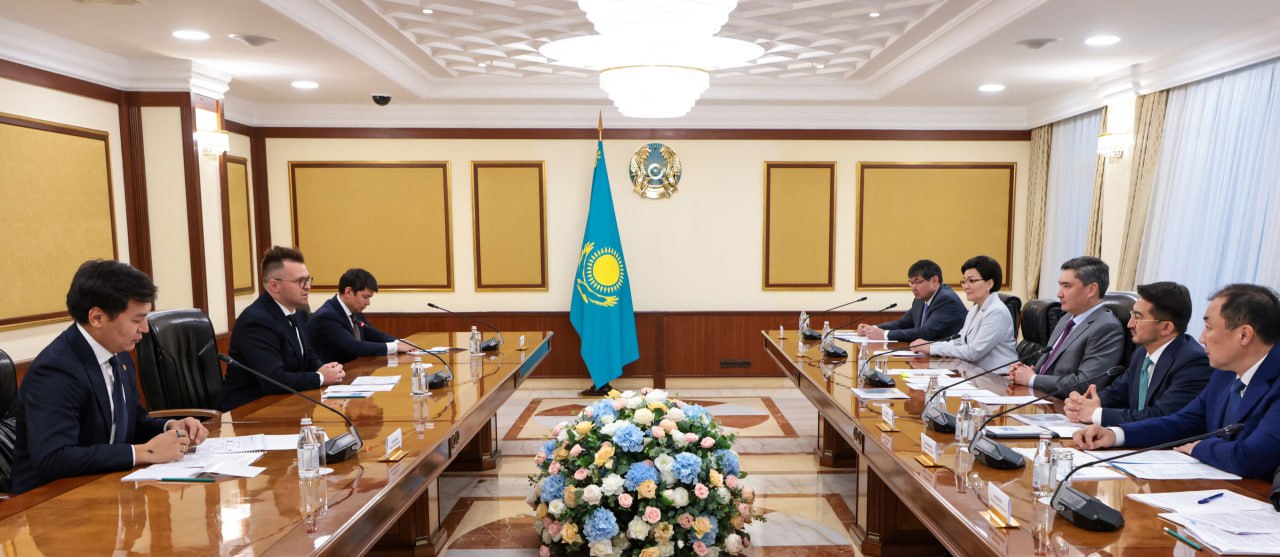

ASTANA, Kazakhstan, July 9. The Prime Minister of the Republic of Kazakhstan, Olzhas Bektenov, held a meeting with Yandex CEO Daniil Shuleyko and the head of Yandex Qazaqstan, Timur Shalekenov, during which they discussed prospects for the development of digital services, platform employment, and the implementation of technological projects in Kazakhstan, Trend reports.
According to the information, the government is currently working on forming balanced regulation of platform employment, taking into account the specifics of taxation of self-employed individuals. In this context, the initiative being implemented by Yandex Qazaqstan is of particular relevance.
Yandex Taxi became the first tax agent in the country. The total number of platform participants since its launch in September last year has already reached 86,000 people. Over 4.9 billion tenge (approximately $9.31 million) have been invested in the development of the project, and as a tax agent, the company has withheld and transferred 4.3 billion tenge (about $8.17 million) to the budget.
“President Kassym-Jomart Tokayev has instructed the active implementation of digital solutions for the convenience of citizens. For effective regulation of platform employment, the government is interested in new approaches to social protection, taxation, and the legal status of the self-employed and freelancers. To bring this sector out of the shadows and involve it in the active economy, it is important to ensure a smooth transition to a new tax regime from January 1, 2026. This issue concerns the activities of hundreds of thousands of our citizens,” emphasized Olzhas Bektenov.
Furthermore, Yandex's Chief Executive Officer, Daniil Shuleyko,
articulated the productive synergies achieved and reaffirmed the
organization's commitment to advancing technological initiatives
within the national landscape.
Moreover, in the course of the assembly, strategic frameworks for
the enhancement of the intercity passenger transit system were
deliberated. Currently, Yandex Qazaqstan encompasses the majority
of critical pathways throughout the nation.
Attention was directed towards the multifaceted challenges
surrounding roadway safety protocols. To enhance the security
protocols for both passengers and operators, the implementation of
driver credential verifications has been initiated, biometric
facial recognition assessments are executed, and systematic
vehicular photographic evaluations are routinely conducted. The
autonomous regulation framework oversees velocity metrics, operator
fatigue indices, and various operational parameters.
Non-conventional scenarios and vehicular incidents are documented
in real-time, alongside anomalies in routing and various risk
factors.
Due diligence was exercised regarding ancillary technological
initiatives deployed by the organization. For instance, a
voice-activated AI assistant, engineered to facilitate interactions
in both Kazakh and Russian dialects, is currently undergoing a
pilot phase within the operational framework of the 1414 contact
center. The initiative to operationalize the visualization of
emergency ambulance dispatches on the urban cartographic interface
is concurrently under development.
At the conclusion of the meeting, the stakeholders affirmed their
preparedness to persist in collaborative endeavors. The Prime
Minister issued a series of directives to the pertinent agencies
for the collaborative execution of digital initiatives.



