


BAKU, Azerbaijan, October 7. The visit of European Investment Bank (EIB) Vice President Marek Mora to Kazakhstan on October 7-8, 2026, marks a new stage in deepening cooperation on key infrastructure and green projects. Against this backdrop, it is worth looking at how Kazakhstan’s cooperation with the EIB has developed and how President Kassym-Jomart Tokayev has consistently advanced this agenda in talks with European partners.
EIB presence in Kazakhstan - history and scale
The EIB has been operating in Central Asia since 2009. According to the bank, the volume of signed agreements and operations in the region amounts to around 750 million euros, while the overall project portfolio has grown to nearly 3 billion euros. In June 2026, the EIB opened its regional office for Central Asia in Tashkent, overseeing projects involving Kazakhstan among other countries.
The growth of these figures reflects the gradual expansion of the European financial institution’s presence in the region. For Kazakhstan, this process is particularly important: the country occupies a central position in the Trans-Caspian Transport Corridor while also prioritizing infrastructure development, renewable energy and closer economic integration with European partners.
At the same time, the scale of cooperation with the EIB has gradually changed. At the initial stage, the focus was primarily on supporting small and medium-sized businesses and green projects through financial intermediaries. Since 2024-2025, the focus has shifted noticeably toward large-scale infrastructure, transport and renewable energy.
The first major step in this direction was a 200 million euro framework loan provided by the EIB to the Development Bank of Kazakhstan in December 2024 and formally finalized in March 2025. The funds are intended for sustainable transport, including elements of the Trans-Caspian Corridor, as well as renewable energy projects. According to the bank, the transport component is expected to contribute to the rehabilitation of up to 5,000 kilometers of national and regional roads.
This project was one of the first practical outcomes of the memoranda signed in January 2024 at the EU-Central Asia Investment Forum. Thus, political agreements gradually began to translate into concrete financial instruments.
The next stage was directly linked to President of Kazakhstan Kassym-Jomart Tokayev’s visit to Brussels in June 2026. During the visit, the EIB signed a 150 million euro framework loan directly with Kazakhstan. The project is being implemented by national road operator QazAvtoZhol.
The funds are earmarked for the rehabilitation of approximately 1,370 km of strategic roads in central and southern Kazakhstan. These include sections of the Trans-Caspian Transport Corridor linking the country with neighboring Central Asian states.
The financing is supported by the European Union under Global Europe (NDICI) and the Global Gateway strategy. The project is expected to create employment equivalent to around 5,900 person-years, improve road safety and climate resilience, and reduce travel times.
EIB Vice President Marek Mora, who is responsible for the bank’s operations in Central Asia, commented on the decision as follows: “Good roads do more than connect places on a map. They connect people, they let businesses reach new markets, make travel safer and faster, and create opportunities for communities. By investing in key transport links across Kazakhstan, we are supporting a corridor that is becoming increasingly important for trade between Europe and Central Asia while delivering tangible benefits locally. Hard infrastructure is the backbone for trades. This is what sustainable connectivity is about: creating practical connections that support growth, resilience and cooperation.”
The transport sector is becoming one of the most concrete points of convergence between Kazakhstan’s priorities and the European Global Gateway strategy. For Astana, the development of the Middle Corridor is not only a transport objective but also part of a broader strategy to increase the country’s transit potential and strengthen economic ties with external markets.
At the same time, the EIB is also involved in regional digital connectivity initiatives. In December 2025, Marek Mora told Trend in an interview that transport and digital connectivity are central elements of the EIB’s mandate in Central Asia and the EU’s Global Gateway strategy. “The EIB supports the Team Europe Initiative on Digital Connectivity through its 60 million euro financing for the SES satellite broadband project, which covers rural areas of Tajikistan as well as Kazakhstan, Uzbekistan, and Kyrgyzstan,” Mora added.
According to him, the bank’s strategy focuses on sustainable cross-border connectivity that supports interoperability, regulatory harmonization and low-carbon transport solutions. In Mora’s assessment, these investments will provide high-speed access to remote communities and expand opportunities in education, healthcare and the economy.
How the EIB affects Kazakhstan’s economy
The direct impact of Kazakhstan’s cooperation with the EIB is primarily reflected in infrastructure development, investment and job creation. The rehabilitation of roads linked to the Trans-Caspian Corridor should reduce logistics costs, accelerate cargo flows and strengthen Kazakhstan’s position as a transit hub.
In recent years, freight volumes along the Middle Corridor have increased severalfold, while further infrastructure development is one of the conditions for achieving the target of increasing transportation volumes to 10 million tons. “The modernization of transport infrastructure has already produced impressive results. Over the past six years, freight volumes along this route have increased fivefold, from 0.8 million to 4.1 million tons per year. Our goal is to increase its capacity to 10 million tons,” President of Kazakhstan Kassym-Jomart Tokayev said at the Kazakhstan-EU roundtable in June this year.
However, the importance of EIB financing for Kazakhstan is not limited to the amount of funds provided. The bank’s loans require compliance with high environmental, social and procurement standards. This raises requirements for project quality while also creating additional requirements for the Kazakh side in terms of documentation, procurement and management.
As a result, cooperation with the EIB provides Kazakhstan not only with long-term and more favorable financing terms, but also with an opportunity to apply European project preparation standards when implementing major infrastructure projects.
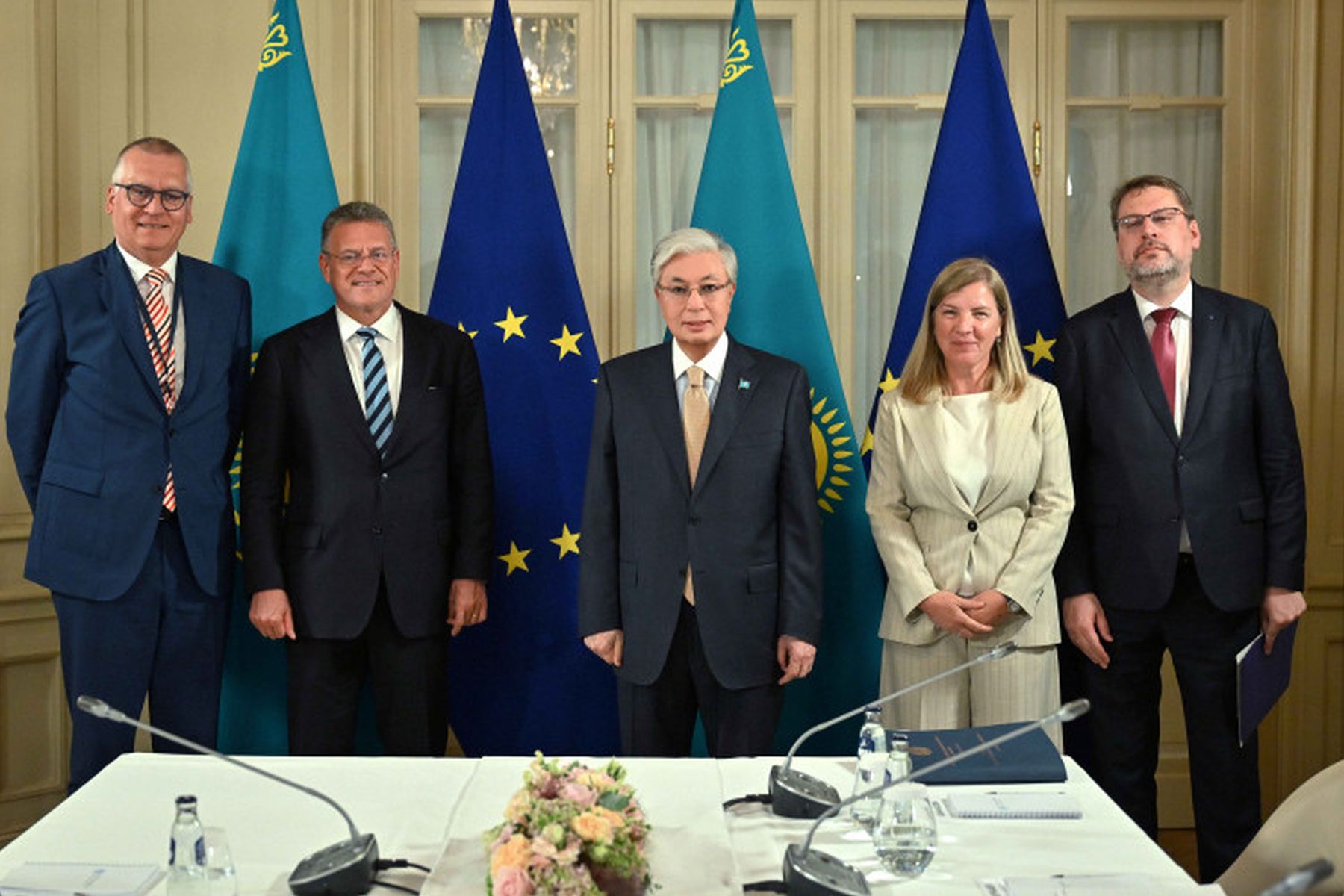
The political framework for this cooperation has been consistently shaped at the level of the head of state. At a meeting with Maroš Šefčovič, Eduards Stiprais and Marek Mora in Brussels on June 23, 2026, Kassym-Jomart Tokayev noted the productive nature of Kazakhstan’s cooperation with the EIB and expressed confidence that further interaction would contribute to the country’s sustainable economic development and strengthen regional connectivity.
At the Kazakhstan-EU roundtable on the same day, Tokayev separately highlighted the role of European financial institutions: “We also welcome the enhanced role of European financial institutions in supporting Kazakhstan’s sustainable economic development and initiatives aimed at strengthening regional connectivity. In this regard, I highly value the active contribution of the European Investment Bank and am pleased that Vice President Mora is here with us today.”
Thus, Tokayev’s contribution to advancing this agenda lies primarily in shaping political priorities and promoting them in negotiations with European partners. The Middle Corridor, the energy transition and regional connectivity are viewed by Astana as elements of a unified economic agenda, while the EIB is becoming one of the instruments for its practical implementation.
This was also reflected in the joint statement issued following the leaders’ meeting, which specifically noted support for opening an EIB representative office in Astana - a step envisaged by the 2025 EU-Central Asia summit declaration.
What to expect next?
According to an official statement by the EU Delegation to Kazakhstan, Marek Mora’s visit to Kazakhstan will focus on strengthening cooperation, advancing key investment projects, deepening interaction between Kazakhstan and the EU, and supporting the further development of the Trans-Caspian Transport Corridor.
One of the most likely topics for discussion will be the implementation of the framework loans already signed - 200 million euros for the Development Bank of Kazakhstan and 150 million euros for QazAvtoZhol. At this stage, what matters for Kazakhstan is not only securing financing but also the pace at which the funds are put to practical use and agreements are translated into completed projects.
Another area could be expanding the EIB’s portfolio in renewable energy, digitalization and critical raw materials. At the same time, Astana is interested in closer coordination with other European financial institutions, including the European Bank for Reconstruction and Development and development institutions of individual EU countries.
The possible opening of an EIB representative office in Astana is also significant. Following the establishment of the regional office in Tashkent, such a step could strengthen the bank’s presence in Kazakhstan and facilitate the preparation of new projects locally. For the Kazakh economy, this could mean faster preparation of subsequent financing and projects, expanded technical assistance and, over time, an additional inflow of long-term capital into infrastructure and the green transition.
At the same time, the scale of EIB financing remains relatively modest compared with Kazakhstan’s needs for modernizing its transport network and energy sector. Therefore, the key factor will be not only the volume of new agreements but also the ability of the Kazakh side to rapidly prepare projects that meet the bank’s requirements.
In September 2026, in Berlin, President Tokayev separately highlighted the potential for cooperation between the EIB and the Development Bank of Kazakhstan with the participation of German capital in the modernization of the energy and industrial sectors, including renewable energy sources and green hydrogen. This shows that Astana views the EIB not as an isolated financial partner but as part of a broader European financial architecture that Kazakhstan seeks to leverage to implement its infrastructure and energy priorities.
In this context, Marek Mora’s visit is a logical continuation of the course that Kazakhstan has been consistently pursuing at the level of the head of state: translating political agreements with the EU into concrete investment instruments.
How quickly these instruments begin to produce measurable results on the ground will depend primarily on the pace of implementation of projects already approved and the preparation of new ones. These indicators will make it possible in the coming months to assess the extent to which the EIB’s expanding presence in Kazakhstan is actually translating into a new stage of practical economic cooperation.



