


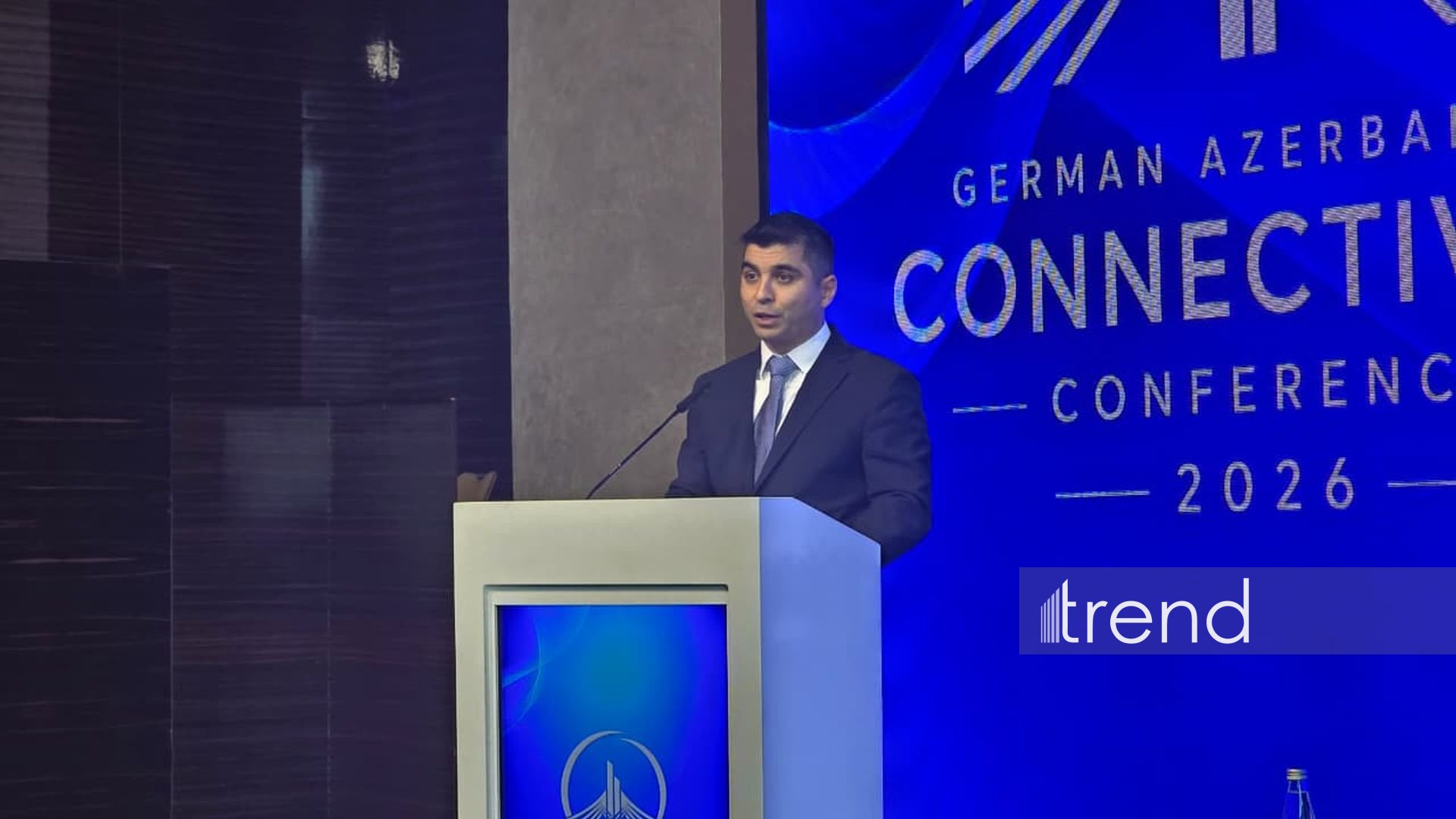

BAKU, Azerbaijan, October 6. Over the past five years, the volume of transit cargo passing through Azerbaijan has roughly doubled, and the goal is to increase this figure to 30 million metric tons by 2030, the Deputy Minister of Digital Development and Transport, Rashad Hasanov, said, Trend's correspondent reports.
He made the remarks at the German-Azerbaijani Conference on Strategic Partnership and Connectivity in Baku on Tuesday.
According to the deputy minister, in today’s world, connectivity is one of the key factors ensuring the rapid and cost-effective movement of goods, services, people, and data between markets.
“Recent years have shown just how vulnerable and complex this system can be. Conflicts have disrupted the operation of land routes, straits, sea lanes, and even undersea cable lines. Companies and governments are prioritizing the diversification of routes. Azerbaijan’s response in this regard is based on two main pillars: 1. The Middle Corridor, which facilitates freight transport; 2. the Digital Corridor, which facilitates data transmission,” R. Hasanov noted.
According to him, the volume of transit cargo passing through Azerbaijan has nearly doubled over the past five years.
“We expect that by the end of this year, the volume of transit cargo will reach about 16 million metric tons. By 2030, we plan to increase this figure to 30 million metric tons,” the deputy minister said.
R. Hasanov emphasized that container traffic is growing particularly rapidly.
“Based on the results of the first nine months of the year, container traffic at the Port of Baku increased by more than 30 percent compared to the same period last year,” he said.
The deputy minister noted that work is underway to strengthen the Port of Baku.
“We have increased the port’s container handling capacity by improving operations. As a result of the second phase of the project, this figure is expected to reach 500,000 TEU,” R. Hasanov added.
According to him, the Zangezur Corridor, which will extend to Türkiye via Nakhchivan, will become Azerbaijan’s second western transport route and will be capable of transporting up to 15 million metric tons of cargo per year.
Hasanov noted that the Caspian Fleet is also one of the key elements of the Middle Corridor.
“The Baku Shipyard is currently building four container ships for Ad Ports and the Kazakhstan Railways. These are the shipyard’s first international orders,” he noted.
The deputy minister noted that international partners have shown great interest in the projects to expand the Port of Baku.
“A model for cooperation on the expansion of the Port of Baku is also being discussed with German companies,” R. Hasanov emphasized.
He added that to fully realize the potential of the Middle Corridor, it is important to transport cargo not only from east to west, but also in the opposite direction.
“Germany, as one of the world’s leading exporters, can play an important role in this process. We would like to see German companies serve as cargo owners, logistics operators, technology providers, and investors in the next phase of the Middle Corridor,” the deputy minister said.
R. Hasanov noted that air transport is also an important part of the transportation system.
“Despite airspace restrictions to the north and south, Azerbaijan has kept its airspace open and safe. Over the past four years, the number of transit flights over the country has increased more than fivefold, reaching 260,000 per year. Numerous flights between Europe and Asia, including those from German airports, use these routes,” R. Hasanov added.



