


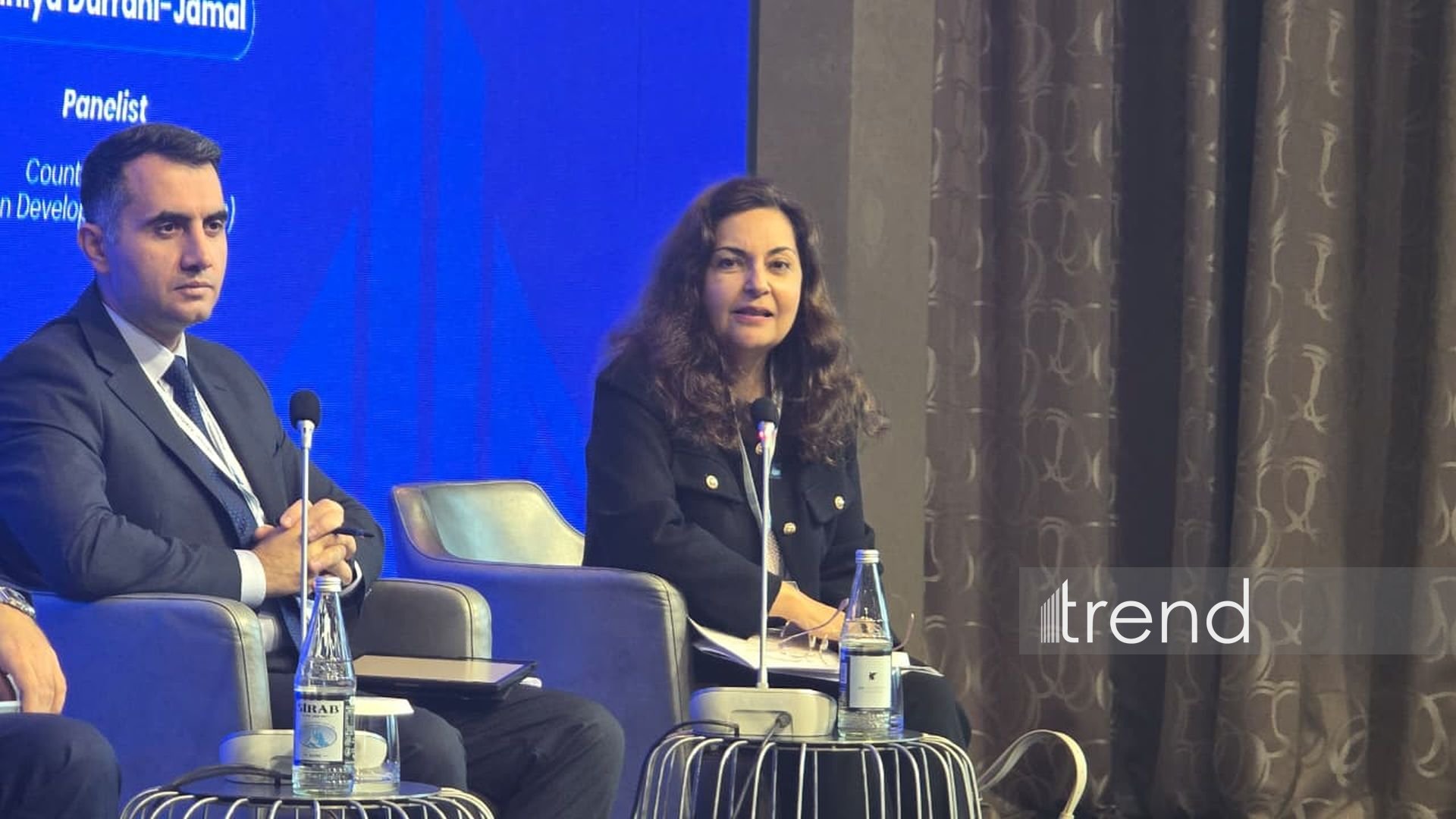

BAKU, Azerbaijan, October 6. The Asian Development Bank (ADB) is using guarantees, blended finance, technical assistance, and other innovative financial instruments to support the attraction of private investment in Azerbaijan, the Country Director for the Asian Development Bank (ADB), Sunniya Durrani-Jamal, said, Trend's correspondent reports.
She made the statement at the Azerbaijan-Germany Conference on Strategic Partnership and Connectivity in Baku today.
According to her, the ADB’s partnership strategy with Azerbaijan is aimed at supporting the government’s development priorities and promoting investment by working with various stakeholders in the ecosystem at different stages.
Durrani-Jamal noted that one example of the ADB’s activities in Azerbaijan is the project related to the development of the Shah Deniz gas field.
“About ten years ago, the government was developing the Shah Deniz gas field. At that time, the risks were assessed as very high for various reasons, including technical and commercial risks. At that stage, the Asian Development Bank provided commercial banks, including several international commercial banks, with a partial loan guarantee of approximately $500 million,” she said.
According to an ADB representative, this mechanism helped attract international investors to the project and may enable local commercial banks to participate in similar projects in the future.
She also cited renewable energy projects as another example of the ADB’s activities in Azerbaijan.
“Together with the EBRD and several other partners, we have financed some of the country’s first renewable energy projects, particularly solar energy projects,” Durrani-Jamal said.
According to her, the ADB aims to provide financing to the private sector on commercial terms. However, in the early stages of developing new sectors, mechanisms such as blended finance are used to mitigate risks.
“When it comes to a new sector, we use tools such as grant financing or technical assistance to help mitigate risks and potential risks for the first few projects. We do not lower the interest rate, but we provide additional funds that can reduce the actual costs and risks of the operations,” she said.
Sunniya Durrani-Jamal noted that the ADB is also working to promote exports and imports in Azerbaijan. She stated that the bank’s trade and supply chain finance program is collaborating with commercial banks to help small exporters and importers manage the risks they face.
“This is an area with great potential, although it does not involve direct investment. In particular, it helps establish connections between small organizations and international banks and exporters who may not be familiar with them. We use our connections to facilitate this process,” the ADB representative said.
She also noted that he views the protection of natural capital and biodiversity in the infrastructure sector as one of the new investment opportunities.
“It is very important to view investments in nature within infrastructure as real and tangible, just like investments in infrastructure projects made of concrete and brick,” Durrani-Jamal emphasized.
According to her, projects related to natural capital and biodiversity can attract concessional financing and socially significant investments. He also mentioned “green” bonds and “green” financing as tools that can be used in the development of innovative infrastructure.
The ADB’s Country Director for Azerbaijan noted that cooperation with state-owned companies is also an important component of the bank’s strategy.
“Most of the infrastructure in Azerbaijan is still being built by state-owned enterprises. Therefore, our strategy is to work with several key state-owned enterprises to help improve their corporate governance and financial performance, business strategies, as well as environmental and social performance,” she said.
S. Durrani-Jamal stated that this process could enable some state-owned companies to conduct an initial public offering (IPO) and gain access to more private capital in the future.
“In addition, we are collaborating with the Ministry of Finance, the Central Bank, and the Ministry of Economy to work on policy reforms that can help attract private investment,” the ADB representative added.



