


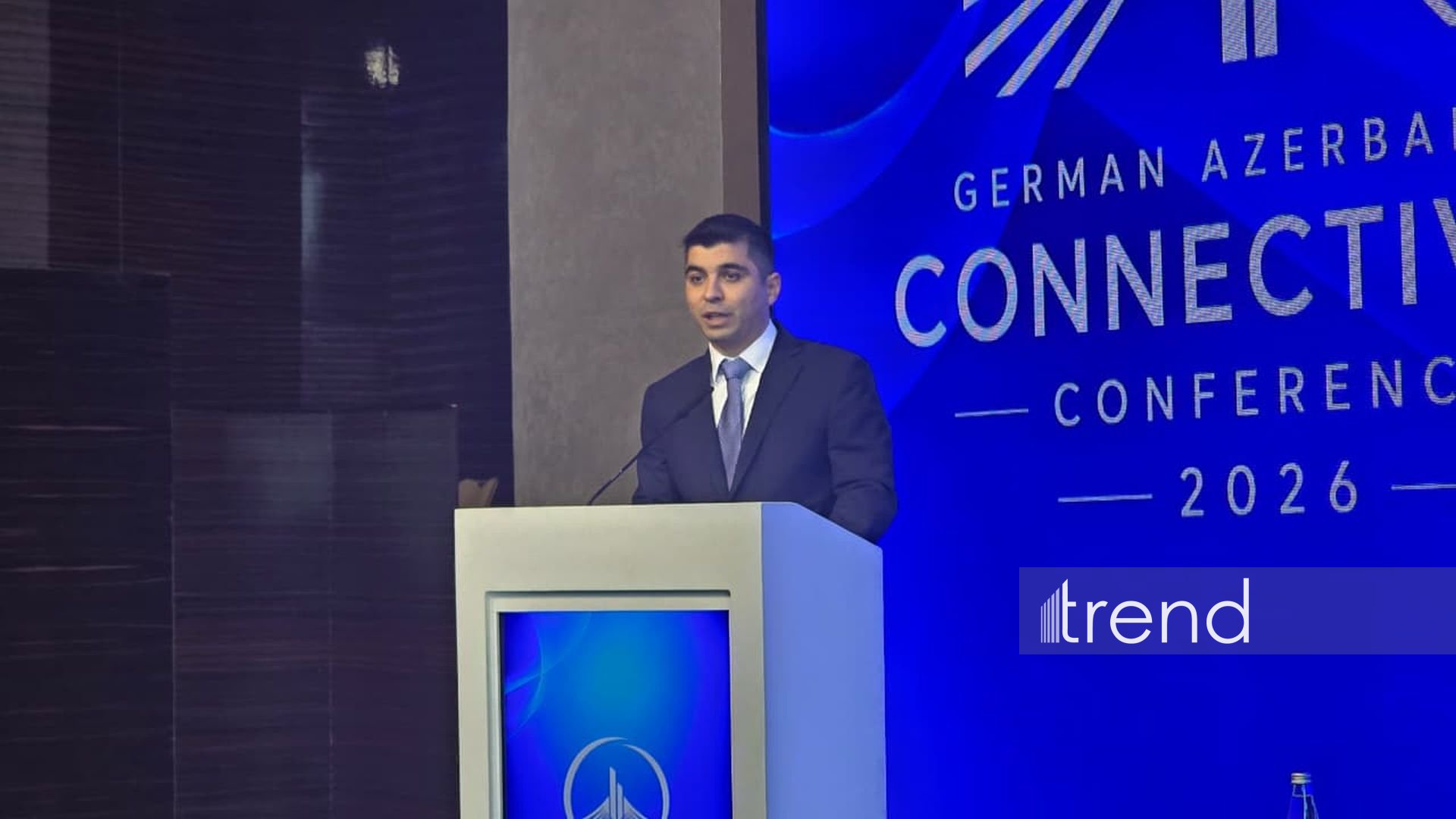

BAKU, Azerbaijan, October 6. The Trans-Caspian fiber-optic cable between Azerbaijan and Kazakhstan is scheduled to become operational by the end of 2026, the Deputy Minister of Digital Development and Transport, Rashad Hasanov, said, Trend's correspondent reports.
He made the remarks at the German-Azerbaijani Conference on Strategic Partnership and Connectivity in Baku on Tuesday.
Hasanov noted that one of Azerbaijan’s main goals in the area of digital development is to transform the country into a regional digital hub.
“To become a regional digital hub, three key factors are necessary: infrastructure, human capital, and the regulatory framework. Important work is underway in Azerbaijan in each of these areas,” R. Hasanov said.
The deputy minister also noted that one of the key elements of the digital corridor is the “Digital Silk Road” fiber-optic route, which will connect Asia and Europe.
“The main component of this project is a fiber-optic cable approximately 380 kilometers long, running along the bottom of the Caspian Sea between Sumgait and Aktau. The cable reached the coast of Kazakhstan in August and is scheduled to be put into operation by the end of this year,” he said.
R. Hasanov emphasized that computing power and energy supply are of particular importance for the development of artificial intelligence.
“For decades, we have exported energy via pipelines. Now, computing capabilities allow us to transform energy into an exportable digital service,” the deputy minister noted.
According to him, work is underway to establish an artificial intelligence data center in the “Alat” Free Economic Zone, and negotiations with international partners are in the final stages.
“The data center is intended to serve not only Azerbaijan but the entire region,” R. Hasanov said.
The deputy minister noted that human capital is another key component of digital development.
“Sustainable infrastructure requires people with the necessary skills. In this regard, our cooperation with Germany is also proving its worth. We have established the ASCON School of Engineering and Technology in partnership with Azerbaijan Technical University and the Technical University of Munich. The model used here is well known to German companies: classroom theory combined with hands-on training in the workplace. In the coming years, we plan to transform this joint program into a dual-degree program,” he noted.
R. Hasanov emphasized that new opportunities have opened up for companies operating in the technology sector and for highly qualified specialists.
“Parliament recently adopted a package of tax and immigration reforms for the technology sector, as well as new laws on venture capital and crowdfunding,” the deputy minister said.
He noted that starting in January 2027, companies operating in the fields of digital technologies, artificial intelligence, and cybersecurity in Azerbaijan will be exempt from income tax and dividend tax for up to 20 years.
“Opportunities are also being created for highly qualified specialists to relocate to Azerbaijan. Such specialists will be exempt from income tax, and income earned abroad will be subject to a 20-year tax exemption,” R. Hasanov added.
The deputy minister stated that Azerbaijan intends to attract leading Western technology companies to establish their regional offices in the country.
“We want leading Western technology companies to choose Azerbaijan as their regional hub. A broader ecosystem can develop around these companies. We would also like German companies to become part of this ecosystem,” he emphasized.
R. Hasanov noted that Azerbaijan attaches great importance to attracting not only capital through international partnerships, but also technology, management expertise, and knowledge transfer.
“Our geographic location has given us this route. What we build along it, both physically and digitally, will determine the value of this route for us. The Middle Corridor will transport your cargo, and the Digital Corridor will transport your data. Starting in January, our regulations will make it easier for your companies to operate in Azerbaijan,” the deputy minister added.



