


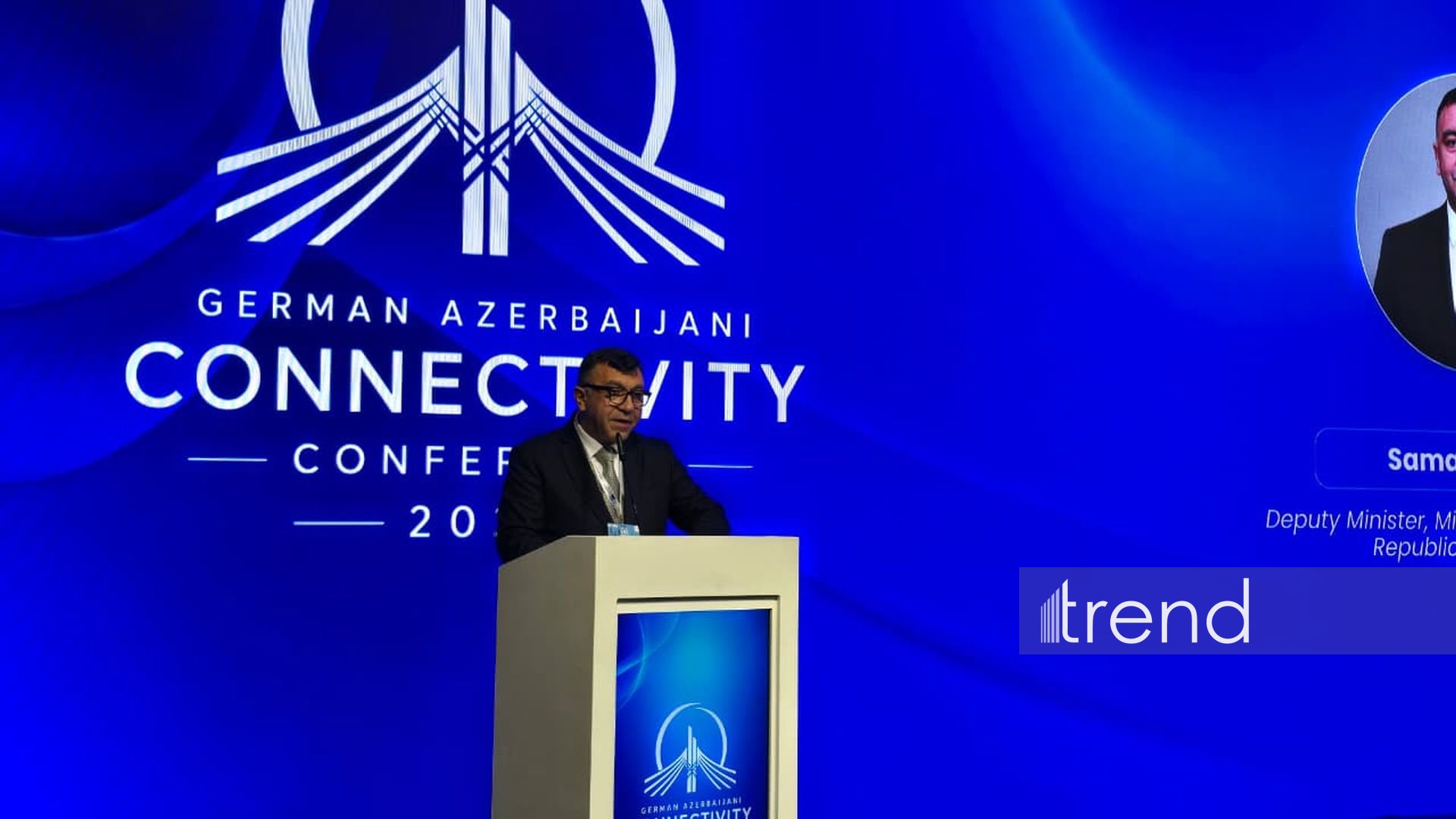

BAKU, Azerbaijan, October 6. Azerbaijan invites German companies to build regional production plants, Deputy Minister of Economy Samad Bashirli said at the German-Azerbaijani Strategic Partnership and Connectivity Conference held in Baku on Tuesday, Trend's correspondent reports from the event.
According to him, Azerbaijan should be viewed by German companies not merely as a market of 10 million people, but as a platform for investment and technology cooperation spanning the Caspian region, Central Asia, and the South Caucasus.
He noted that efforts to strengthen business ties between Azerbaijan and Germany are supported by high-level political dialogue.
"Today's conference takes place following a significant milestone in our bilateral relations. High-level meetings and substantive discussions were held during President Ilham Aliyev's official visit to Berlin in July. During the visit, a Joint Declaration on the strategic agenda for bilateral partnership was signed, and an agreement was reached to establish the Azerbaijan-Germany Business Council," said Bashirli.
According to the deputy minister, Azerbaijan is working with the German side to translate political momentum into concrete projects and to secure the necessary financing for their implementation.
"We plan to visit Germany in early November to advance specific initiatives currently under discussion and to hold the inaugural meeting of the Azerbaijan-Germany Business Council," he pointed out.
Bashirli emphasized that Germany is regarded as a key industrial partner in the development of Azerbaijan's priority sectors.
"Our proposal to German companies is simple: establish a presence in Azerbaijan, but manufacture for the wider region," the deputy minister noted.
According to him, this approach enables German manufacturers to process raw materials from Central Asia in Azerbaijan and supply products to markets in Türkiye and Europe. Logistics facilities, terminals, and digital services along the route also offer opportunities for private investment.
The deputy minister highlighted the crucial role of connectivity in Azerbaijan's economic cooperation with Germany.
"We view connectivity in terms of the movement of goods, energy, data, and capital. Integrating these flows can transform transport routes into economic corridors that support regional production, services, and investment," Bashirli explained.
He also said that Azerbaijan's goal is to ensure that connectivity generates additional economic value, rather than serving merely as a transit opportunity.
According to Bashirli, the Alat Free Economic Zone, located along the Middle Corridor adjacent to the Baku International Sea Trade Port, provides a platform for investment with a distinct legal and regulatory framework.
"Our goal is not merely to facilitate transit, but to ensure that this connectivity generates value. The Alat Free Economic Zone offers opportunities for investments that create high added value and target export markets," he emphasized.
The deputy minister also highlighted the expansion of cooperation in the green energy sector. He noted that the Green Energy Corridor being developed jointly with Kazakhstan and Uzbekistan, as well as the planned Caspian-Black Sea-Europe corridor, creates new opportunities for cooperation in the field of renewable electricity.
"These projects create opportunities for German companies in areas such as electricity generation and transmission, infrastructure, and energy-intensive industries," Bashirli said.
He added that the Trans-Caspian Fiber-Optic Cable project would also serve to strengthen digital connectivity between Europe and Asia. According to him, establishing an additional route for high-capacity data transmission across the Caspian Sea will enhance the resilience of regional communication networks and reinforce Azerbaijan's role as a digital transit hub.
Bashirli mentioned that reliable power supplies for high-capacity digital connections, combined with growing renewable energy potential, could attract investments in data centers, high-performance computing, and artificial intelligence infrastructure.
"We are collaborating with international partners, including Oracle, Dell Technologies, and bp, to expand these opportunities," the deputy minister noted.
He stressed that for Azerbaijan, artificial intelligence is not a standalone sector but a horizontal platform that boosts productivity across various areas of the economy.
"For us, artificial intelligence is not a separate sector. It's a horizontal platform that enhances productivity in manufacturing, logistics, agribusiness, tourism, and export services," Bashirli said.
The deputy minister added that, under the Strategy for the Development of the Digital Economy in Azerbaijan for 2026–2029, plans are in place to support the digital transformation of up to 300 companies by 2030 through the adoption of Industry 4.0 technologies. Concessional loans and other support mechanisms will be utilized to achieve this. S. Bashirli noted that a clear investment model is needed to develop connectivity on this scale. According to him, the public sector creates a favorable environment, core infrastructure establishes initial demand and mitigates risks, while private capital scales up successful projects.
The deputy minister also noted that the High-Level Working Group on Trade and Investment between Azerbaijan and Germany has established a clear framework and strategic direction for economic cooperation. According to him, the working group has established a clear framework and strategic direction for economic cooperation. According to him, the working group's last meeting, held in September of last year, gave new impetus to the dialogue between the parties and contributed to advancing shared priorities.



