


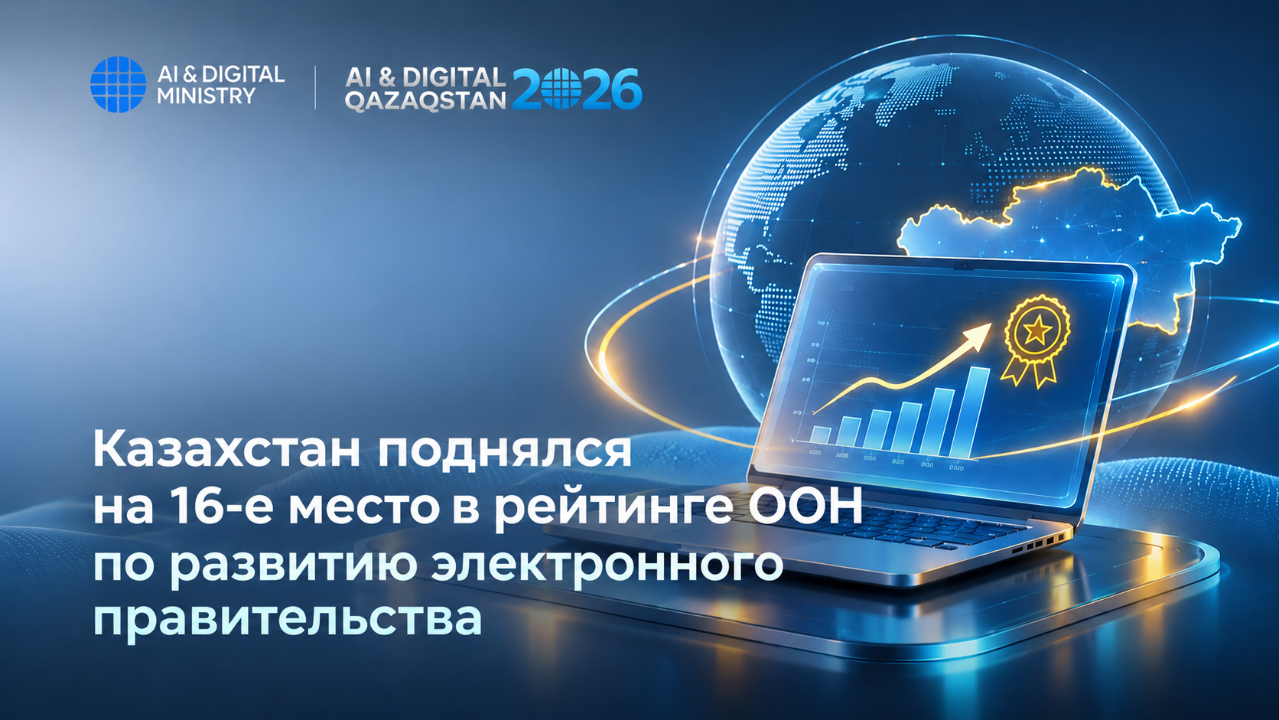

BAKU, Azerbaijan, November 20. Kazakhstan has climbed from 24th to 16th place in the United Nations E-Government Development Index (UN EGDI), entering the highest rating category for the first time, according to the country's Ministry of Artificial Intelligence and Digital Development.
Kazakhstan improved its position by eight places over two years, with the UN describing the progress as one of the most significant among leading countries. It has become the first country in Central Asia to enter the highest rating category.
The highest rating category comprises 21 countries with the world's most advanced e-government systems. Kazakhstan is now in the same group as South Korea, Denmark, Singapore, the United Kingdom, Estonia, and the United States. In 2026, only three countries - Kazakhstan, Ireland, and Poland - entered this category for the first time.
Over the past two years, Kazakhstan has overtaken Sweden, Germany, Ireland, New Zealand, Austria, and Japan, all of which ranked ahead of it in 2024. The country's EGDI score increased from 0.9009 to 0.9363, compared with the global average of 0.6675.
Kazakhstan has also narrowed its gap with Estonia, widely regarded as a benchmark for digital government, fourfold over the same period. It retained its leading position among CIS and Central Asian countries. In the global ranking, Uzbekistan placed 32nd, Azerbaijan 38th, and Russia 50th.
The improvement was driven by progress across all key components of the index. The UN highlighted significant advances in connectivity: Kazakhstan rose from 41st to 13th globally in terms of mobile and internet accessibility. Its telecommunications infrastructure indicator also reached the level of Estonia.
Digital literacy also improved, increasing by approximately 1.5 times, while Kazakhstan advanced from around 42nd to 28th place in education and skills. The country's legal framework for digital government received the highest UN assessment.
The UN report identified Central Asia as one of the major success stories of 2026. Kazakhstan's eGov.kz ecosystem and eGov Mobile application were highlighted as examples of an integrated digital government, while the international artificial intelligence centre alem.ai was recognized as a platform for education, research, startups, and applied AI development.
According to UN experts, Kazakhstan continues to strengthen its position by building on an already advanced digital foundation. The country's progress is based not on individual websites but on an integrated system combining government interaction platforms, digital identification, mobile services, and public service centres.
More than 90 percent of public services in Kazakhstan are now available online, with government services accessible to most citizens through their smartphones, the ministry noted.
The eGov.kz portal has more than 16.4 million registered users. In January-October 2026 alone, more than 51 million public services were provided through the e-government system, with nearly two-thirds accessed by citizens via smartphones.
Kazakhstan has also established a legal framework for its emerging digital economy. The Digital Code, which comprehensively establishes citizens' digital rights for the first time, has been adopted, while the Law on Artificial Intelligence has entered into force.
Kazakhstan is also expanding its technological capabilities. The international artificial intelligence centre alem.ai has been opened, while the country's supercomputer has entered the list of the world's 100 most powerful computing systems, according to the TOP500 ranking.


