


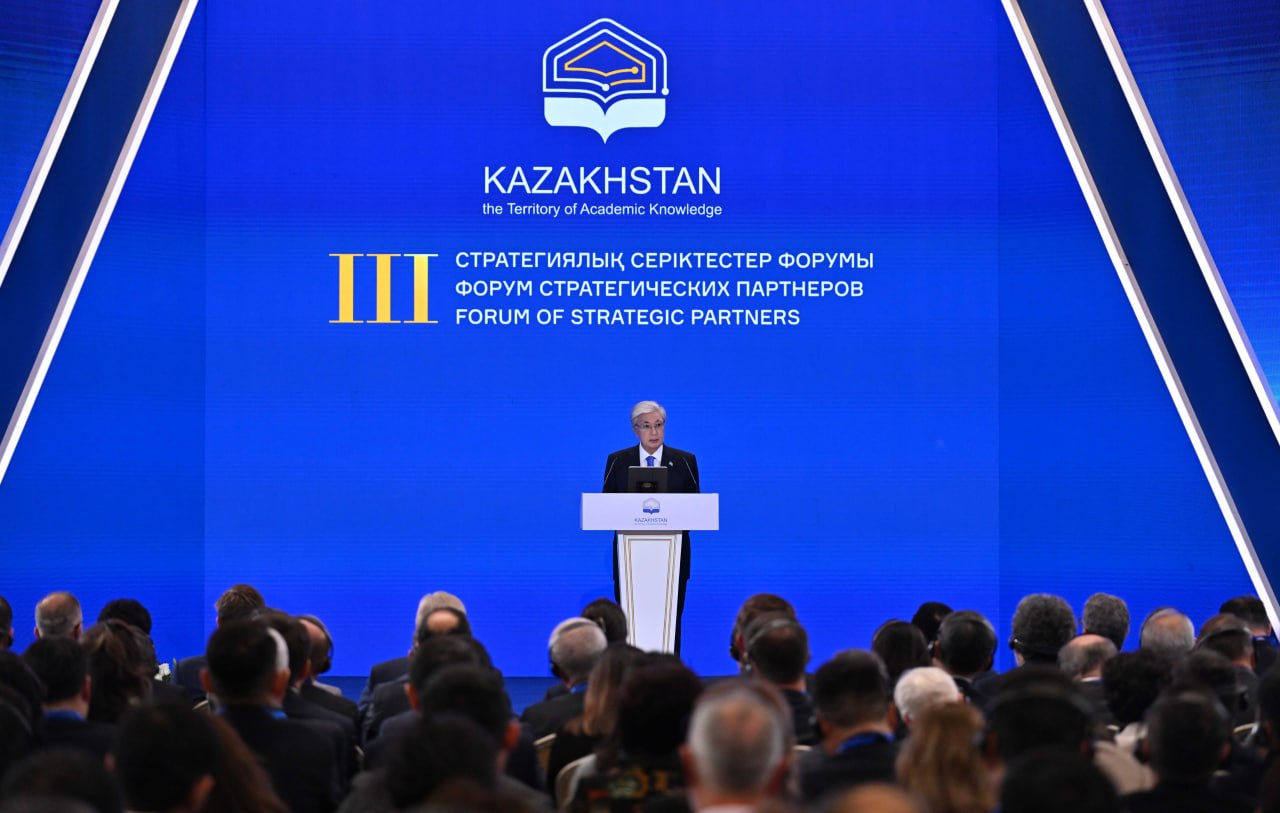
BAKU, Azerbaijan, November 19. Kazakhstan aims to become an academic hub in Central Asia and strengthen its position in the global knowledge market, Kazakh President Kassym-Jomart Tokayev said, according to the press service of the President of Kazakhstan.
Addressing the 3rd Strategic Partners Forum in Astana, Tokayev highlighted the progress made by Kazakh universities in international rankings, noting that 18 domestic universities had been included in the QS World University Rankings 2026, while 10 Kazakh universities had entered the Times Higher Education World University Rankings 2027.
He also pointed to Kazakhstan's continued progress in the Global Innovation Index 2026, where the country recorded the highest results in the region.
"Under conditions of global competition, however, we cannot afford to rest on our laurels. Kazakhstan is committed to strengthening its position as a regional center for higher education, science and international academic cooperation.
Our strategic goal is to turn Kazakhstan into an academic hub of Central Asia and become part of the global knowledge market, offering relevant and high-quality knowledge.
Science and education are no place for rote learning, formalism and, ultimately, self-deception," he said.
Tokayev said that the first stage of organizational work to establish the academic hub had essentially been completed. Kazakhstan has built productive partnerships with leading educational institutions worldwide, opened branches of several foreign universities and launched the modernization of its educational, scientific and innovation infrastructure.
He noted that the branch of Lomonosov Moscow State University had been successfully operating in Kazakhstan for many years, serving as a platform for effective scientific and educational cooperation between Kazakhstan and Russia. The branch recently marked its 25th anniversary, and a new academic building was handed over to it for the occasion.
Last year, a branch of the Moscow State Institute of International Relations (MGIMO) opened in Astana. It has begun training specialists at the intersection of diplomacy, economics and digital technologies, while a new building for the institute is under construction in the Kazakh capital.
The president also highlighted several other international academic partnerships. Under the cooperation between M. Kozybayev North Kazakhstan University and the University of Arizona, a modern academic and laboratory building and a dormitory have already been built. This year, the first graduates of joint educational programs received dual degrees from Kazakh and US universities.
A branch of Cardiff University has also opened in Kazakhstan, becoming the British university's first international campus.
Meanwhile, campuses are being built or expanded for Coventry University, the National Research Nuclear University MEPhI, Beijing Language and Culture University, and China's Northwestern Polytechnical University.
Tokayev said that training for specialists in the nuclear industry, artificial intelligence, and creative industries was being developed in the country's largest cities. At the same time, he stressed the importance of making world-class education accessible in other regions of Kazakhstan.
"That is why the location of foreign university branches takes into account the sectoral specialization and workforce needs of the regions," he said.
The president expressed gratitude to international partners for helping Kazakhstan establish a solid foundation for academic cooperation.
"Now I have set the task of retaining world-class knowledge in Kazakhstan in the form of qualified personnel, scientific achievements and innovations.
At the second stage of developing the academic hub, we plan to focus on active scientific cooperation, the establishment of joint research laboratories and the implementation of breakthrough technological projects.
In this regard, we are paying particular attention to creating the most favorable conditions for leading foreign universities and expanding international cooperation in science and research," Tokayev said.


