


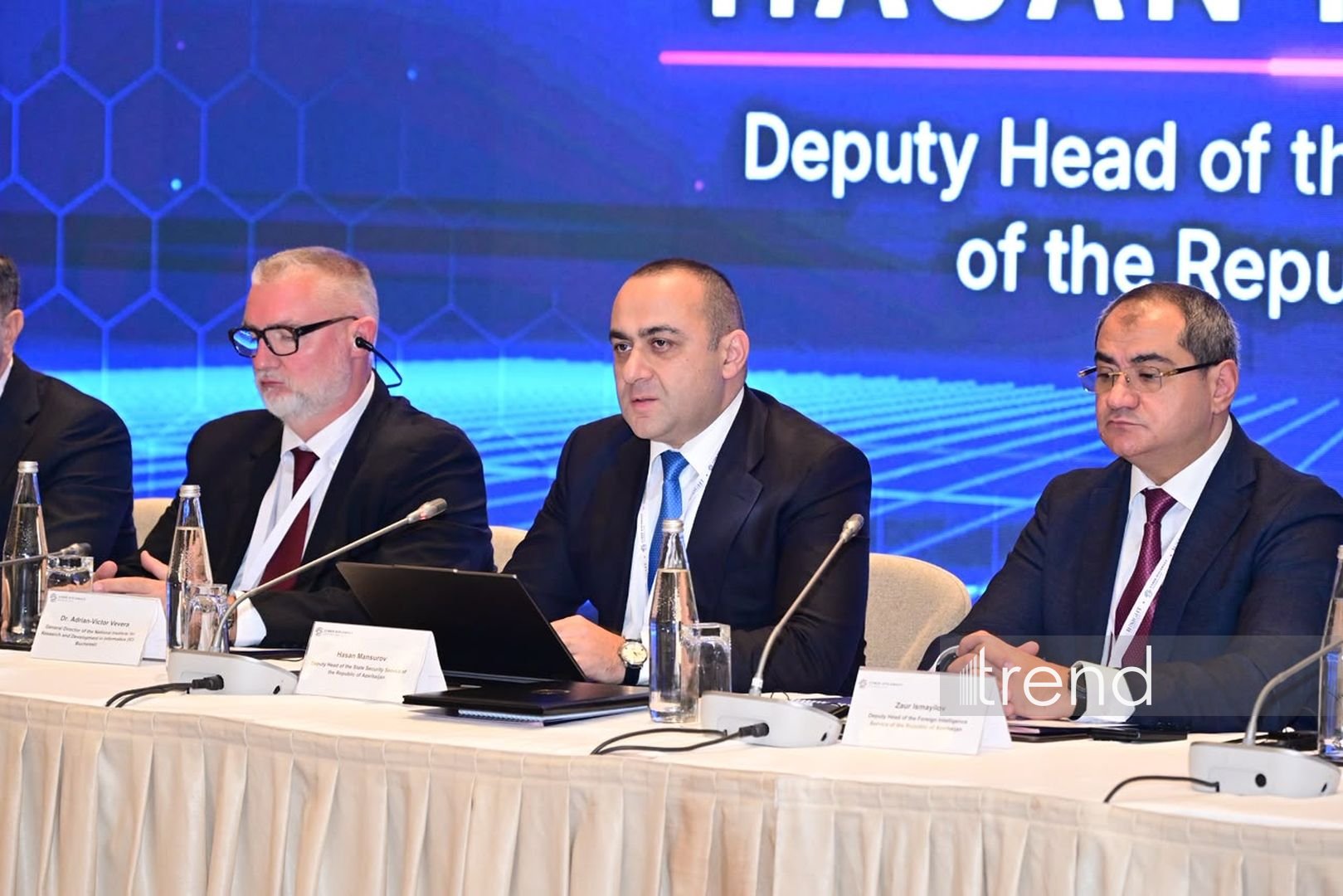

BAKU, Azerbaijan, November 19. Strengthening international cooperation against cyber threats, protecting critical information infrastructure and promoting the safe use of artificial intelligence should be among the key priorities of cyber diplomacy, Deputy Head of Azerbaijan's State Security Service Hasan Mansurov said, Trend's correspondent reports.
He made the remarks at the opening ceremony of the 2nd International Conference on Cyber Diplomacy in Baku.
Mansurov said the international relations system was undergoing a profound transformation. Global geopolitical developments, advances in digital technologies and the expanding use of artificial intelligence are significantly changing countries' security environments, economic potential and instruments of international influence.
"The world is only at the beginning of unprecedented cyber transformations," he said.
According to Mansurov, while power in international relations has traditionally been measured in terms of military, economic and political capabilities, control over information resources, technological capacity, the resilience of digital infrastructure and the protection of national interests in cyberspace have also become strategically important.
The deputy head of the State Security Service noted that the nature of cyberattacks was changing, with energy infrastructure in various countries increasingly coming under large-scale cyberattacks.
He cited an incident in a European country in October this year, when a cyberattack targeting the government's digital services reportedly involved around 11 million requests and resulted in the unauthorized acquisition of data associated with nearly 750,000 personal identification numbers.
Mansurov also said that some Azerbaijani information resources, particularly those in the gov.az domain, had recently been targeted by DDoS and other cyberattacks.
"Such incidents demonstrate that cyber threats can have real consequences for national security," he stressed.
He said cyber and technological capabilities had become instruments of geopolitical pressure, while geopolitically motivated cyberattacks had become commonplace. According to international survey reports, 64 percent of organizations factor geopolitically motivated cyberattacks into their risk strategies.
Mansurov noted that advances in artificial intelligence were accelerating these changes. Countries with limited access to AI technologies, computing resources and data infrastructure risk becoming increasingly dependent on foreign technology platforms.
At the same time, he said, complete technological independence was not a realistic option. The practical solution was to establish reliable mechanisms for global partnerships.
He also pointed out that technology companies were no longer merely market players. Some decisions shaping the global cyber environment were now being made not in national capitals, but in technology companies' offices and, in some cases, on the darknet.
The deputy head of the State Security Service stressed that, in the age of artificial intelligence, regional security was no longer defined solely by geographical borders and traditional military capabilities. Energy systems, transport corridors, telecommunications networks, financial infrastructure and digital government services were becoming increasingly interconnected.
He said Azerbaijan occupied an important position in energy, transport and communication links connecting Europe and Asia. The cybersecurity of this infrastructure could affect not only Azerbaijan's national interests, but also international energy supplies, trade and economic ties.
Mansurov noted that the Cybersecurity Operations Center of the State Security Service, also known as the National Cyber Center, was carrying out its responsibilities for protecting critical information infrastructure under a presidential decree dated April 17, 2021.
He added that Azerbaijan continued to focus on information exchange concerning cyber incidents, building mutual trust between states and developing rapid communication mechanisms.
Mansurov also spoke about international efforts to establish norms for responsible state behavior in cyberspace.
He recalled that in 2015, the UN Group of Governmental Experts had agreed on 11 voluntary norms for responsible state behavior in cyberspace. This dialogue is continuing within the UN Global Mechanism, which began its work this year.
According to Mansurov, the international cyber diplomacy conferences held in Baku demonstrate Azerbaijan's potential to contribute to this field.
He noted that Azerbaijan was among the first countries to ratify the UN Convention against Cybercrime, in the drafting of which it had actively participated. He also described the country as one of the initiators of cybersecurity regulatory initiatives.
Mansurov further said that Azerbaijan was currently the only country to have ratified both the UN and Council of Europe conventions on cybercrime.
"Azerbaijan's experience in bridge diplomacy has become a unique point of reference internationally, and this also extends to cyber diplomacy," he said.
He stressed that the main challenge in cyberspace today was not so much the lack of rules as the difficulty of enforcing them. The effectiveness of diplomacy, he said, should be measured by practical results rather than declarations.
The deputy head of the State Security Service said particular attention should be paid to attributing cyberattacks. Attackers conceal their tracks and route operations through the electronic infrastructure of multiple countries, while artificial intelligence makes this process even more complicated.
He warned that insufficient cyber diplomacy mechanisms increased the risk of countries making misguided decisions against one another.
Citing international reports, Mansurov said some cyberattacks were already being carried out largely by artificial intelligence, with the management of cyber operations gradually being handed over to AI systems.
"Cyberattacks take place within minutes, while diplomatic responses take weeks. Closing this gap is a new task for cyber diplomacy," he said.
Mansurov added that global forecasts offered little reassurance, as cyber risks were increasing faster than defensive capabilities.
He also highlighted the emerging risks associated with quantum technologies. Encrypted data is already being collected and stored with the aim of decrypting it using next-generation computers in the future. For this reason, international standardization bodies are recommending that the transition to post-quantum cryptography begin now.
"Today's encrypted secrets in cyberspace will become tomorrow's open book," he said.
Mansurov also drew attention to the new risks posed to diplomatic relations by generative AI, deepfake technologies and automated information operations. He said individuals and legal entities alike could increasingly find themselves having to deal with deepfakes in their daily lives.
He noted that Azerbaijan's strategy in this area covered technological development, infrastructure building, improvements to governance and the strengthening of professional expertise.
Referring to Azerbaijan's Victory Day celebrations, Mansurov said that the country's diplomacy, following the full restoration of its territorial integrity and sovereignty, was now contributing to an agenda of peace and cooperation across a wider region.
"Azerbaijan is a carrier of international diplomacy whose reach extends far beyond its geographical and demographic size," he said.
The deputy head of the State Security Service emphasized that the main mission of cyber diplomacy was to channel the opportunities created by technological progress into strengthening international security.
He outlined three key priorities in this regard.
The first is to improve the timely exchange of information on cyber threats and mechanisms for cooperation between states.
The second is to ensure the security of critical information infrastructure and develop international partnerships for the safe use of artificial intelligence.
The third is to encourage all countries to participate more actively and on an equal footing in shaping global cybersecurity rules.
Concluding his remarks, Mansurov stressed that the ultimate goal should go beyond simply addressing existing problems.
"The most important task is not only to solve problems, but also to create an environment in which they do not arise," he said.


