


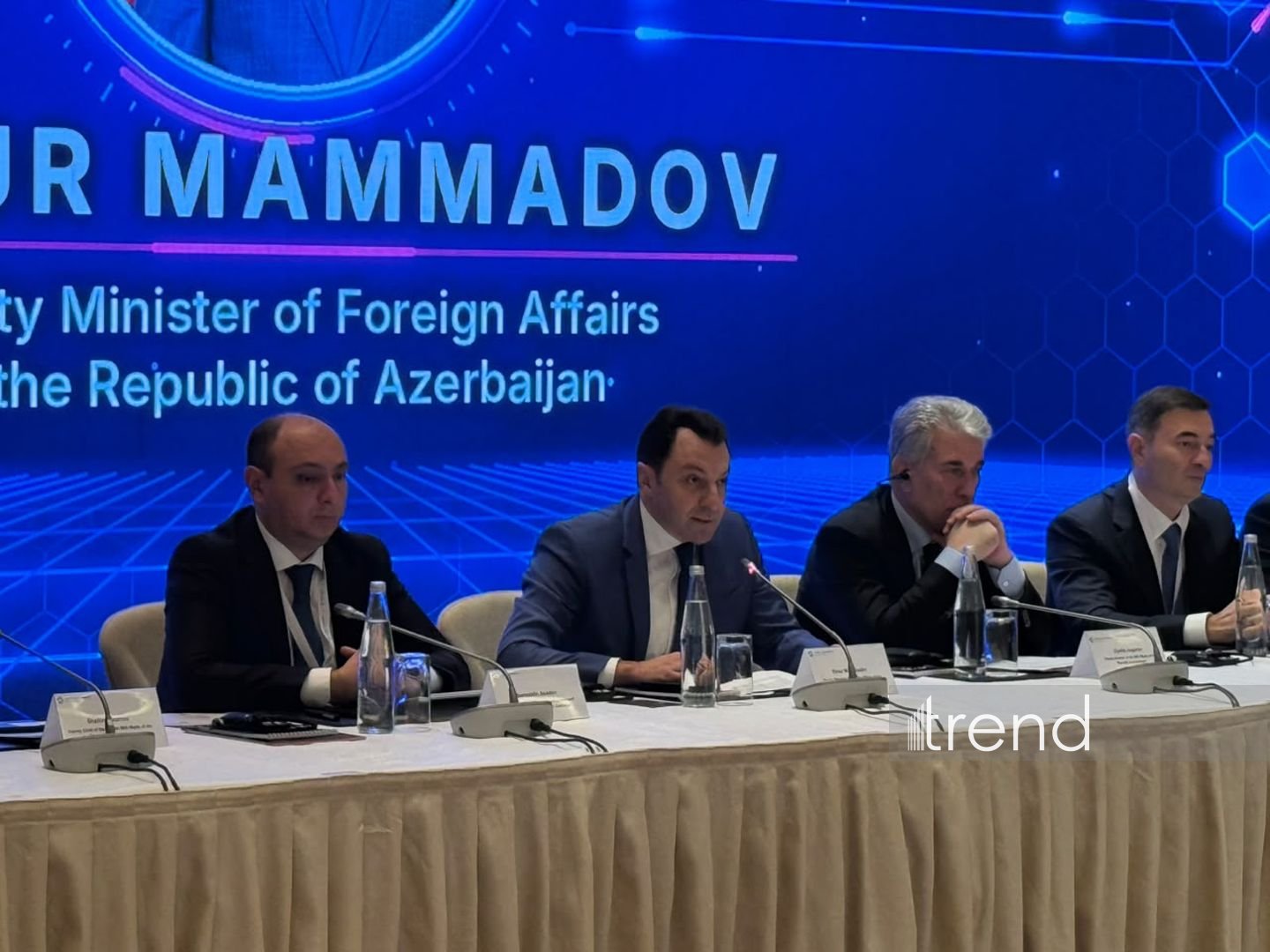

BAKU, Azerbaijan, November 19. Artificial intelligence is enabling cyberattacks to be carried out at greater speed and scale, making more agile early-warning and information-sharing mechanisms between states increasingly important, Azerbaijan's Deputy Foreign Minister Elnur Mammadov said, Trend's correspondent reports.
He made the remarks at the opening ceremony of the 2nd International Conference on Cyber Diplomacy in Baku.
He noted that artificial intelligence offers significant opportunities for innovation, development and stronger cyber defense. At the same time, the key challenge is to make effective use of these opportunities while addressing the associated risks.
According to Mammadov, one of the major challenges today is the creation of convincing fake content, including deepfakes. Voice cloning, video manipulation and the fabrication of false statements attributed to government officials make it essential to verify the authenticity of information in diplomatic communications.
He noted that three foreign ministers were among the targets of an impersonation campaign in June 2025 that used AI-generated voice messages.
"This shows why verifying who is speaking has become an essential part of diplomatic communication," he said.
Mammadov stressed that fabricated content can heighten political tensions, undermine negotiations and weaken public support for international cooperation. Even after a fake is exposed, the mistrust it creates can have lasting consequences, he added.
He also pointed out that artificial intelligence enables malicious actors to carry out cyber operations more rapidly and on a larger scale.
According to CrowdStrike's 2026 Global Threat Report, attackers in observed cybercrime intrusions in 2025 took an average of just 29 minutes to move beyond the initially compromised system. The fastest recorded instance took only 27 seconds.
"These figures show how little time defenders may have to respond," Mammadov said.
According to him, this situation exposes a serious gap: the speed at which cyberattacks are carried out can far exceed the speed at which states share information about them. Attackers may exploit vulnerabilities before warnings have passed through verification procedures.
Mammadov said closing this gap should be a practical priority. Early warnings must reach partners while there is still time to take protective measures.
He outlined three key priorities for action in this regard.
The first is establishing reliable and functional communication channels before a crisis occurs. According to Mammadov, diplomatic contacts and national computer incident response teams should be connected through secure mechanisms that are regularly tested.
He said the UN Global Intergovernmental Points of Contact Directory provides one possible foundation for this purpose. He emphasized that these communication channels should remain open even during periods of strained broader political relations.
The second priority is agreeing in advance on procedures for rapid information sharing. States should determine beforehand what information can be shared, with whom and under what safeguards, he noted.
"Early warnings can identify a threat and recommend protective measures while clearly indicating what remains uncertain. Sharing such a warning should not have to wait for a final assessment of who is responsible," Mammadov said.
The third priority is building trust through regular cooperation. According to him, joint exercises, expert exchanges and direct engagement with technology companies can turn formal commitments into practical working relationships.
Mammadov stressed that states would be more willing to share information if they were confident that it would be protected, used responsibly and acted upon appropriately.
He also highlighted the important role of regulation in this process. The European Union's Artificial Intelligence Act, including its provisions on transparency requirements, the labeling of AI-generated content and the disclosure of deepfakes, is a relevant example, he said.
According to Mammadov, such approaches should be supported by cross-border cooperation, engagement with technology providers and efforts to raise public awareness.
He said capacity-building was equally important, emphasizing that countries with limited resources should also be able to participate effectively in international cooperation, receive early warnings and take timely action.
Mammadov also outlined Azerbaijan's commitments in the field of cybersecurity. He said the country was strengthening its national cyber resilience under its Information Security and Cybersecurity Strategy for 2023–2027.
"Azerbaijan was also among the first countries to sign and ratify the United Nations Convention against Cybercrime and is a party to the Budapest Convention," he emphasized.
He added that Azerbaijan had actively participated in the UN Open-Ended Working Group on the security of and in the use of information and communications technologies and welcomed the adoption of the group's final report by consensus.
Mammadov said Azerbaijan supported continuing this dialogue through the newly established global mechanism, which provides an important platform for strengthening trust and advancing inclusive cooperation.
"These commitments reinforce our call for practical cooperation, timely information sharing and stronger collective resilience. Artificial intelligence is accelerating the threats we face. We must bring the same urgency to building trust, sharing information and preserving the cooperation on which our common security depends," he said.


