


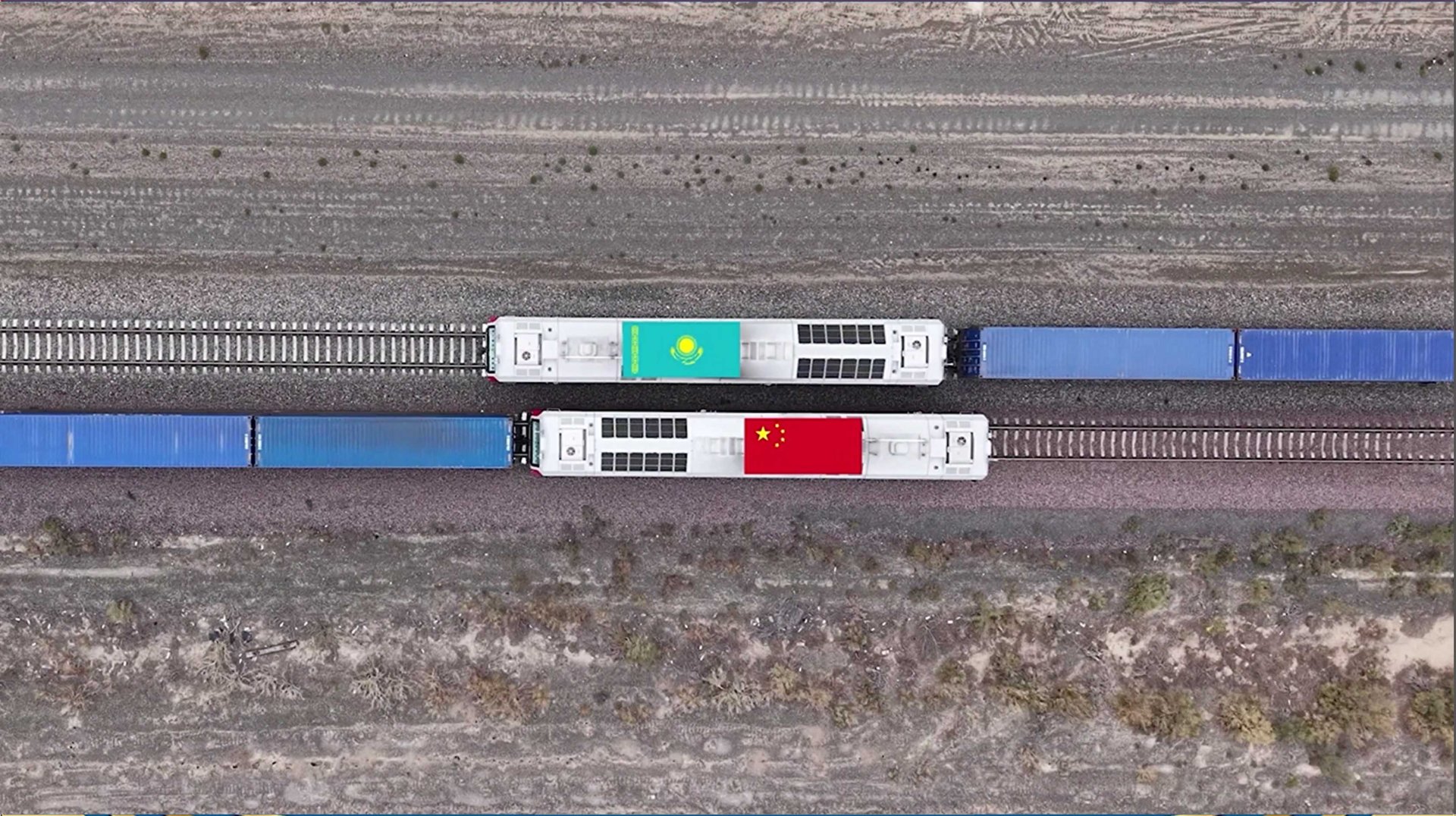

BAKU, Azerbaijan, November 19. Kazakhstan is constructing the 303-kilometer Bakhty-Ayagoz railway, a project expected to strengthen transport connectivity in the country's eastern regions and expand rail links with China. Construction began in 2023, with the railway scheduled for completion and commissioning in 2027. Bakhty is located in the Abai Region in eastern Kazakhstan, on the border with China's Xinjiang Uyghur Autonomous Region, while Ayagoz lies further west within the same region. Although Bakhty already has a road border crossing, the new railway is expected to broaden the region's transport capacity and connectivity.
A key outcome of the project will be the establishment of a third railway crossing on the Kazakhstan-China border, complementing the existing Dostyk and Altynkol crossings. In July 2026, construction also began on a multimodal dry port and logistics park in Bakhty. According to estimates, the new hub will add 20-25 million tons of annual cargo-handling capacity at the Kazakhstan-China border, helping to ease pressure on existing crossings.
The terminal is designed to handle up to 1 million containers annually, with a target of reaching an annual throughput of 700,000 containers by 2032. This capacity is expected to accommodate further growth in cargo turnover as the logistics complex develops. The facility will comprise container and grain terminals, warehouses, customs and logistics infrastructure, a road terminal and service facilities, as well as bonded warehouses covering up to 50,000 square meters.
The development of an additional border crossing is supported by the steady growth in freight traffic between Kazakhstan and China. At present, rail transportation between the two countries operates along two routes: Dostyk-Alashankou and Altynkol-Khorgos. In January-October 2026, bilateral freight traffic reached 31.8 million tons, an 8% increase from 29.4 million tons recorded in the same period of 2025.
Freight volumes increased in both directions. Shipments from China to Kazakhstan totaled 12.1 million tons, up 9% year-on-year. Of this amount, 5 million tons passed through Dostyk, representing a 13% increase, while 7.1 million tons were transported through Altynkol, up 6%.
Cargo flows in the opposite direction were considerably larger. Shipments from Kazakhstan to China reached 19.7 million tons, an increase of 8% compared with the same period a year earlier. Dostyk handled 13.1 million tons, up 12%, while 6.6 million tons passed through Altynkol, representing a 1% increase.
The figures highlight two notable features of bilateral rail freight flows. First, shipments from Kazakhstan to China substantially exceed those moving in the opposite direction, reaching 19.7 million tons compared with 12.1 million tons. Second, freight flows from Kazakhstan to China are concentrated primarily at Dostyk, which accounts for approximately two-thirds of the total volume transported in this direction.
Second, freight growth rates at the two existing crossings differ considerably. In particular, export traffic through Altynkol increased by just 1%, compared to 12% through Dostyk. The increase in traffic through Dostyk may be partly related to the launch of the second Dostyk-Moyynty railway line on September 30, 2025, which expanded the capacity of the railway network along this route.
Trade turnover between Kazakhstan and China is also increasing. According to the Bureau of National Statistics of Kazakhstan, bilateral trade exceeded $26.9 billion in January-September 2026, up 8.9% compared to the same period in 2025, when the figure stood at $24.7 billion.
Against this backdrop, the construction of the Bakhty-Ayagoz railway will allow Kazakhstan to diversify its rail routes along the border with China and establish an additional channel for cargo transportation. Amid growing bilateral trade and increasing rail freight volumes, a third crossing could make the transport system more flexible and reduce dependence on the two existing routes.
The significance of the project goes beyond the development of rail links between Kazakhstan and China. The new Bakhty-Ayagoz line will become an additional component of the Middle Corridor (Trans-Caspian International Transport Route, TITR), whose role in Eurasian logistics continues to grow.
According to Kazakhstan's Ministry of Transport, freight traffic along the TITR increased by 30% in January-September 2026, while transit container traffic along the China-West route rose by 64%. According to World Bank estimates, freight volumes along the TITR could increase 3.6 times by 2040, provided that countries continue making strategic investments along the corridor.
At the same time, Kazakhstan is working to expand capacity along the western section of the route. In October, Kazakhstan and Azerbaijan signed an intergovernmental agreement on the development of the TITR. The document is aimed at strengthening transport and logistics cooperation between the two countries, improving freight transportation efficiency, and further developing the route's transit potential.
The agreement provides for mutual commitments to ensure the necessary capacity of the TITR and maintain stable transportation tariffs. This is expected to make freight transportation conditions more predictable and increase the route's attractiveness to shippers.
In November, Kazakhstan and Azerbaijan signed agreements under the Caspian Bridge project, which envisages integrating ferry services into the railway system. The project concept provides for transportation of at least 8 million tons of cargo per year, with the potential to increase capacity to 10-12 million tons. The parties also agreed on the terms for establishing a joint intermodal freight terminal at the Port of Alat in Baku.
European partners are also showing interest in the development of the Middle Corridor. On November 17, during a working visit to Brussels, Kazakhstan's Foreign Minister Mukhtar Tleuberdi held talks with Belgium's Deputy Prime Minister and Minister of Foreign Affairs Maxime Prévot. During the meeting, the Belgian side expressed interest in having Belgian companies participate in projects related to the development of the TITR.
Kazakhstan is also interested in integrating the Middle Corridor with the TRIPP route (Trump Route for International Peace and Prosperity), as Tokayev has stated on several occasions.
Taken together, these projects form part of Kazakhstan's broader transport and logistics strategy aimed at turning the country into one of Eurasia's leading transport hubs. Within this framework, the new railway crossing with China will become an important component of the eastern route, providing additional capacity for bilateral trade and transit traffic. Meanwhile, the development of the Middle Corridor, stronger cooperation with Azerbaijan, and the expansion of port and ferry infrastructure are creating conditions for further cargo transportation across the Caspian Sea towards the South Caucasus, Türkiye, and European markets.
At the same time, the implementation of large-scale infrastructure projects requires not only investment and expanded transport capacity but also effective operations by state-owned companies. This issue has gained particular relevance amid a corruption investigation involving the heads of the Samruk-Kazyna Fund, Nurlan Zhakupov, and Kazakhstan Temir Zholy, Elzhas Otynshiev. They were detained on November 12 on suspicion of committing corruption-related offenses, and a court subsequently authorized their arrest.
Aibek Smadiyarov, Adviser and Press Secretary to the President of Kazakhstan, stated that "the corrupt nature of the case involving the heads of the Samruk-Kazyna Fund and Kazakhstan Temir Zholy is beyond doubt." According to him, this is confirmed by the actions of those involved during investigative procedures.
Kazakhstan's Prime Minister and Chairman of the Board of Directors of Samruk-Kazyna, Olzhas Bektenov, said that the Fund's internal control, compliance, and internal audit mechanisms would be reviewed and strengthened. Particular attention will be paid to preventing corruption offenses, identifying conflicts of interest, increasing transparency in decision-making, and strengthening the personal accountability of senior executives.
The authorities' actions indicate Tokayev's determination to ensure the effective implementation of large-scale infrastructure projects. The detention of the heads of two major entities, which are also responsible for transport and logistics projects, demonstrates that the country's leadership is prepared to hold even senior officials of state-owned holdings accountable. For investors and international partners, this could signal an effort to improve the transparency and predictability of state-owned companies whose operations are essential to the implementation of the country's infrastructure plans.


