


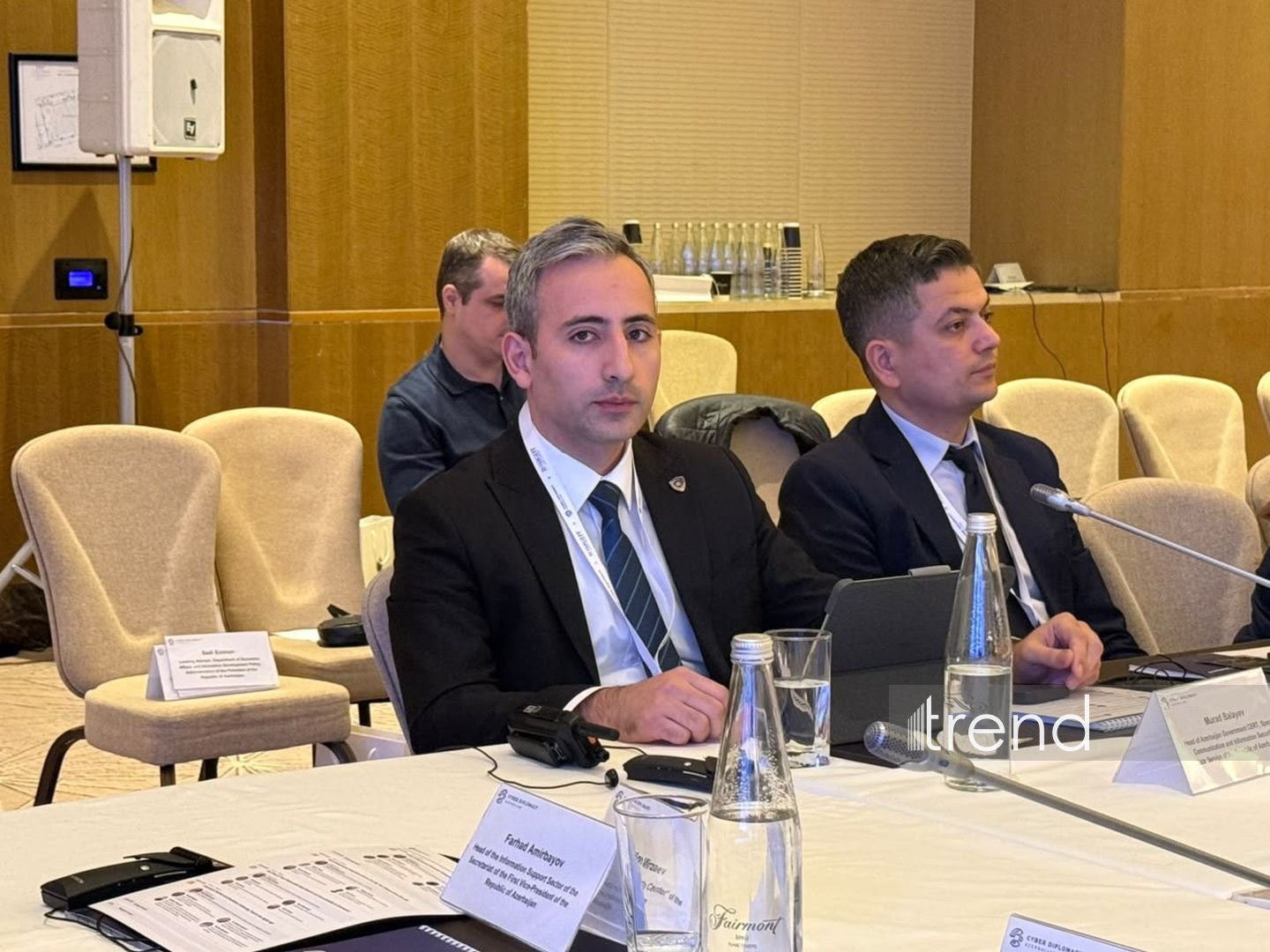

BAKU, Azerbaijan, November 19. Fake images and voices generated using deepfake technology have become an integral part of hybrid attacks, Murad Balayev, head of the Computer Incident Response Center of the State Service of Special Communications and Information Security, Trend's correspondent reports.
He made the remarks during a panel discussion titled “Information Warfare and Deepfakes: Defending the Truth in the Digital Age,” held as part of the Second International Conference on Cyberdiplomacy.
“Generative artificial intelligence has made cyberattacks cheaper, faster, and more convincing, shifting their focus from systems to people,” Balayev said.
He explained that generative AI has transformed cyberattacks in three main ways: they have become cheaper and faster, their targets have shifted from systems to people, and disinformation has become more widespread and persuasive.
According to Balayev, complex cyberattacks previously required significant resources and were typically carried out by advanced persistent threat (APT) groups operating with state support. However, artificial intelligence has now expanded the range of possibilities available to attackers.
Citing a threat report published by Anthropic in September, Balayev said that one of the incidents described involved attackers intercepting more than 2,100 access tokens across more than 40 organizations in just 34 hours. Virtually the entire operation was carried out by AI agents.
He also noted that the first AI-driven cyber-reconnaissance campaign was recorded last November. Approximately 30 organizations were targeted, with 80–90% of the operation conducted by an AI model without human intervention.
Balayev also referred to Microsoft's October report, noting that newly discovered vulnerabilities begin to be exploited in attacks within less than 24 hours. He added that the share of phishing attacks used as an initial access method had increased from 7% to 23% in just one year.
“For us, the conclusion is clear: the time available to patch vulnerabilities has shrunk from days to hours, and the complexity of an attack no longer indicates who is behind it,” Balayev emphasized.
He said that as security systems become more sophisticated, attackers increasingly seek to deceive people rather than hack systems directly. Artificial intelligence makes such attacks more convincing by reproducing familiar faces and voices.
Citing CrowdStrike data, Balayev noted that the number of voice phishing attacks doubled in the first half of this year. He also referred to a September report by the US Federal Bureau of Investigation (FBI), which received approximately 61,000 complaints about fraud attempts carried out in the names of government officials. The losses from these incidents exceeded $1.6 billion.
According to Balayev, Interpol estimates that AI-enabled fraud schemes are 4.5 times more profitable than traditional methods.
He cited several cases involving the use of deepfake technology. In May this year, a businessman in Singapore was invited to a meeting on Zoom, where the faces of people presented as the prime minister, president, a government minister, and a Central Bank representative appeared on screen. However, their images had been fabricated using deepfake technology.
Balayev added that the discussion concerned the actual geopolitical agenda at the time, specifically the situation in the Strait of Hormuz. Available data put the damage caused by the incident at at least 4.9 million Singapore dollars.
He also described an incident directly related to cyberdiplomacy. In June 2025, an unidentified individual used an AI-cloned voice of the US Secretary of State to contact three foreign ministers, one governor, and one member of Congress through the Signal app. Following the incident, the US State Department issued a warning to all diplomatic missions.
According to Balayev, a similar scheme was carried out in January this year using the identity of Japan's Minister of Defense.
“In both cases, no systems were hacked. Instead, people's trust, including their trust in diplomatic channels, was undermined. This represents a new category of risk for cyberdiplomacy,” he emphasized.
Turning to the role of deepfakes in information warfare, Balayev explained that hybrid warfare involves states pursuing their objectives not only through military means but also in the economic, political, and informational spheres. Disinformation is the main tool of information warfare, while deepfakes have become one of its most convincing forms.
“Deepfake technology spreads lies not through text, but through faces and voices that people recognize. This, in turn, makes it easier for people to accept false information,” he said.
Balayev also cited fake content circulated in connection with the war that began in February this year in a neighboring region. According to estimates by The New York Times, more than 110 AI-generated fake videos and images were recorded during the first two weeks of the war. One disinformation campaign attracted 125 million views in 14 days.
He added that a fake video showing Dubai's Burj Khalifa skyscraper on fire was viewed tens of millions of times. The day before the war began, one individual also hacked 31 social media accounts and used them to spread fake videos depicting combat operations.
“In other words, a cyberattack and disinformation were combined into a single operation,” Balayev said.
He also highlighted the use of deepfake technology during elections. According to him, fake videos targeting one of the candidates were circulated this fall in connection with the US Senate elections. The video received more than 850,000 views in just 24 hours, and researchers linked the incident to a foreign influence operation.
Balayev stressed that these examples demonstrate how different aspects of hybrid warfare are interconnected. In one case, the target is citizens' financial resources; in another, it is relations between states. In both cases, disinformation is the main tool.
“Generative AI has not created a new type of attack. It has made existing attacks cheaper, faster, and more convincing. Deepfakes are the face and voice of disinformation in hybrid warfare,” he concluded.


