


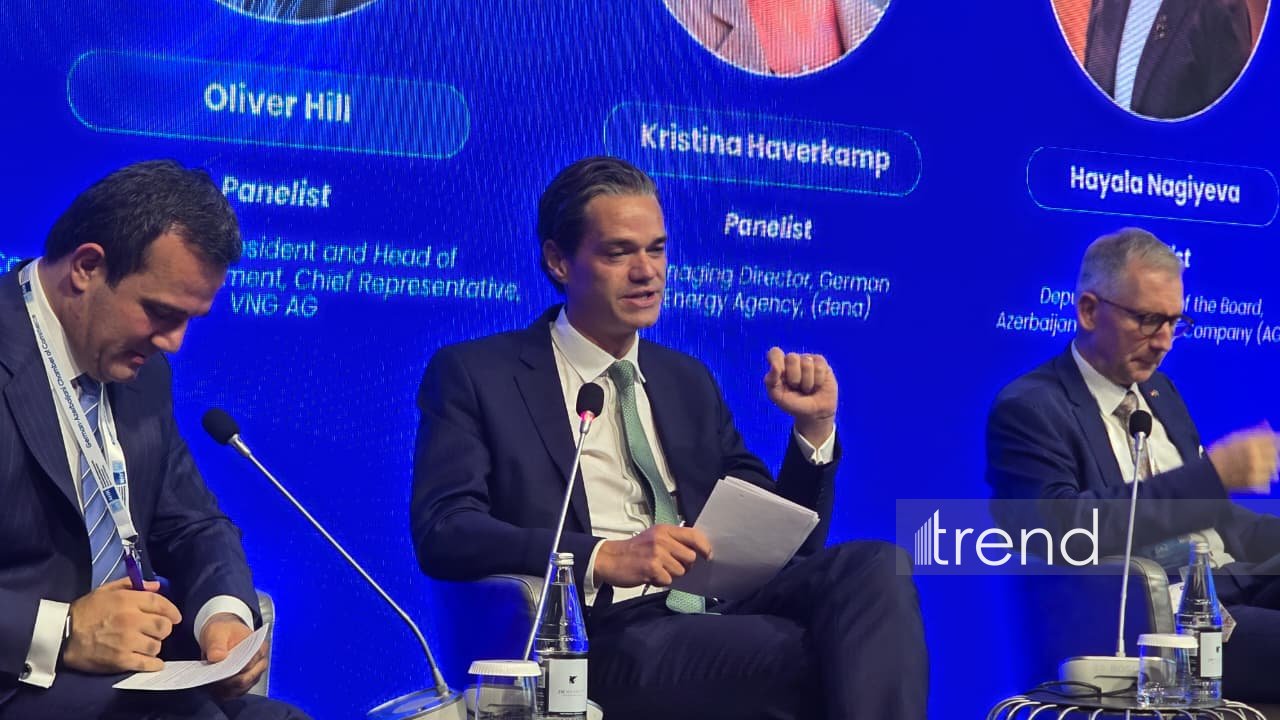
BAKU, Azerbaijan, October 6. It’s important to elevate the partnership between Germany and Azerbaijan to a new stage and expand cooperation in the field of renewable energy, Senior Vice President and Head of Europe at Siemens Energy, Frederik Doye, said at the German-Azerbaijani Connectivity Conference in Baku on Tuesday, Trend's correspondent reports from the event.
He noted that currently, energy cooperation between Germany and Azerbaijan is primarily focused on fuel exports.
"The time has come to elevate the partnership between Germany and Azerbaijan to a new level. At present, this cooperation centers largely on fuel exports to Germany, an undeniably important factor. However, we are now entering the era of electricity. The importance of electric power is growing day by day, and renewable energy sources are beginning to play a decisive role in this context," Doye pointed out.
According to him, there is immense potential for offshore and onshore wind and solar energy in Azerbaijan and the region as a whole.
"There is great potential for wind and solar energy, both offshore and onshore, not only in Azerbaijan but across the entire region. This potential has not yet been fully realized and could serve as a crucial step toward bringing our countries even closer together," he stated.
Doye emphasized that the integration of energy grids is a complex process and highlighted the particular importance of digitalization in this regard.
"The integration of cross-border networks, and even the complexity of systems within a country like Germany, demands serious attention. For instance, there are four main transmission system operators managing the electricity grid in Germany. The fact that each has different grid codes makes the process quite complex," the Siemens Energy official noted.
He stated that the average age of electricity grids in Europe is approximately 50 years, and these systems have lacked sufficient investment over a long period.
"In the past, the system was simpler: there was a single large power plant, and energy was transmitted from there to consumers. Now, however, the system is highly complex. There are parties that both generate and consume energy, and power flows in two directions. Consequently, grids need to become more digital and capable of handling heavier loads," Doye said.
According to him, building digital electricity grids from scratch based on modern standards could offer a significant advantage in the region.
Doye also pointed out that the involvement of multiple countries in the implementation of 'green corridor' projects adds further complexity to the process.
"When speaking of a 'green corridor,' we envision the participation of multiple countries, which in itself makes the process more complex. For instance, reaching an agreement between Denmark and Germany on integrating offshore wind energy into the German power grid took years," he noted.
He added that similar discussions are currently underway between France and Spain.
"While connecting countries makes sense from an economic perspective, the interests of the parties involved may not always align," Doye emphasized.
The Siemens Energy official noted the importance of close cooperation among governments, industry representatives, banks, financial institutions, and investors to realize such large-scale infrastructure projects.
"To turn such large-scale infrastructure projects into reality, governments, industry representatives, banks, financial institutions, and investors must work in close cooperation. I am confident that this collaboration will succeed and yield the expected results," he concluded.



