


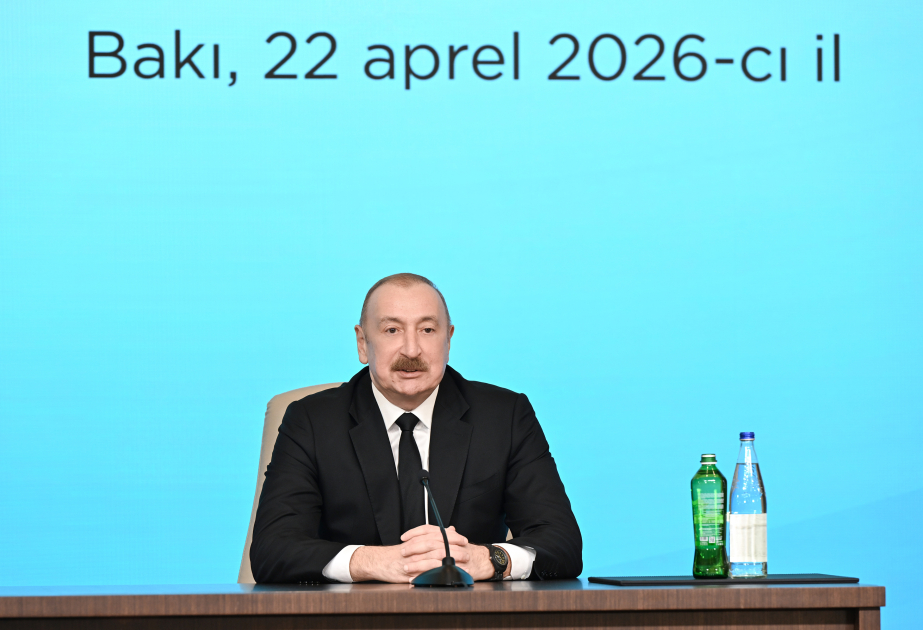
BAKU, Azerbaijan, April 22. During the last 20 years we had over 350 billion dollars of investments in our economy, almost half—$170 billion—in investments from foreign sources, President Ilham Aliyev said during his speech at the Azerbaijan-Latvia Business Forum, Trend reports.
Speech by President Ilham Aliyev
- Mr. President, members of the official delegation, guests from Latvia, ladies and gentlemen,
I'm very glad to host the President of Latvia on an official visit. We had excellent discussions and documents signed, and among many things we discussed also the issue of economic partnership. And especially the business forum which is organized today really demonstrates a mutual aspiration to do business together.
I'm glad that the President is accompanied by a big group of business representatives from Latvia, and I'm sure that the interaction with the Azerbaijani colleagues will be interesting and productive. Of course, any kind of business activity has several factors in its background, and first of all is stability in the country where you do business, predictability, business climate, investment climate, and many others, including connectivity and accessibility to export markets, and also the size of domestic markets.
We tried in Azerbaijan hard in order to transform the country from being purely dependent on oil and gas into a country which can be proud of the process of diversification of our economy. If you look at the structure of our GDP, we see rapid growth during the last 4–5 years. The share of non-oil industry in our GDP grew from 50 to more than 70%, and it continues. So this means that diversification of the economy is already a reality.
Now we are actively working on diversification of our exports. Though it will be difficult to do because production of natural gas in Azerbaijan is growing and will grow, and the biggest part of the gas we produce is exported. So non-oil- and gas-related industry and economy have to match the growing production profile and the growing demand in the international markets, primarily European.
Financial stability is also important for any investor, whether it's local or foreign. And here also we can report good achievements. Our financial system is stable. We steadily, based on the strategic plan, reduced dependence on borrowings. Today we borrow only for projects which demand a high level of technological performance. And we borrow only from leading international institutions like the World Bank, EBRD, Asian Development Bank, Asian Infrastructure Investment Bank, and some others.
Reduction of foreign debt, I think this plan is done. We have a foreign debt which is equal to 6.1% of our GDP. Our currency and gold reserves exceed the foreign debt by more than 18 times. So in other words, we could reduce our foreign commitments to zero within probably a couple of months.
But of course, there is a big demand for additional investments, primarily aimed at the reconstruction and rehabilitation of the liberated territories of Garabagh and East Zangezur. Investment priorities are clear; probably we already discussed them partly and will continue to discuss.
And also I'm sure that Azerbaijani colleagues also informed our guests about the figures. During the last 20 years we had over 350 billion dollars of investments in our economy, almost half—$170 billion—in investments from foreign sources. So an investment-friendly business climate was also one of the targets in front of us, and it has mostly been achieved.
With respect to our plans, we are continuing investments in Azerbaijan and also outside, primarily in energy facilities in the neighborhood and also in the EU area. And this is also supported by the European Commission. We have several formats of cooperation with the European Commission. One of them is energy cooperation.
The European Commission in its public statements always refers to Azerbaijan as a reliable partner in the energy field. And this energy is growing. We started from oil sales; now we export natural gas, we export electricity, petrochemicals, and are planning to export green energy. So one of the areas of investments which is in our portfolio is renewables, with a huge potential for sun and wind.
We are already enjoying strong interest from major actors. Our plan, which is based not only on our aspirations but also on signed, legally binding contracts, is to have 8 gigawatts of solar, wind, and hydro power by 2032. And this is absolutely realistic. We will largely substitute natural gas, which we use for electricity production, with renewables, and that will save us several billion cubic meters of gas, which is so needed now on international markets.
It was needed always during the last several years, and during the last couple of months even more. And the plan is to increase production and definitely to increase exports. Today, 10 members of the European Union are receiving natural gas from Azerbaijan. The total number of countries is 16. And by this parameter, we are number one in the world.
We are not the largest producer and exporter; there are much bigger players, but among countries that export gas by pipelines, with respect to geography of supply, we are number one.
And for many countries in the European Union, Azerbaijani gas and oil make up the largest part of their energy consumption portfolio. Another area which we have largely concentrated on was, is, and will be connectivity. Here, geography is complemented by our investments and long-term policy to transform Azerbaijan, which is a landlocked country, into an international transportation hub. It has already happened. Transportation corridors from East to West and vice versa, North to South and vice versa, are already functioning. On Azerbaijani territory, all construction works have been completed. What we are doing now is only investing in modernization, in creating new physical infrastructure, in digitalization, including the opportunities provided by AI, in order to make transportation through Azerbaijan not only the safest in today's geopolitical situation but also competitive from the point of view of fees, transportation costs, and timing. And here, there is a big room for investments because connectivity between East and West today, without Azerbaijan, is rather problematic. We have already invested significantly, as I said, and also, in cooperation with friendly countries, with our immediate neighbors and neighbors of our neighbors, we have managed to provide a safe and reliable transportation route for cargo. By the way, the number of cargoes going through Azerbaijan is growing year after year.
We also discussed today largely the opportunities in agricultural cooperation between our countries, and the co-chairs of the Joint Economic Commission are both ministers of agriculture. So definitely this will continue to be one of the priorities for our government, taking into account that more than 40% of our population lives in rural areas, and this infrastructure has been created, as well as business opportunities in the regions. Of course, they are different from business opportunities in the capital. Therefore, agriculture, tourism, and water management—all these are projects which state and private companies are implementing in Azerbaijan, and I think they will be of interest to Latvian investors as well. Also, the Alat Free Economic Zone provides good services and very investment-friendly legislation, which already allows it to attract foreign investments in substantial volumes. Though today it is clear that attracting foreign investments is not an easy task, I think the legal framework and proximity to the main trading seaports and the railroad make the Alat Free Economic Zone attractive.
One of the issues which we also discussed and probably will also be a potential area of cooperation is the defense industry. We found out that both countries are actively developing their capabilities, and as far as we are concerned, we are already exporting products of our defense industry companies—private and state—to a large number of countries. So joint manufacturing, cooperation, and creating synergy, I think, are also something we can look at. And many others.
Today, in our brief remarks, it is difficult to embrace all the areas of partnership, but I'm sure that during the forum and follow-up—definitely there should be a follow-up, just not to make this event isolated—many other opportunities will be explored. And definitely, we as a country, and I'm sure our business community, are interested in investment opportunities in Latvia, in your priority projects.
As we discussed today, we can table a list of potential projects where both countries can successfully participate. And the last point is about the importance of the President's visit. I'm once again very grateful for accepting my invitation. I enjoyed very much our tête-à-tête conversation, as well as the meeting with delegations and our discussion during lunch. And thank you once again. I wish you a pleasant stay. I'm sure that our business delegations will also support all these positive trends. So welcome once again.



