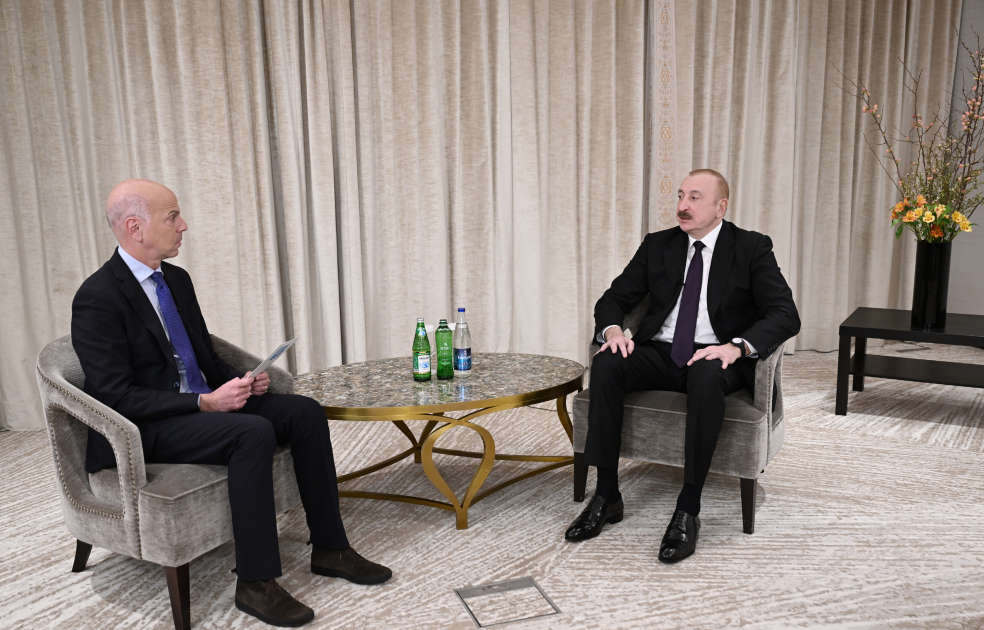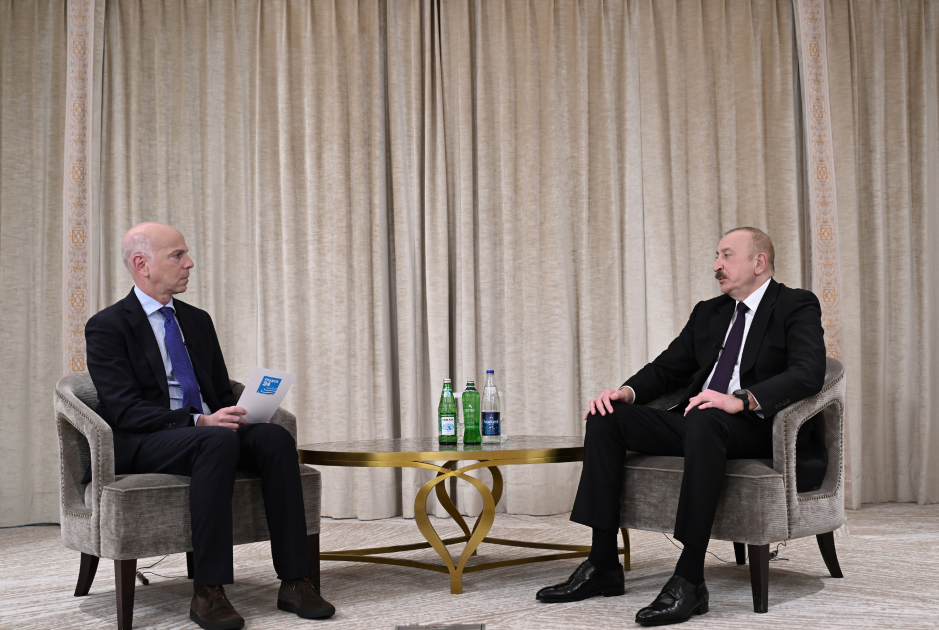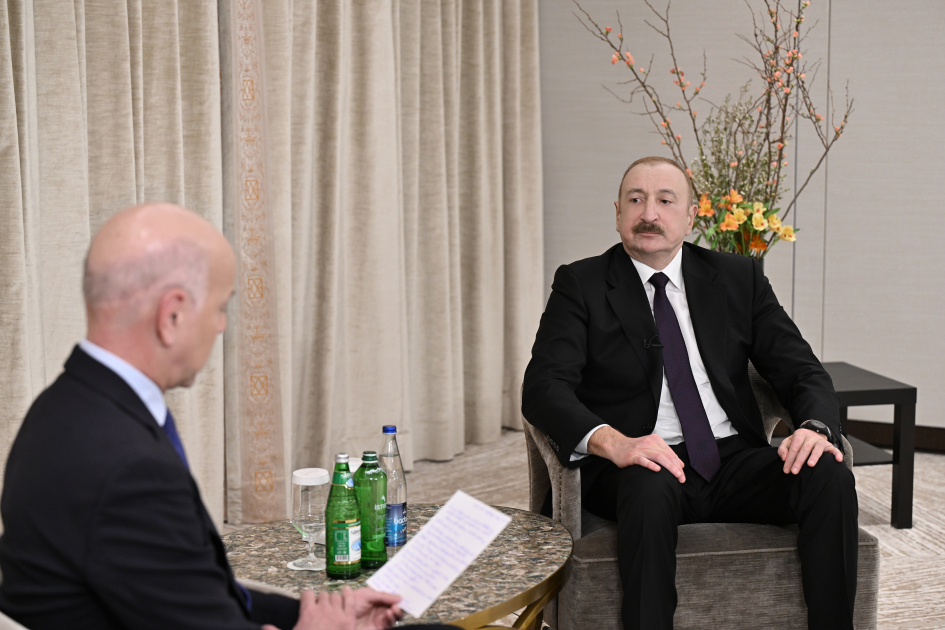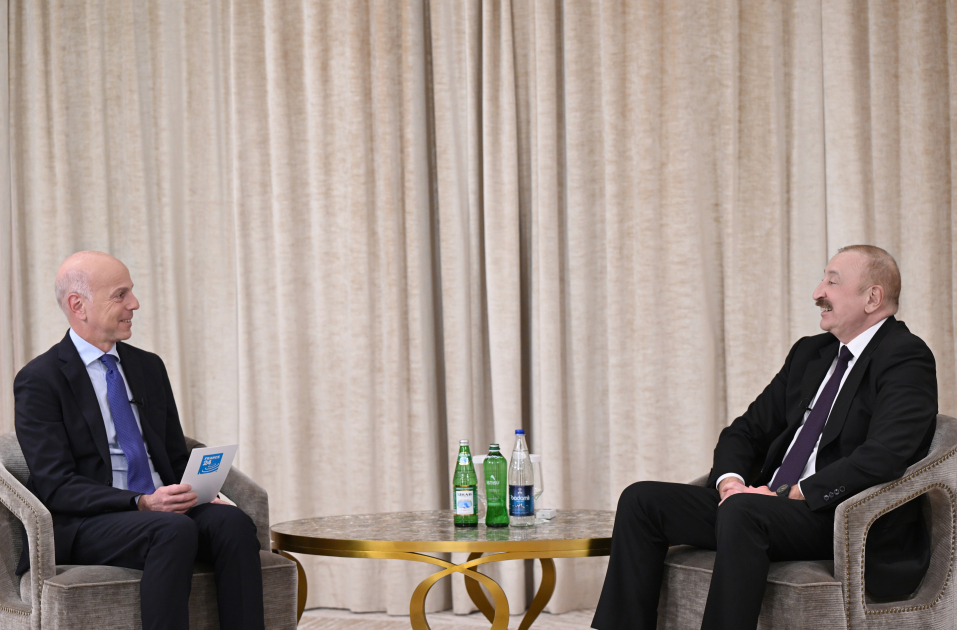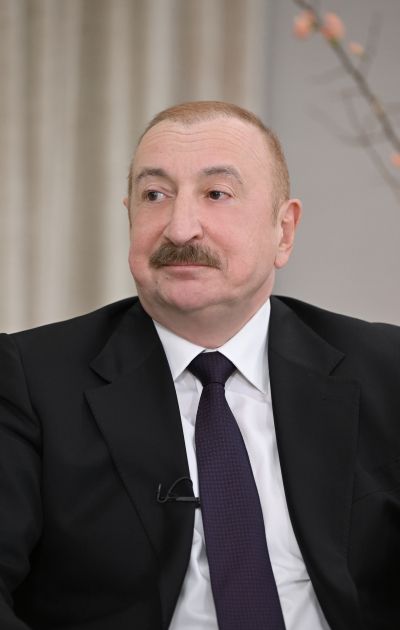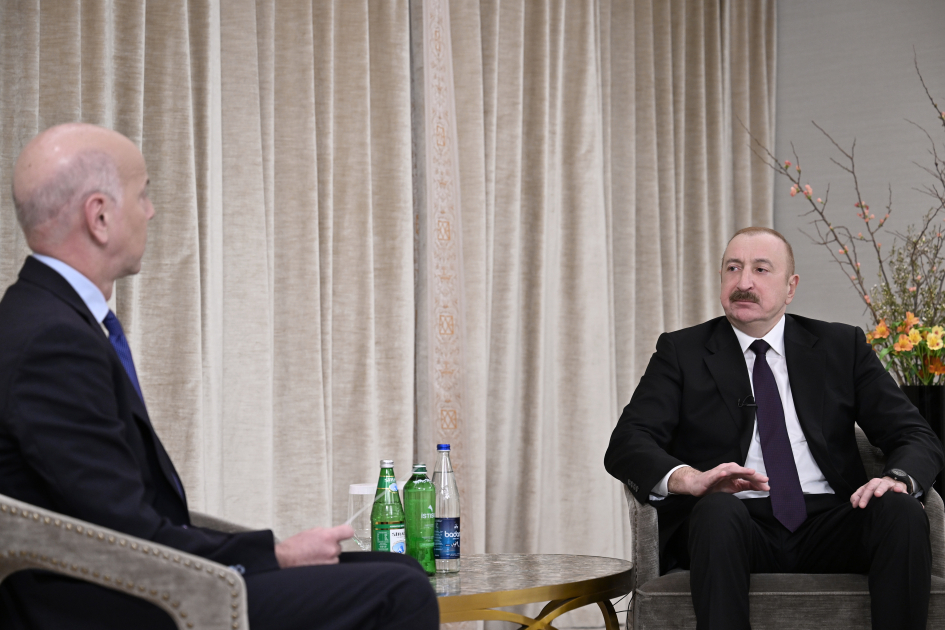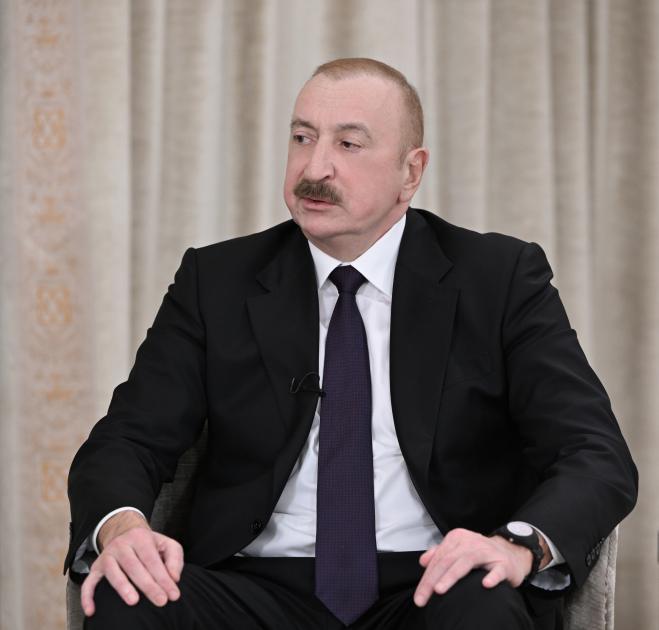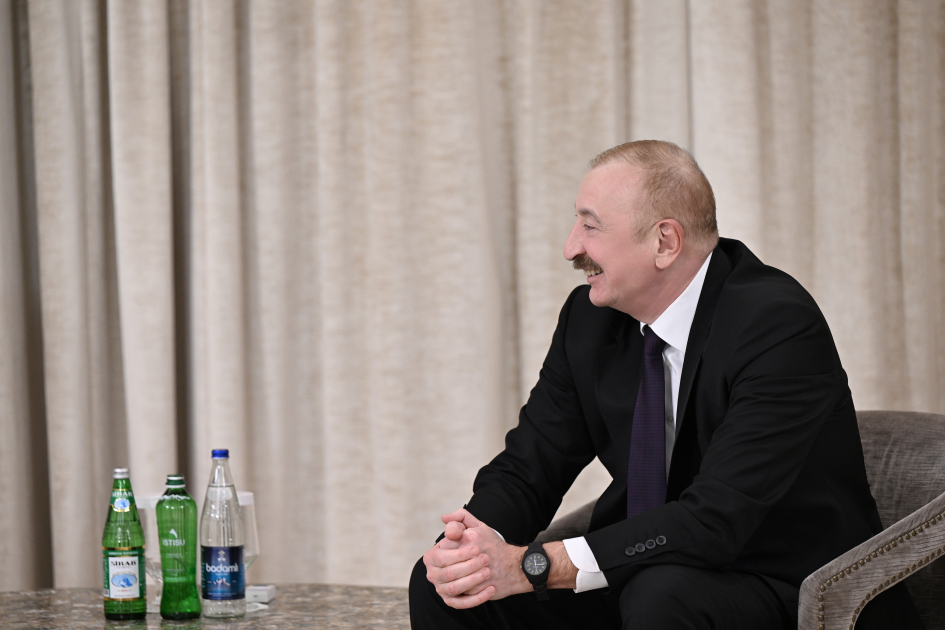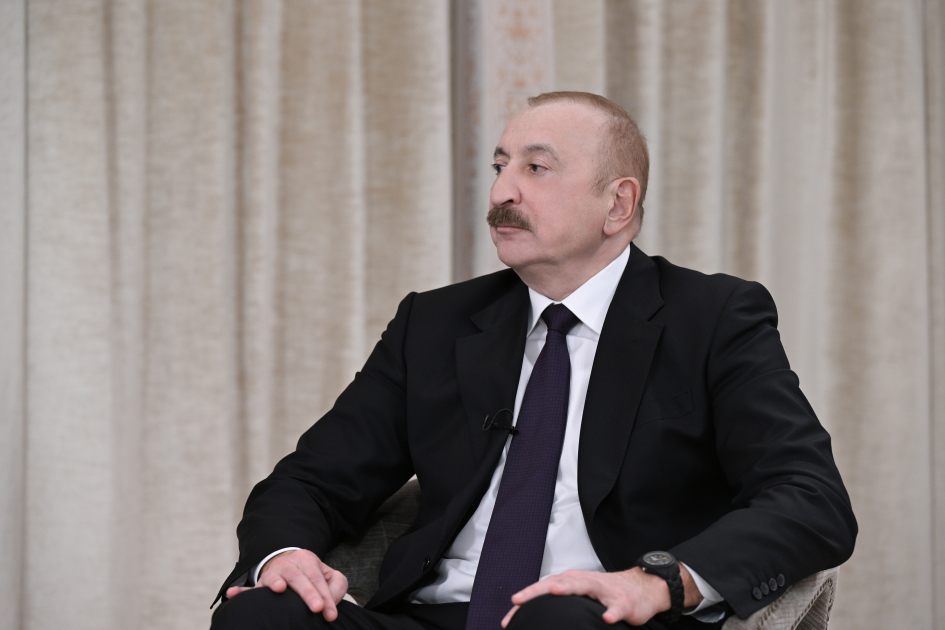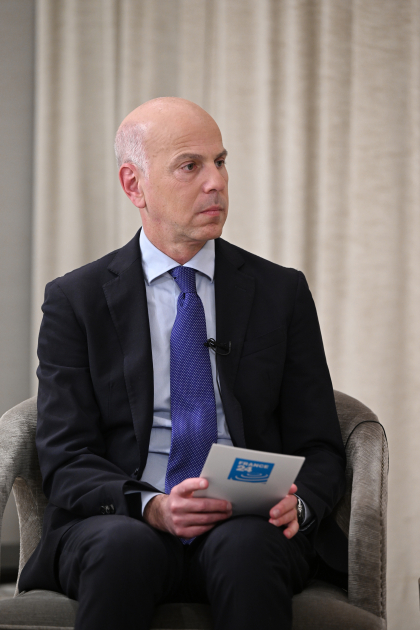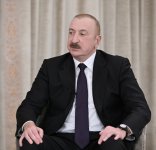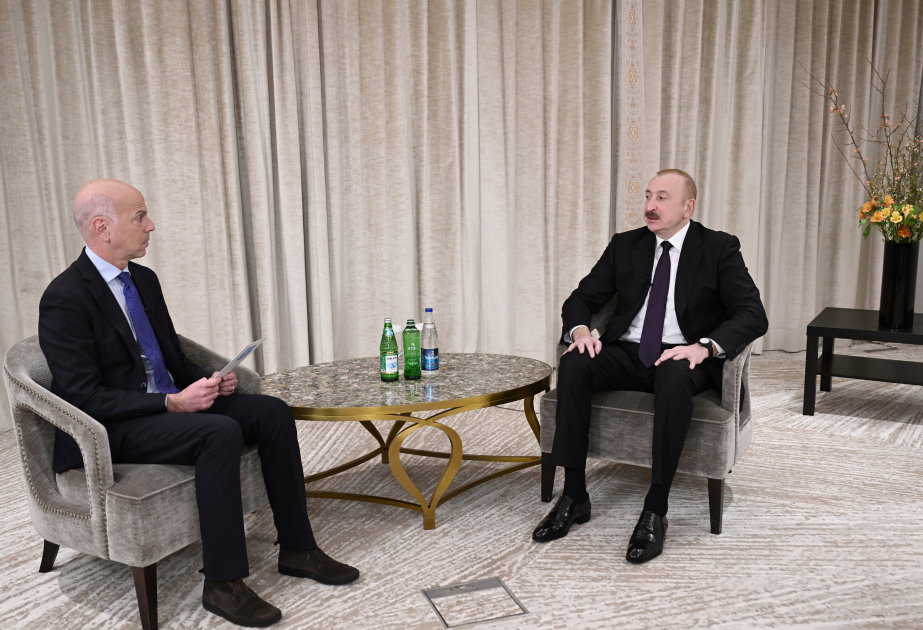

MUNICH, Germany, February 14. On February 13, President of the Republic of Azerbaijan Ilham Aliyev was interviewed by France 24 in Munich.
Trend presents the interview.
Correspondent: Hello and welcome to “Tête à tête”, France 24’s flagship interview show. Our guest today is the President of Azerbaijan, Ilham Aliyev. Thank you very much, Mr. President.
President Ilham Aliyev: Thank you.
Correspondent: On August 8, there was a trilateral summit at the White House with you, Armenia's Prime Minister Nikol Pashinyan, and U.S. President Donald Trump, and a declaration to end the conflict between Azerbaijan and Armenia was signed, with promises to reopen transportation routes and normalize relations. Can you tell us whether total peace and full normalization are now coming soon?
President Ilham Aliyev: I think so, because the signing of this historic document at the White House, in the presence of the President of the United States, who, by the way, also signed the Joint Declaration as a witness, means that the conflict is over and that we have entered a period of peace, which I hope will last forever. Since that time, more than six months have passed, and we have a very quiet situation on the border with Armenia. No more shootings, no victims, no wounded. Azerbaijan unilaterally lifted the restrictions on the transit of goods to Armenia, and we also started supplying critical oil products to Armenia, which actually marks the beginning of our trade relations. So we can see that peace has already been achieved. There are certain formalities in order to sign a final peace agreement, but along with the declaration, which you mentioned, the foreign ministers of both countries in Washington also initialed the text of the peace agreement. So for me, it is done. I think the Prime Minister of Armenia shares the same opinion. We are just learning to live in peace, and it's a very good feeling.
Correspondent: It's a very good feeling. However, what's missing for full normalization? I understand that for Azerbaijan there is an issue with Armenia's constitution and language pertaining to territorial claims on Garabagh. Is this an absolute red line for you? Without this being changed, there will be no normalization?
President Ilham Aliyev: Yes, you're right. There will be no signing of a peace agreement. I would divide normalization from a formal peace agreement because normalization is already taking place. As I said, all these positive developments show that. But the Armenian constitution, which was adopted a long time ago during the times of the occupation of Garabagh, contains the reference to the Declaration of Independence of Armenia, which contains the paragraph that so-called Nagorno-Karabakh and Armenia should unite. So this is a territorial claim to Azerbaijan. Our position for many years, since the end of the Second Garabagh War, has been very clear: this should be changed. And as far as I know, Armenia is planning to hold a referendum. And as soon as it is done, there will be no obstacles to the formal signing of a peace agreement. But again, I'd like to underline that for Azerbaijan, peace has been achieved. The normalization process is moving successfully, and I hope that as soon as these legal formalities are done, we will have formal peace.
Correspondent: This year?
President Ilham Aliyev: Definitely.
Correspondent: JD Vance, the Vice President, visited both countries. There were announcements of a strategic partnership, where the U.S. would sell all kinds of weapons now to Azerbaijan. There is also this so-called TRIPP project, the Trump Route for International Peace and Prosperity, a road and rail link through Armenia to your exclave of Nakhchivan. Is this a pie in the sky, or is this really going to happen and change the dynamics?
President Ilham Aliyev: I have no doubt that it will happen. One of the reasons is that, again, the United States played a crucial role in this process. The route, which will connect two parts of Azerbaijan through Armenia and even stretch to the European continent, carries the name of President Trump. It's the Trump Route for International Peace and Prosperity. And I think that this very personal commitment of the U.S. President and also the agenda of the U.S. government shows that the TRIPP will be built. It's not a big distance; it's only 40-plus kilometers. By the way, I'd like to say that the railroad which Azerbaijan is now building to the Armenian border from the capital is about 400 kilometers, plus almost 200 kilometers in our Nakhchivan exclave to be rehabilitated. So the Armenian segment of the Zangezur Corridor, as we call it, is very short. And I'm sure that it will be done.
And coming to the question about Vice President Vance's visit, yes, it was a very important visit. The visit in itself of the Vice President of the United States is important for any country. In this case, it was marked with the signing of the Charter on Strategic Partnership between the governments of the United States and Azerbaijan. Thus, we became an official strategic partner of the most powerful country in the world, and we consider it a big success for our country.
And this Strategic Charter, it was published in the press, so it contains different segments. One of them was defense sales, but not only that. It's energy, connectivity, AI, investment, and trade, and also all the restrictions on the arms supplies to Azerbaijan have been lifted.
Correspondent: I want to get to a decision by the military court in your country that handed out harsh prison sentences to 13 officials of the Nagorno-Karabakh region, including life imprisonment for the former leader. There were reports that the U.S. Vice President talked about the issue and asked you maybe to grant them a pardon as a way to seek peace in the region. Did he do this, and will you do this?
President Ilham Aliyev: During the interaction with the Vice President, which lasted for several hours, among other issues, this issue was also raised by him, and I expressed Azerbaijan's position on this issue, and that was it. We mainly discussed bilateral relations, regional development, TRIPP, and prospects for formal peace with Armenia. With respect to these people whom you mentioned, these are the leaders of the illegal separatist regime, which illegally functioned on our territory, on the territory of the sovereign Azerbaijani state, recognized as such by the entire international community, including Armenia.
For many years, these people were masterminds of all the war crimes against Azerbaijanis and Azerbaijan, and they were brought to justice. They were detained in Garabagh as a result of our military operation and brought to justice. They were provided with lawyers. The trial was absolutely transparent. Their crimes were proven by the testimonies of witnesses, numerous testimonies, and there is no question about suspicion of wrongdoing.
Correspondent: But could you do something about this, Mr. President?
President Ilham Aliyev: What do you mean?
Correspondent: Turn the page and grant them clemency or something. You could make a gesture. This is within your powers.
President Ilham Aliyev: You know, these people committed serious crimes against humanity. Imagine after the Second World War, the Nuremberg trials, and all those Nazi leaders, who were sentenced to death, in two months some would come and say, please release them.
Correspondent: It's the same for you?
President Ilham Aliyev: Yes, absolutely. It's even worse, even worse. Their crimes were even worse than what the Nazis did during World War II.
Correspondent: But in terms of turning the page, do you also maybe have some compassion for the Armenians who had to leave Garabagh as a result of the latest war?
President Ilham Aliyev: Our position on that issue was very clear. It was articulated many times, including publishing on the website that we offered all Armenians who lived in Garabagh to apply for citizenship or to apply for a work permit. We had several rounds of interactions with the representatives of Garabagh Armenians, but they preferred to choose to leave for Armenia. We have hundreds of thousands of Azerbaijanis who have been deported and ethnically cleansed from the territory of today's Armenia, but never did the Armenian government offer any kind of proposals for them to come back. I think we need to treat this issue from a reciprocal point of view. The right of return is a universal right, and, of course, Azerbaijan will definitely observe this right if we have such an application. But at the same time, taking into account that we were at war with Armenia for 30 years, and for 30 years they were occupying our territory, we expect the same attitude toward hundreds of thousands of Azerbaijanis, who we call Western Azerbaijanis, to be able to return to today's Armenia.
Correspondent: I want to quickly get to the relation with France. It was very bad, especially during the last war. You criticized France for being a colonial power in New Caledonia and in Corsica – very harsh words. A few months ago, a French citizen, Théo Clerc, was freed. There's another one who's currently on trial. You met the French President briefly on the sidelines of a European summit. Would you say that the relation is back on track, or that there are still problems between Azerbaijan and France?
President Ilham Aliyev: You know, we were not the source of the problems with France. We had very good relations with France before the Second Garabagh War. There have been visits of presidents, of President Sarkozy, President Hollande, and my official visits to France. Also, I visited France during the term of President Macron. We had very friendly relations, a lot of business activity, more than a dozen sister cities. But when the Second Garabagh War started, and we started to restore our territorial integrity, unfortunately, the position of France was absolutely incomprehensible, because France is defending the territorial integrity of countries. It tries to defend its own territorial integrity. Now it defends the territorial integrity of Denmark. They defend the territorial integrity of Ukraine, but unfortunately, they supported separatists. More than 10 resolutions of the National Assembly and Senate were aimed at supporting separatists, and even your parliament recognized so-called Nagorno-Karabakh, though even Armenia did not recognize it. Also, relations with the government were tense, but again, we were not the source of this tension. We only wanted our sovereignty to be respected.
Correspondent: But you used very harsh words…
President Ilham Aliyev: Well, I did not start to use the harsh words. What was done on behalf of Azerbaijan, I want you to be absolutely sure, was only a response. We have a catalog of harsh words which were used by the French President and many French officials, chairman of your Senate, chairman of your National Assembly, your famous personalities, which used words that insulted our state and me personally. Moreover, after the Second Garabagh War of 2020, before the anti-terror operation of 2023, very famous French personalities like Madame Pécresse, Monsieur Barnier, Monsieur Retailleau, all the names are familiar to the audience, illegally visited Garabagh and supported the separatists. So that was an open insult to Azerbaijan’s statehood and a total sign of disrespect. All that has been said or done by us was done and said in response. Maybe it was harsh. It's difficult to measure. But I think what is important is, as you mentioned, my meeting with President Macron at the end of last year, which was very positive, and we agreed to put a restart button. We are ready for that. The last thing we need is to have problems with any country, including France. Again, it was not our initiative, but now I think both sides are more ready for normal relations, especially after Armenia and Azerbaijan have already achieved peace.
Correspondent: So as a conclusion, we can expect maybe you to meet the French President in the near future.
President Ilham Aliyev: Yes, definitely. By the way, our meeting in Copenhagen was very friendly. And, of course, since the meeting took place several months ago, there has been a lot of interaction between our teams. They regularly contact each other. There have been several meetings. Yes, there are still some issues which President Macron and I underlined to be settled by both sides. But again, it's important to understand that it's a road with both directions. And as two sovereign countries, we need to respect each other, respect each other's legal systems, and also not interfere in each other's affairs. We were not the first, if I may use your word, to talk about Caledonia, etc. It was France who started to interfere in our internal affairs about Garabagh, and not only that, even into our political agenda. So this should be stopped. And I think both sides know how to do it.
Correspondent: President Aliyev, thank you very much for being our guest. And thank you all for watching this edition of “Tête à tête” here on France 24.
President Ilham Aliyev: Thank you.