


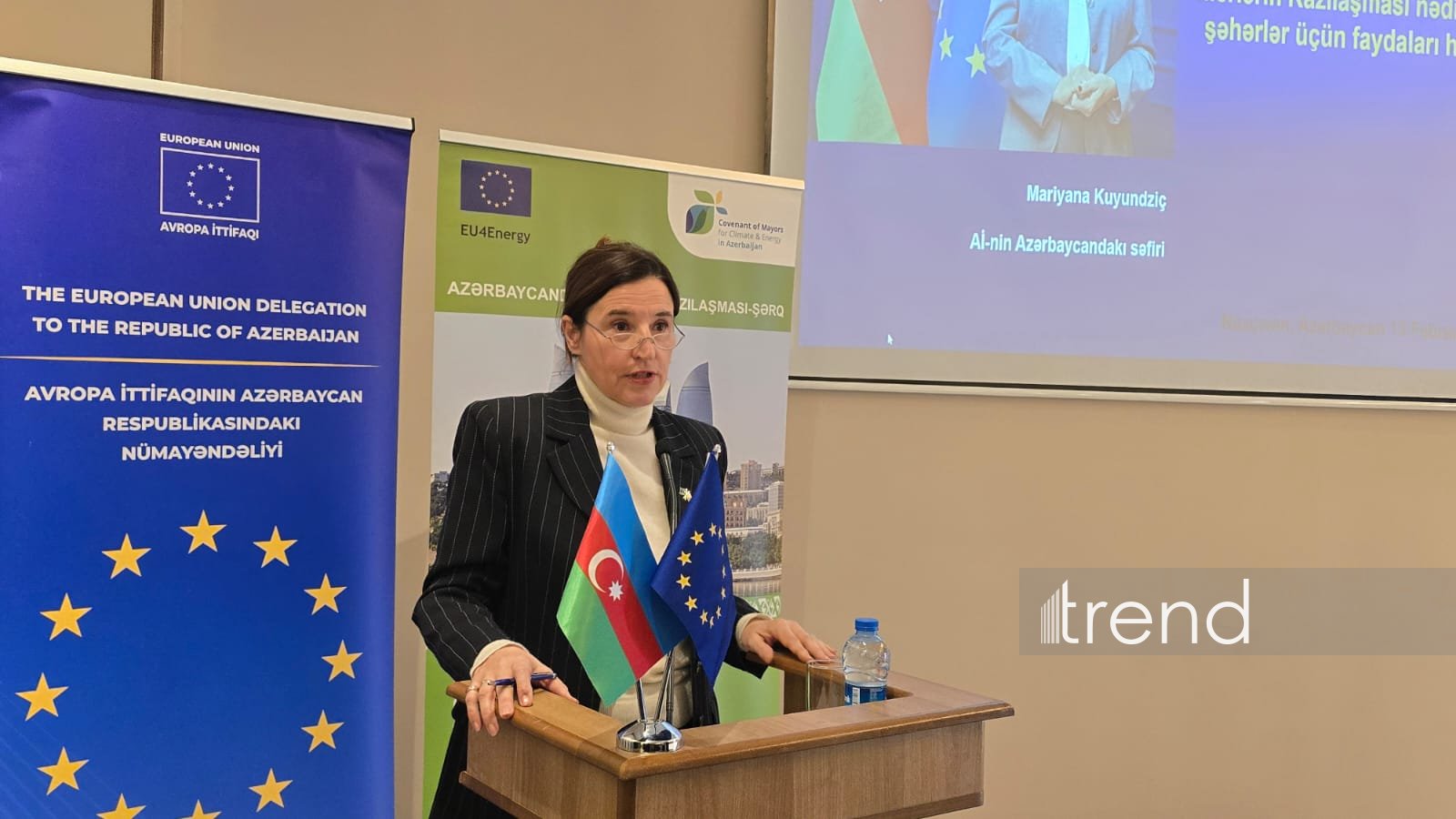

NAKHCHIVAN, Azerbaijan, February 13. Cooperation between the European Union (EU) and Azerbaijan can ensure low-carbon and sustainable urban development, EU Ambassador to Azerbaijan Marijana Kujundžić said at an event on the Covenant of Mayors-Eastern Partnership (CoM East) initiative in Nakhchivan, Trend reports.
"The EU and Azerbaijan can work together to ensure that the country's cities are low-carbon, sustainable, and liveable for future generations," she explained.
According to her, climate change is no longer a problem of the distant future, nor is it just a global issue.
"It's real and has a direct impact on our cities, communities, and economies.
Azerbaijan, like the rest of the world, is already facing rising temperatures, water shortages, extreme weather events, and environmental degradation. All of this has a direct impact on urban life.
Local governments are at the forefront of climate action. Because energy is mainly consumed in cities, waste is generated here, and buildings are heated here. In other words, the impacts of climate change are felt most strongly in cities.
The Covenant of Mayors provides a strong framework for cities to lead, set climate targets, and translate national goals into real action at the local level. Municipalities joining this initiative voluntarily commit to reducing greenhouse gas emissions, increasing climate resilience, and strengthening energy efficiency and sustainability.
This is not just a political statement but also a practical approach based on a concrete roadmap and data. The energy sector, while being a major source of emissions, also has the greatest potential for change. presents. Key priorities include increasing energy efficiency in public buildings, schools, hospitals, and residential buildings, promoting renewable energy sources such as solar and wind in municipal infrastructure, and reducing losses in local energy distribution systems," she noted.
The ambassador emphasized that energy efficiency is not only beneficial for the climate but also reduces municipal costs, increases energy security, and lowers household utility costs.
"Buildings account for a large share of energy consumption in cities. Thermal insulation and renovation of old buildings, energy-efficient lighting and heating systems, as well as smart urban planning approaches, reduce energy demand, improve living comfort, health, and quality of life.
The transport sector also has a serious impact on the increase in emissions. Population growth, increased use of public transport, and, at the same time, the rapid increase in the number of cars exacerbate the problem in this area. For example, in Baku, the number of cars has increased by 20–30% in recent years. This is a trend also observed in many European cities, and urgent measures must be taken," she delineated.
Kujundžić noted that waste management and the implementation of a circular economy are also important components of climate policy.
"Overall, climate action at the local level creates multiple benefits, such as economic savings, new job creation, improved public health, and cleaner, more attractive cities. Investing in climate action today is cheaper and safer than dealing with the severe consequences of climate change tomorrow.
We are here today to increase public awareness and active participation of cities. I am pleased to see all the cities that have already joined the Covenant of Mayors initiative, and I hope that new cities will also join this initiative. This is not just a signature, but a shared responsibility for all of us.
Working together, the EU and Azerbaijan can ensure that our country's cities are low-carbon, sustainable, and livable for future generations. I congratulate the cities of Ganja, Shaki, Mingachevir, Shamakhi, Khirdalan, and Yevlakh on becoming active members of this initiative, and this list will expand. The cities of Nakhchivan will also benefit from the program and actively participate in the country's climate action," the ambassador added.
Stay up-to-date with more news on Trend News Agency's WhatsApp channel



