


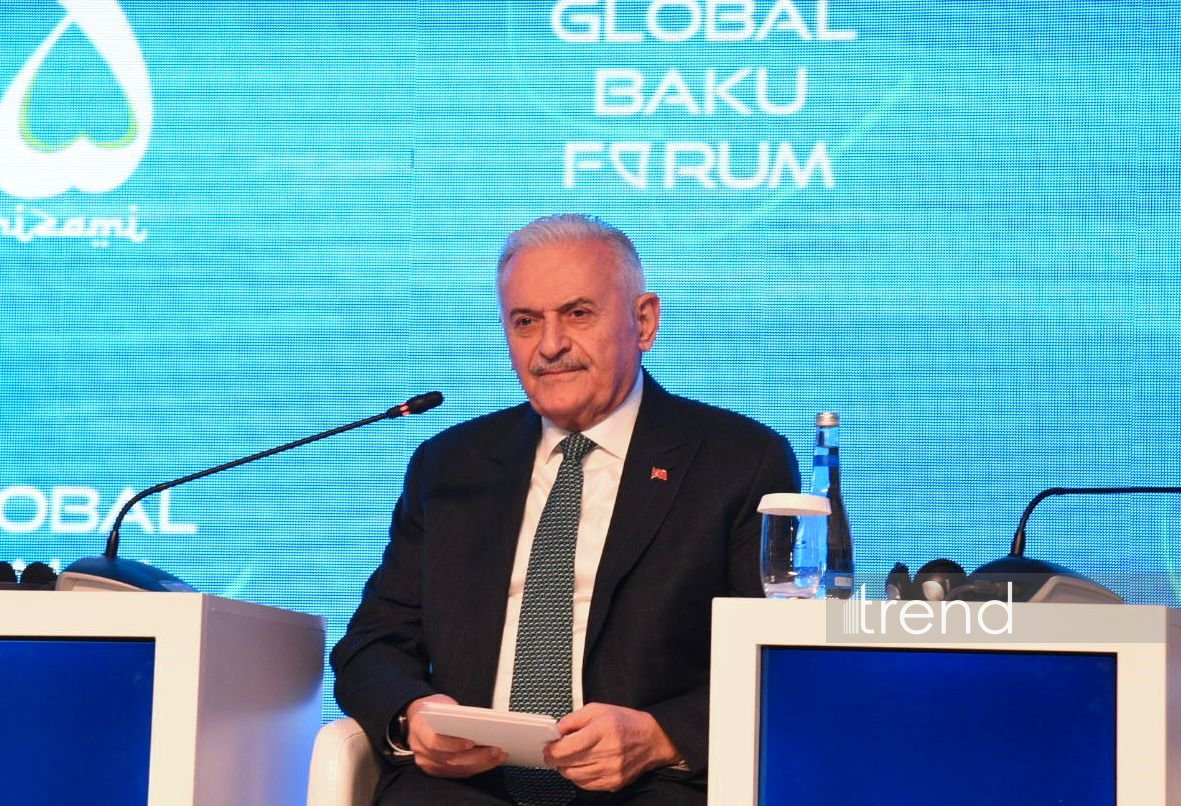

BAKU, Azerbaijan, March 12. The UN has failed to achieve sufficiently successful results for a number of reasons in recent years, Binali Yildirim, Chairman of the Council of Elders of the Organization of Turkic States (OTS), said at the panel discussion within the 13th Global Baku Forum, Trend reports.
According to him, when it comes to the issue of representation in the Security Council and the rights of permanent members, this topic attracts much criticism at the regional and global levels.
"At that time, the permanent members gave themselves these rights; I say this openly. There was no other authorized body that gave them these rights. In other words, the permanent members determined rights for themselves and acted accordingly. However, it would not be right to evaluate all their steps as completely wrong or insincere," he noted.
Yildirim also said that over the years, the United Nations has carried out very valuable missions both at the regional and global levels.
"However, when we look at various conflicts in recent years—for example, the war between Russia and Ukraine in your region, the ethnic cleansing in Gaza, the confrontation in Tbilisi, as well as the conflicts in Syria, Iraq, Afghanistan, and Israel—unfortunately, the United Nations hasn't been able to achieve a sufficiently successful result for a number of reasons.
One of the main reasons for this is that the permanent members of the Security Council should actually take a neutral position and not be parties to the conflict. However, in the process of solving problems, we see that in some cases, instead of becoming part of the solution, the permanent members become part of the problem itself. This is a serious problem. That is why experts, world leaders, politicians, and scientists constantly emphasize that reforming the United Nations has become an urgent necessity.
On the other hand, there is a certain paradox here. Who will implement these reforms? Because such changes require the consent of the permanent members. That is, even if reforms are proposed, their implementation still requires the approval of the permanent members. This creates a paradoxical situation because the parties that benefit the most from the current system must approve changes that will lead to a decrease in their powers. From a practical point of view, this seems very difficult," he explained.
Yildirim suggested reviewing the current structure of the permanent members of the Security Council.
"Many leaders and countries state that the weight of the veto mechanism should be reassessed. For example, the consent of at least two members may be required for a veto decision, or the scope of participation in the Security Council may be expanded. In this case, the regional and global geopolitical situation should be taken into account. For example, the African continent is not actually represented in the Security Council.
At the same time, the Muslim world is not adequately represented in the Security Council. This and various similar proposals are already on the agenda. I hope that all these issues will be considered logically and naturally and will not serve the interests of individual states," he concluded.
Stay up-to-date with more news on Trend News Agency's WhatsApp channel



