


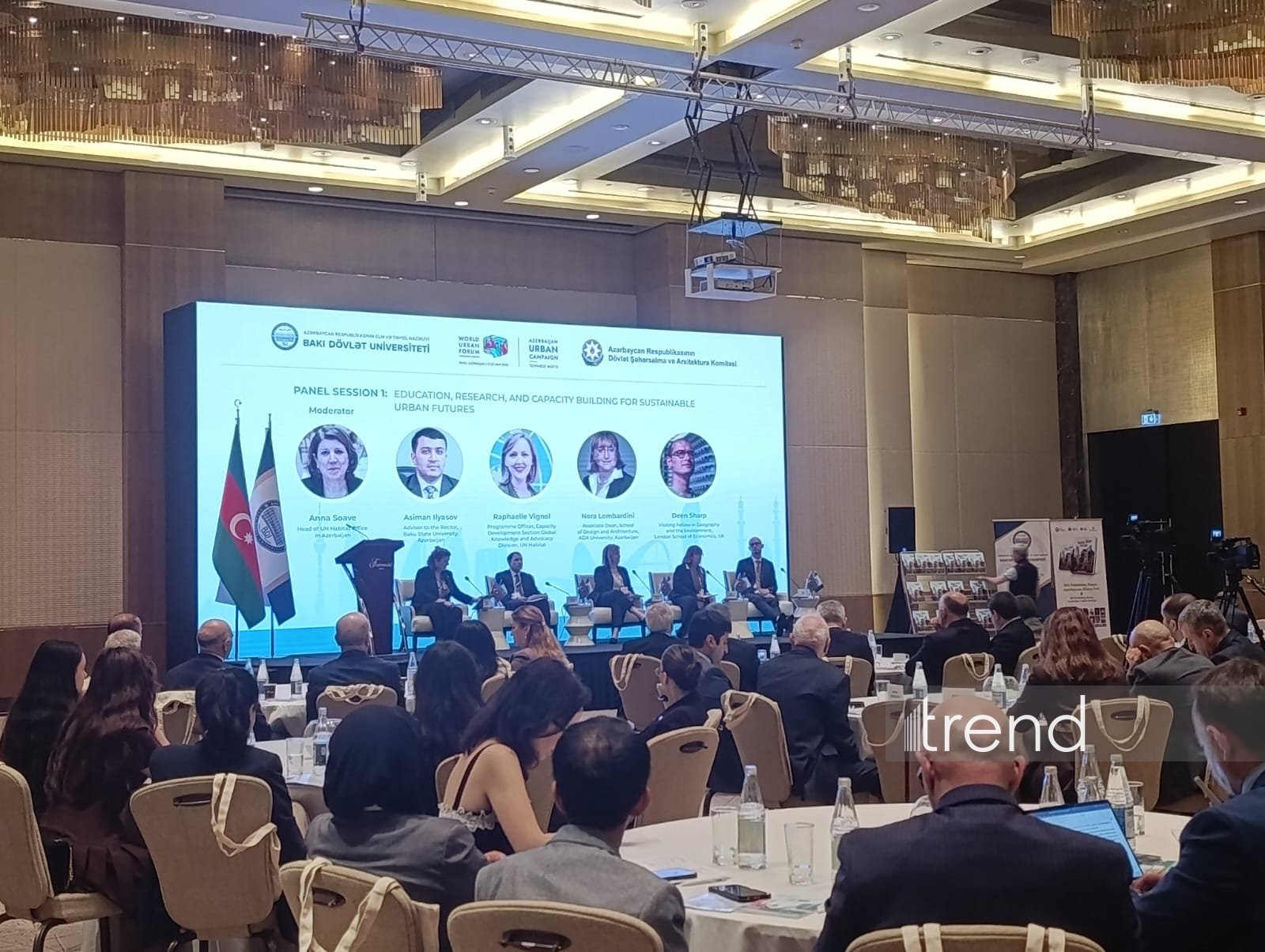

BAKU, Azerbaijan, May 15. Knowledge production must be oriented toward eliminating key gaps, which are contextual and vary by region, country, and institutional level, Raphaelle Vignol, Programme Officer at the Capacity Development Section of the Global Knowledge and Advocacy Division of UN-Habitat, said, Trend reports.
She made the remark during the international conference “Shaping Human Capital for Sustainable and Resilient Urban Development" in Baku.
The UN-Habitat representative noted that capacity development occurs at multiple levels, ranging from individual specialists involved in university programs and professional training to institutional capabilities. These institutional capabilities encompass the organizations themselves and the mechanisms for their interaction within the system and between various structures involved in sustainable urban development.
Despite the existence of various international and national frameworks, including national urban policies and local tools, the official emphasized that the primary challenge lies in their practical implementation.
"We have the regulatory architecture, but the key question is how to strengthen the capacity to implement it in different contexts," Vignol stressed.
A crucial task remains the collection and dissemination of practical experience gained on the ground in various cities and among different groups of stakeholders to bridge the gap between policy and practice.



