


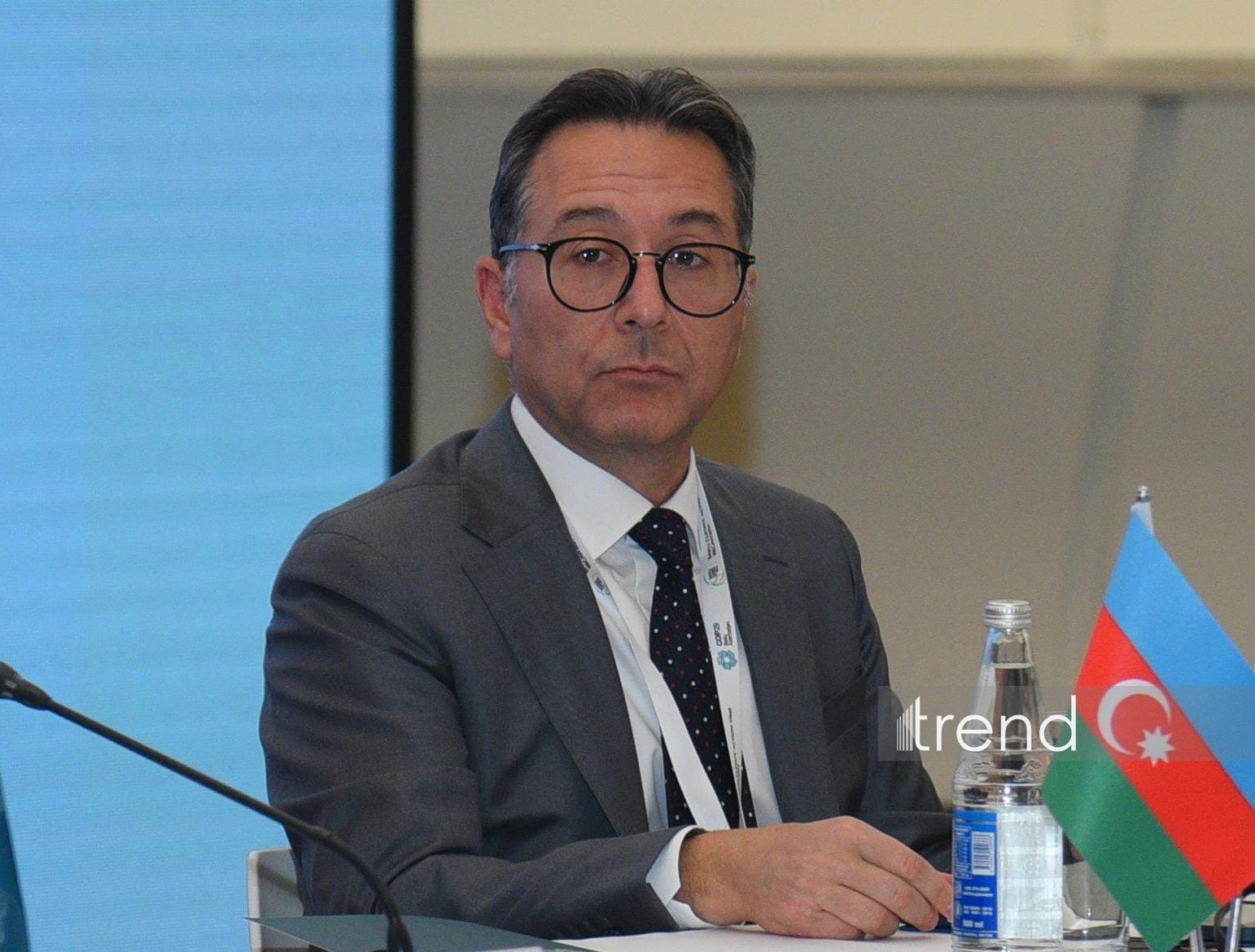

WASHINGTON, U.S., March 12. The State Oil Company of Azerbaijan (SOCAR) is actively exploring the country’s geothermal energy potential in partnership with U.S. companies, SOCAR Vice President Afghan Isayev told Trend in an exclusive interview.
Speaking on the sidelines of the U.S.–Azerbaijan Trade and Business Conference, held to mark the 30th anniversary of the U.S.-Azerbaijan Chamber of Commerce (USACC) in Washington, Isayev highlighted SOCAR’s long-standing collaboration with U.S. energy firms.
“The foundation of this collaboration was laid in 1994 with the signing of the Contract of the Century, which established Azerbaijan’s new oil strategy. This landmark agreement was pivotal in integrating the country’s oil and gas sector into global energy markets and set the stage for long-term partnerships between SOCAR and U.S. companies.
Initially, this cooperation focused mainly on upstream activities, particularly exploration and production. Over time, however, it has expanded considerably, encompassing multiple segments of the oil and gas value chain,” Isayev said.
He recalled that when the Contract of the Century was signed, ExxonMobil was among the first U.S. companies to partner with SOCAR.
“Working with ExxonMobil has been crucial for adopting international best practices in oil and gas production and fostering mutual knowledge exchange. This partnership remains strong today. In 2024, during my visit to the United States, I participated in a high-level meeting with ExxonMobil focused on strategic cooperation in decarbonization.
The discussions centered on expanding collaboration between SOCAR and ExxonMobil. I also visited a project site to study ExxonMobil’s carbon capture and storage (CCS) technology firsthand. During the visit, I received detailed insights into the practical application of CCS, process management, and its impact on emission reduction. I would also like to highlight that in 2025, SOCAR and ExxonMobil signed a memorandum of cooperation,” the SOCAR vice president said.
Isayev also highlighted SOCAR’s collaboration with U.S. companies such as SLB and Baker Hughes to apply advanced technologies across its oil and gas operations.
“At the same time, through partnerships with these companies, SOCAR is exploring Azerbaijan’s geothermal energy potential to advance the country’s renewable energy development. Additionally, SOCAR has partnered with U.S.-based Honeywell to modernize operations, implement advanced management systems, and drive digitalization.
SOCAR also works closely with Boston Consulting Group (BCG) on strategic initiatives supporting decarbonization and long-term sustainability in oil and gas operations. As part of this collaboration, we launched the ‘C&S Lighthouse’ project to advance green transformation efforts. Its implementation has made a significant contribution toward achieving SOCAR’s decarbonization targets,” he said.
According to Isayev, the overall partnership between SOCAR and U.S. companies has played a key role in modernizing Azerbaijan’s energy sector, promoting the adoption of advanced technologies and engineering solutions, and driving digitalization and decarbonization initiatives.
SOCAR’s Decarbonization Targets
SOCAR Vice President Afghan Isayev noted that rising methane emissions, driven by rapid industry growth, have become a major global concern.
“To address this challenge, countries, international companies, institutions, and civil society worldwide are taking serious, coordinated steps. In response to these global calls, SOCAR is implementing targeted measures to reduce methane emissions across all its operations.
The company has made the reduction of greenhouse gas emissions a key priority in every region where it operates and announced its medium- and long-term decarbonization targets during COP28,” he said.
SOCAR’s targets include:
• Achieving zero routine flaring across all operations by 2030;
• Reducing emissions intensity in the upstream segment by 30% by 2030 compared with 2022 levels (for SOCAR’s direct assets);
• Cutting corporate emissions intensity by 30% and total emissions by 20% by 2035 compared with 2022 levels (for SOCAR’s direct assets);
• Achieving near-zero methane emissions in the upstream segment (below 0.2%) by 2035 (for SOCAR’s direct assets);
• Reaching net-zero emissions by 2050.
SOCAR’s Decarbonization Projects
According to Afghan Isayev, SOCAR has launched a comprehensive decarbonization program across its key operational regions to reduce greenhouse gas emissions.
“Under this program, corporate procedures, management tools, and specialized organizational units have been established to drive decarbonization and explore new business directions. In line with its decarbonization targets, SOCAR has made the continuous reduction of emissions a core objective. Decarbonization projects are being implemented across SOCAR’s upstream, midstream, and downstream operations.
With a particular focus on methane reduction, SOCAR has carried out a large-scale Leak Detection and Repair (LDAR) project at the Oil Rocks. The project identified previously unaccounted emission sources, quantified the volumes released, and implemented measures to prevent further emissions. Measurements were conducted using Optical Gas Imaging (OGI) cameras, high-flow sampling devices, as well as satellite and drone technologies. The assessments covered all major facilities, including pipelines, wells, compressors, turbines, engines, tanks, and separators,” he added.
Afghan Isayev noted that conducting emission inventories using modern technologies reflects SOCAR’s targeted and responsible efforts to achieve its decarbonization goals, as well as its contribution to transparent reporting initiatives in this area.
“As part of this ongoing process, extensive measurement campaigns are being conducted across SOCAR’s other assets to detect and prevent methane emissions. In 2025, in partnership with an international consulting firm, SOCAR launched the AI-based ‘Methane AI’ platform to more effectively manage methane emissions.
The platform supports compliance with the reporting requirements of the OGMP 2.0 initiative, as well as other international programs. Key benefits of the Methane AI platform include:
• centralized advanced monitoring, reporting, and emissions reduction capabilities;
• rapid mitigation of identified emission sources through the platform;
• integration of emissions data from satellites, drones, and other sources into a single system;
• more accurate analysis of emissions data with minimal human intervention;
• ensuring compliance with OGMP 2.0 and other international reporting standards.
Using this platform, SOCAR prepared and submitted its first OGMP 2.0-aligned report in 2025 in accordance with international standards. The platform has significantly contributed to establishing a unified and reliable digital approach for managing methane emissions,” the vice president said.
Afghan Isayev added that, given the global climate agenda’s emphasis on accountability and transparency, the systematic and accurate management of emissions is of critical importance.
“To this end, SOCAR has established an advanced Measurement, Reporting, and Verification (MRV) system to enable effective collection and digital management of emissions data. The system minimizes human error, reduces workload, ensures precise tracking of key performance indicators, and allows for more accurate reporting in line with international standards. The MRV system has been made fully operational, and in 2025, internal training sessio8ns were conducted for MRV users to ensure its effective implementation,” he said.
Afghan Isayev said that one of SOCAR’s key achievements in improving emissions detection has been the use of innovative technologies such as satellites and drones.
“The application of these technologies significantly contributes to the rapid identification of methane emissions, precise source determination, and timely mitigation. In this regard, under the Oil and Gas Climate Initiative (OGCI) partnership, SOCAR conducted satellite-based emissions measurements across its onshore operations using technologies from GHGSat.
Additionally, in 2024, in cooperation with TotalEnergies, SOCAR implemented drone-based measurements using the Airborne Ultralight Spectrometer for Environmental Applications (AUSEA) technology. The AUSEA system consists of compact dual sensors mounted on drones capable of detecting methane emissions and pinpointing their sources. This technology allows measurements in hard-to-access emission sources and delivers highly accurate results.
Research using these innovative methods continued at TotalEnergies’ offshore Caspian operations as well as SOCAR’s production sites. This integrated and advanced approach has enabled SOCAR to effectively inventory emissions, measure volumes more precisely, identify key gaps, and implement mitigation measures,” he added.
Afghan Isayev said SOCAR collaborates closely with a number of international initiatives to achieve its decarbonization targets and proactively align with global regulatory requirements on greenhouse gas emissions.
“These include the Oil & Gas Methane Partnership (OGMP 2.0), the Oil & Gas Decarbonization Charter (OGDC), the International Association of Oil & Gas Producers (IOGP), the World Bank’s ‘Zero Routine Flaring by 2030’ initiative, and the Caspian Methane Emissions Accelerator. These partnerships not only strengthen SOCAR’s role in sustainable development, energy transition, and decarbonization globally, but also facilitate the formation of joint positions with international oil and gas companies across various platforms.
The main goal of all these projects is to accelerate decarbonization in SOCAR’s oil and gas operations, develop low-carbon projects, reduce emissions, and ultimately achieve the company’s decarbonization targets,” he emphasized.
SOCAR advances low-carbon business through renewable energy projects
Afghan Isayev said that one of the key activities supporting decarbonization in SOCAR’s oil and gas operations is the development of renewable energy sources.
“To accelerate the implementation of low-carbon initiatives, SOCAR established its specialized subsidiary, SOCAR Green LLC, which focuses on developing renewable energy projects, improving energy efficiency, and implementing green hydrogen initiatives. Several successful collaborations with international organizations have already been established, and project implementation in this area has begun.
Notably, the Bilesuvar Solar Power Plant (SPP), Banke SPP, Absheron/Qaradağ Wind Power Plant (WPP) developed with Masdar, as well as the Shafag SPP in partnership with bp are of particular significance. Additionally, work continues with Chinese companies on the development of next-generation power capacities,” he said.
Afghan Isayev noted that construction on the Bilesuvar Solar Power Plant (SPP) began in October 2025, with commissioning scheduled for the second quarter of 2027.
“Construction on the Banke SPP is also expected to start shortly. The Absheron/Garadagh Wind Power Plant (WPP) is currently in the development phase, with relevant works ongoing. These projects contribute to Azerbaijan’s goal of increasing the share of renewable energy in electricity generation to 30% by 2030, while reducing carbon emissions by nearly 1 million tons, supporting sustainable development.
For the Shafag SPP, the Final Investment Decision (FID) was made in the second quarter of 2025, and several key contracts have been signed. The plant is planned to be commissioned in the second quarter of 2027,” he added.
Afghan Isayev said that SOCAR’s collaboration with Chinese companies in the renewable energy sector continues successfully.
“Projects are being implemented jointly with China Energy Overseas Investment Co., Ltd and China Datang Overseas. For the solar power plant project with PowerChina Resources, an Implementation Agreement has been signed between SOCAR Green LLC, PowerChina Resources, and the Ministry of Energy of the Republic of Azerbaijan, along with a Shareholders’ Agreement between SOCAR Green and PowerChina Resources. Relevant steps are currently underway.
In addition, memoranda of understanding have been signed with China Datang and PowerChina Resources, SOCAR Green LLC, and the Ministry of Energy to develop offshore wind energy projects in Azerbaijan’s section of the Caspian Sea.
Furthermore, within a collaboration with the State Water Resources Agency of Azerbaijan, a Letter of Intent has been signed for a hybrid renewable energy project aimed at decarbonizing water management facilities. Potential joint investment opportunities with international partners are also being considered for this project.
Overall, these ongoing and planned projects contribute significantly to SOCAR’s low-carbon business portfolio, the “greening” of its oil and gas operations’ energy supply, and the achievement of Azerbaijan’s strategic renewable energy targets,” SOCAR’s vice president said.



