


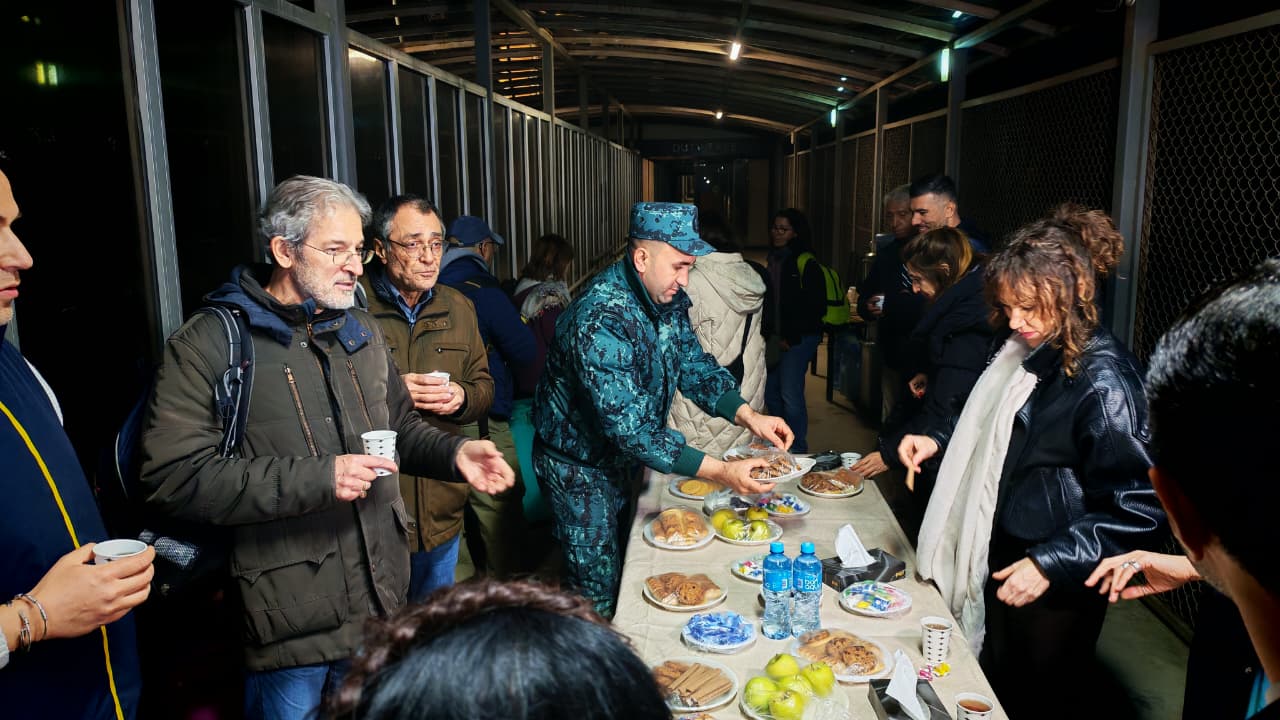

BAKU, Azerbaijan, March 11. The evacuation of citizens of both Azerbaijan and other countries from Iran continues, Trend reports.
From 08:00 (GMT +4) on February 28 to 10:00 on March 11, a total of 2,168 people, including citizens of various countries, were evacuated from Iran.
Thus, 633 Chinese, 383 Azerbaijani, 293 Russian, 174 Tajik, 137 Pakistani, 57 Oman, 44 Italian, 32 Indonesian, 29 Iranian, 26 Spanish, 25 Algerian, 18 Saudi Arabian, 17 Japanese, 16 French, 16 German, 13 Georgian, 12 Uzbekistan, 12 Hungarian, 12 Polish, 11 Mexican, 10 Nigerian, 10 Belarusian, 10 Bulgarian, 10 Congo Democratic Republic, 9 UK, 9 Canadian, 8 Brazilian and 8 Kazakh citizens were evacuated.
The list also includes 6 citizens each from the UAE, Slovakia, Belgium, and Romania, 5 citizens each from Serbia, Switzerland, the Czech Republic, Afghanistan, Austria, and India, 4 citizens each from Jordan, Bangladesh, Türkiye, Ukraine, Sri Lanka, Kuwait, Bahrain, the United States, Finland, and the Netherlands, 3 citizens each from Qatar, the Philippines, Croatia, and Denmark, and 2 citizens each from Nepal, Lebanon, Yemen, Kyrgyzstan, Sweden, Sudan, Cyprus, and Slovenia.
At the same time, 1 person each from Tunisia, South Africa, the Maldives, Myanmar, Cuba, the Vatican, Argentina, Bosnia and Herzegovina, Latvia, Egypt, Australia, and Belize was evacuated.
Since negotiations between the U.S. and Iran on the nuclear program did not lead to a concrete agreement, on February 28, the U.S. and Israel launched military airstrikes against Iran. In response, Iran has since been striking Israel and U.S. military targets in the region with missiles and drones.
On the first day of the military airstrikes on Iran, Iran's Supreme Leader Ayatollah Seyed Ali Khamenei and several high-ranking military officials were killed. On March 8, the Iranian Assembly of Experts unanimously elected Ayatollah Seyed Ali Khamenei's son, Seyed Mojtaba Khamenei, as Iran's third supreme leader.
From March 1 through March 5, the conflict expanded to include various countries in the Middle East.
According to the U.S., at least eight people were killed, and more than 140 were injured.
The conflict also seriously threatened the region's energy infrastructure and maritime transport. Due to security tensions around the Strait of Hormuz, oil prices on the world market rose sharply, and a number of countries urged their citizens to leave the region.
Stay up-to-date with more news on Trend News Agency's WhatsApp channel



