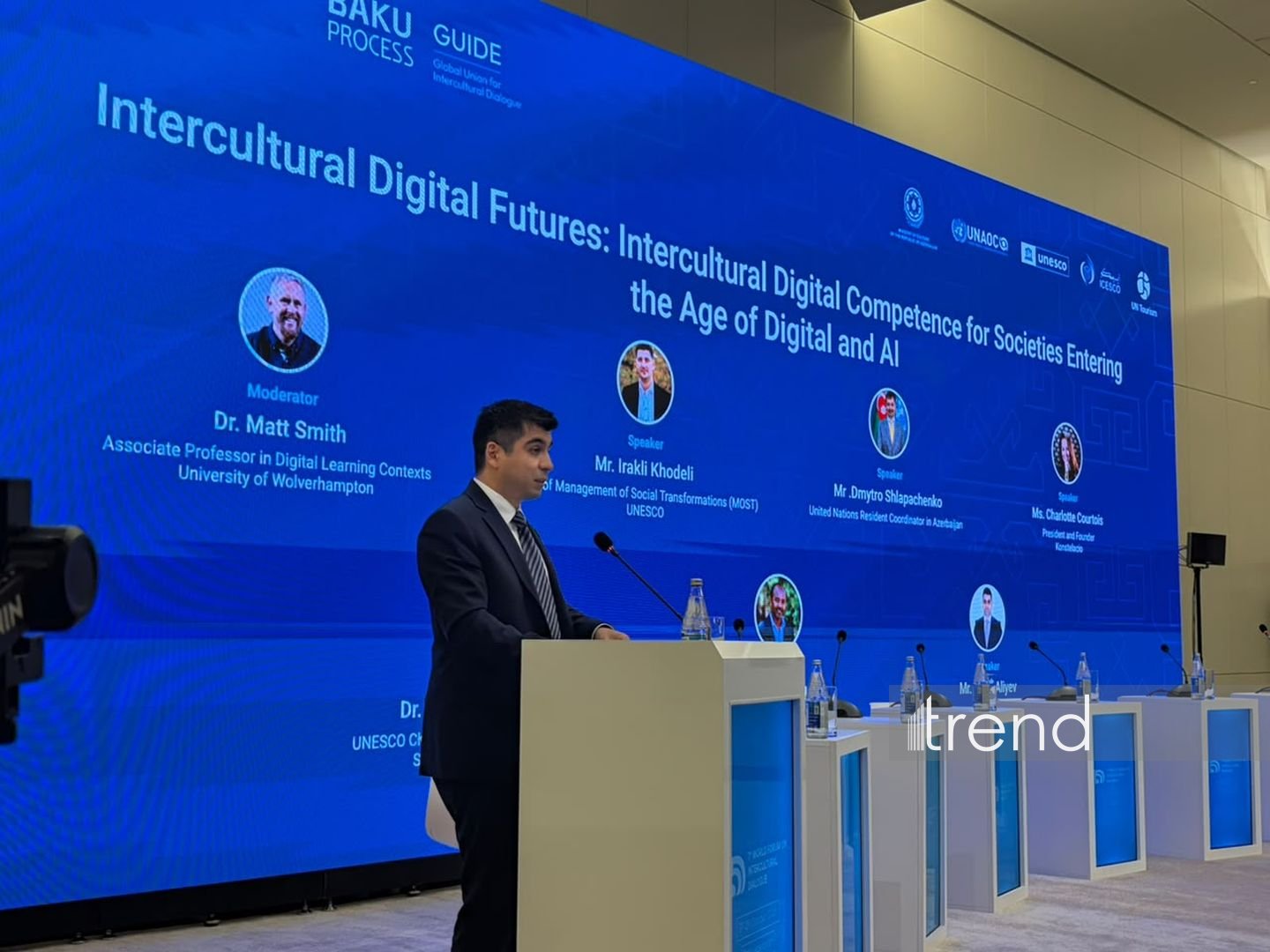
BAKU, Azerbaijan, October 27. Azerbaijan is developing Azerbaijani-language artificial intelligence (AI) models to be used in the provision of state services, Azerbaijan’s Deputy Minister of Digital Development and Transport, Rashad Hasanov, said during a discussion titled "Intercultural digital future: intercultural digital competence for societies entering the era of digitalization and artificial intelligence," held as part of the 7th World Forum on Intercultural Dialogue in Baku on Tuesday, Trend’s correspondent reports from the event.
He noted that AI is utilized across various aspects of life, from drafting emails and documents to assisting children with their homework. However, the responses generated by this technology often reflect a single, uniform cultural perspective.
"If you ask an AI how a family should care for an elderly parent, it will suggest professional care options. Yet, in most of our societies, including Azerbaijan, an elderly parent simply lives with us. This is not a decision regarding a service option; it is an integral part of who we are," emphasized Hasanov.
The deputy minister added that when an artificial intelligence chatbot is queried in a language spoken by one million people, rather than one billion, the responses may be shorter and of lower quality, and the system might gradually shift toward English. According to him, while these responses are not necessarily incorrect, they are incomplete and reflect a limited cultural perspective.
"The core question today is this: whose values does a screen present to us when we perceive the world through that screen? The same technology can connect people and communities, enabling them to learn from one another. At the same time, it can also narrow down diverse cultures, limiting them to the few languages and perspectives through which they are presented. It’s people, not machines, who decide the direction in which this will evolve," he said.
Highlighting the importance of UNESCO’s framework for intercultural digital competencies, Hasanov noted that knowing how to use a digital device is not enough; people must also be able to listen to one another, understand the perspectives of others, and critically question the information presented on the screen.
According to him, Azerbaijan’s AI strategy and the digital development action plan for 2026–2028 aim to ensure that services are accessible to every citizen, regardless of their age, language, or skill level.
"For objective reasons, global companies will not develop models in the Azerbaijani language for a market of 10 million people. Therefore, we are creating these capabilities ourselves. This has become a matter of sovereignty for us," the deputy minister remarked.
He pointed out that speech-to-text conversion and the first agent-based services have been introduced on the 'my.gov' application, a unified platform for interactions between citizens and the state. It's planned to expand the number of such services on the platform by the end of the year.
Hasanov also highlighted the importance of understanding the fundamentals of AI and cybersecurity by citizens, how to craft effective prompts, and how to identify fake news and fraudulent attempts.
According to him, training programs have been announced for various groups to this end. Under the recently launched "Digital Horizons" program, it’s planned to provide training to over 25,000 civil servants from 275 institutions in the coming months.
The deputy minister mentioned that, in collaboration with the Ministry of Science and Education, the safe application of AI in schools is being expanded. A number of tools are already in use, and the implementation of additional tools is also planned.
"Today, children in the digital environment face real dangers, such as manipulative algorithms, harmful content, addictive design, and interactions with strangers," he said.
Hasanov noted that the Azerbaijani parliament passed a law this year concerning the safety of children on social media. According to him, Azerbaijan was among the first countries to prohibit the use of social media by children under the age of 16.
The deputy minister explained that children under 16 aren’t permitted to create social media accounts, while those aged 16 to 18 require parental consent and the use of a parental control dashboard. Platforms must also disable infinite scrolling and autoplay features for children, cease targeted advertising, and remove harmful content within 24 hours.
"We believe that technology should serve our children. The digital age will be cross-cultural, regardless of whether we are prepared for it or not. Our task is to ensure that it’s also human-centric," Hasanov added.