


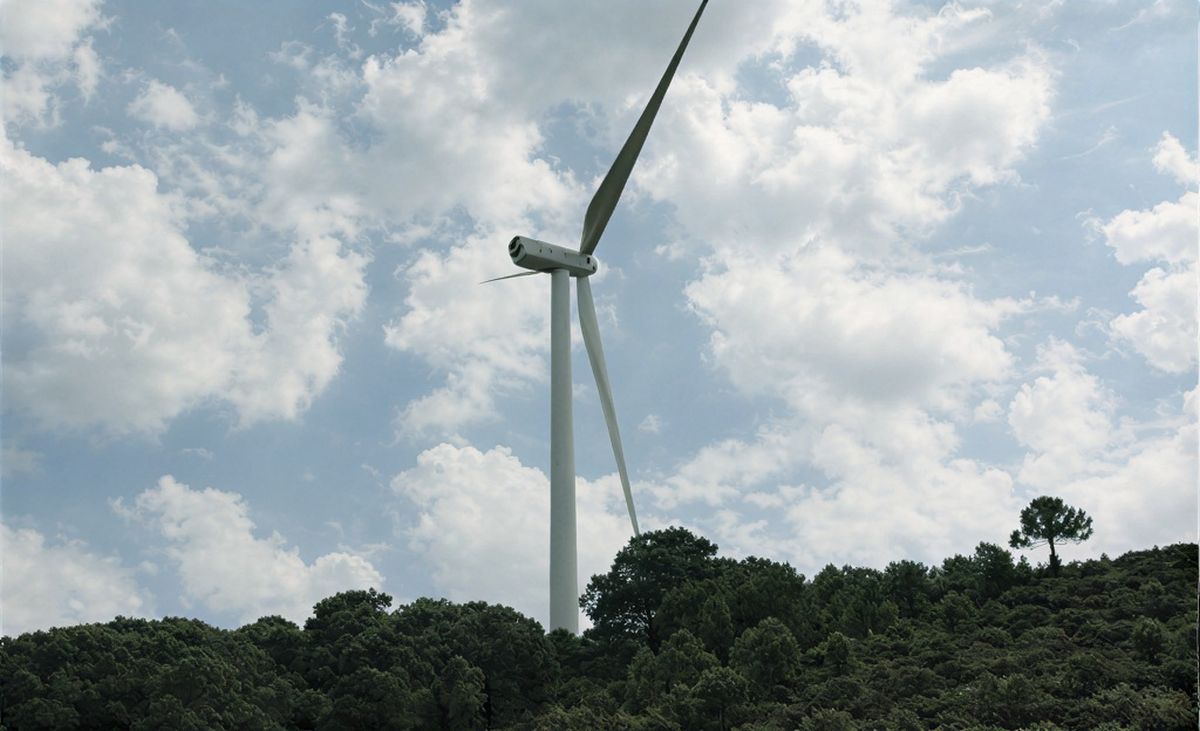

BAKU, Azerbaijan, October 27. Uzbekistan plans to increase the total capacity of its wind power plants to more than 10 gigawatts (GW) by 2030, strengthening wind energy’s role in the country’s renewable power mix.
This was reflected in the statement by the Ministry of Energy of Uzbekistan.
According to the Ministry, wind power plants in Uzbekistan can operate at full capacity for an average of 3,200 hours per year, compared with about 2,300 hours for solar power plants, according to Uzbek energy authorities.
This means a 1-megawatt (MW) wind power plant could generate about 1.4 times more electricity annually than a solar plant of the same capacity under the stated operating conditions.
The higher utilization potential is expected to make wind power an increasingly important component of Uzbekistan’s renewable energy portfolio as the country brings new projects online and diversifies its electricity generation mix.
Uzbekistan’s wind power sector has expanded rapidly in recent years. Six utility-scale wind power plants with a combined capacity of 1,672 MW were operational as of July 2026, according to the country’s Committee for Industrial, Radiation and Nuclear Safety. Between January and July, utility-scale solar and wind plants together generated 7.5 billion kilowatt-hours of electricity.
The government is planning a further substantial expansion. Uzbekistan’s Energy Ministry has said wind power capacity is expected to reach 12 GW by 2030, with new projects planned in Karakalpakstan and the Navoi, Bukhara, Jizzakh and Samarkand regions. Solar capacity is targeted at at least 7 GW over the same period.
One of the projects underpinning the expansion is the 500 MW Zarafshan Wind Power Plant in the Navoi region, developed with support from the Asian Development Bank. The project was designed to help meet rising electricity demand and diversify Uzbekistan’s energy mix.
Other projects are also moving forward. In May 2026, ACWA Power signed $226 million in financing agreements for the 300 MW Bash II wind farm in Bukhara region. The project is expected to begin commercial operations in the second half of 2027 and supply electricity to more than 336,000 households.
According to Trend’s calculations, the current 1,672 MW of installed utility-scale wind capacity represents about 14% of the 12 GW target for 2030, leaving roughly 10.3 GW of additional capacity to be developed. If the full 12 GW target is achieved, Uzbekistan’s wind capacity would be about 7.2 times its current level.
At the stated operating-hour assumptions, 1 GW of wind capacity could generate about 3.2 TWh annually, compared with 2.3 TWh for 1 GW of solar capacity. At 12 GW, wind facilities could theoretically generate about 38.4 TWh per year at 3,200 full-load hours, although actual generation would depend on wind conditions, plant availability and grid dispatch.
This expansion is taking place alongside broader upgrades to Uzbekistan’s power system. The country plans to raise total installed generation capacity to 46.1 GW by 2030 and is also developing new substations, battery storage and nearly 5,000 kilometers of transmission lines to accommodate additional generation.


