


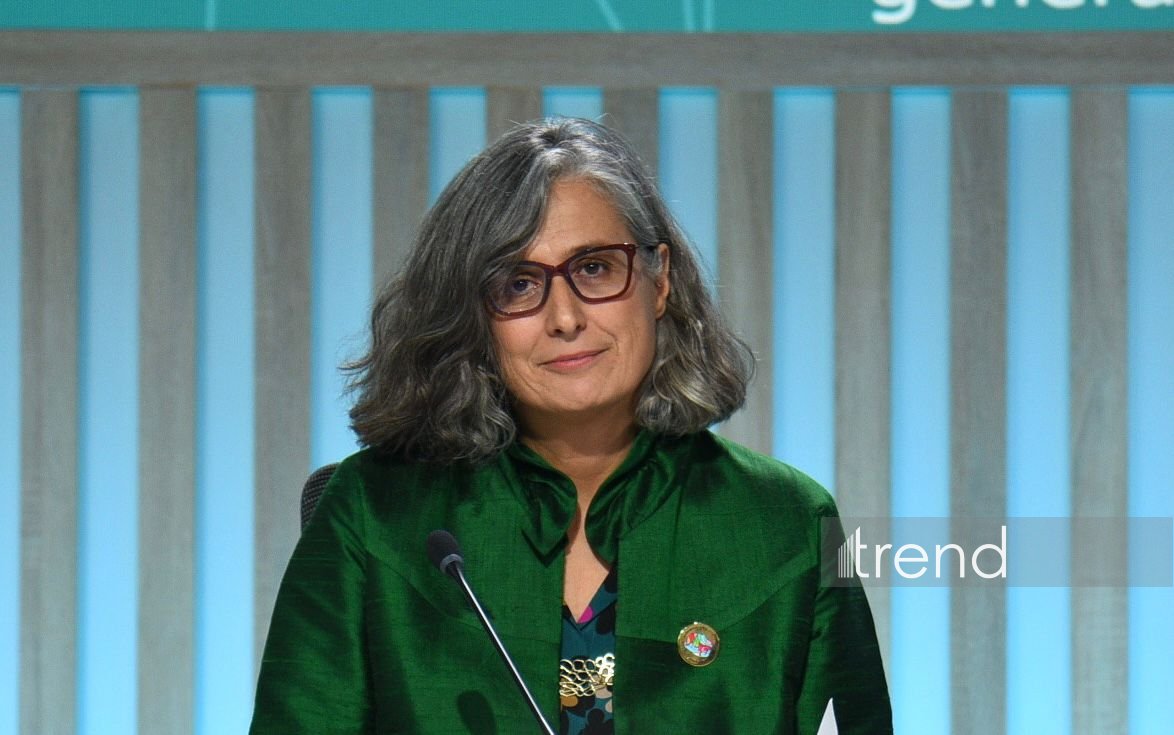
BAKU, Azerbaijan, May 22. UN-Habitat will maintain the strategic operational momentum generated in Azerbaijan as the international community transitions toward WUF14, systematically reinforcing the execution links connecting innovative ideas, multilateral partnerships, and concrete field implementation, UN-Habitat Executive Director Anaclaudia Rossbach said, Trend reports.
She made the remarks during the official closing press conference of the 13th session of the World Urban Forum (WUF13) in Baku.
According to her, the primary institutional challenge facing global governance does not lie in merely defining theoretical urban agendas, but in executing them effectively while permanently positioning adequate housing at the center of human dignity and sustainable metropolitan development.
"WUF13 has successfully solidified the global coalition driving systemic urban transformation. Ultimately, the long-term success of this forum will not face measurement by the mere scope of our panel debates in Baku, but by the tangible operational steps implemented from this point forward across individual cities, local communities, and national and global public policy frameworks," Rossbach emphasized.
The UN-Habitat chief noted that the international delegation concludes the Baku summit equipped with a renewed sense of institutional urgency, robust cross-border partnerships, and a shared responsibility to transform high-level multilateral commitments into field-level operations.
"We leave Baku with the absolute determination to carry this exact momentum directly into the next session of the World Urban Forum, scheduled to take place in Mexico City in 2028. Our collective expectation remains focused on documenting verified, data-backed breakthroughs in securing adequate housing for all by the opening of the WUF14 cycle," she concluded.
Today marks the final day of the 13th session of the World Urban Forum (WUF13).
The first day included a ministerial meeting dedicated to the New Urban Agenda, a ministerial roundtable, assemblies for women and civil society, business sessions, and discussions on urban prosperity. An official ceremony marking the raising of the UN and Azerbaijani flags also took place.
The second day stood out for the inaugural Leaders' Summit, featuring high-level discussions on the global housing crisis, urbanization policy, and urban resilience. Concurrently, the opening of the Mexico City pavilion took place, serving as a significant platform for expanding cooperation with the Latin American region and preparing for WUF14.
The third day of WUF13 featured a comprehensive program of events covering the global housing crisis, the formation of safe and inclusive cities, climate resilience, artificial intelligence and urban governance, green urbanization, social equity, and sustainable transport.
One of the highlights of the third day was the signing of a sister-city memorandum between the Azerbaijani city of Shusha and the Turkish city of Trabzon.
The fourth day of WUF13 featured a broad program of events dedicated to urbanization, climate change, inclusive urban development, housing policy, and sustainable governance.
The fifth day of WUF13 continued discussions on the global housing crisis, the creation of safe and inclusive cities, climate resilience, the use of artificial intelligence in urban management, green urbanization, and social equality.
One of the important events of the UN Special Program for the Economies of Central Asia (SPECA) Cities Forum, held on the fourth day, was the announcement of Almaty’s official accession to the “Declaration of Intent on the Establishment of the SPECA Smart Climate-Resilient Cities Forum.”
Also, for the first time in WUF history and at Azerbaijan’s initiative, the “WUF13 NGO Forum: Global Partnership and Decision-Making” was held.
WUF13, which has attracted more than 40,000 registered participants from 182 countries, will continue until May 22. Held under the theme “Housing the world: Safe and resilient cities and communities,” the forum brings together governments, international organizations, experts, and representatives of civil society to strengthen global cooperation in the field of sustainable urban development.



