


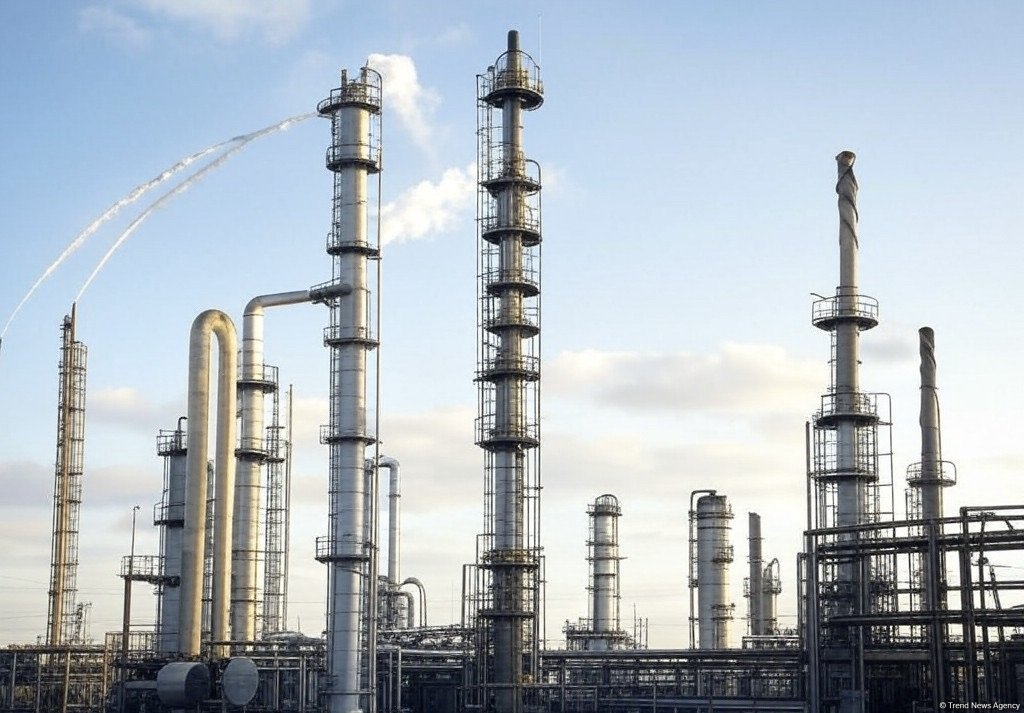

BAKU, Azerbaijan, February 6. Total refinery throughput in Q4 2024 stood at 1,432 thousand barrels per day (kb/d), marking a 7% decline from Q3 2024’s 1,539 kb/d, Trend reports.
The company attributed this quarter-to-quarter drop to a turnaround at the Leuna refinery in Germany, which constrained output. However, compared to Q4 2023, which posted 1,381 kb/d, throughput increased by 4%, reflecting some recovery.
On an annual basis, total refinery throughput for 2024 reached 1,472 kb/d, up 2% from 2023’s 1,436 kb/d. Regional throughput gains were observed across France (+2%), the rest of Europe (+2%), and the rest of the world (+3%).
The utilization rate based on crude for 2024 averaged 83%, falling short of the company’s 85% annual target. This was due to unplanned shutdowns at key facilities, including the Normandy and Donges platforms in France and the Port Arthur refinery in the United States. While still below expectations, the 2024 utilization rate marked an improvement from 2023’s 81%.
In the fourth quarter alone, utilization dropped to 82%, down from 86% in 3Q24, reflecting the immediate impact of the Leuna refinery turnaround. Compared to 4Q23, which had a 79% rate, the quarter showed an upward trajectory, albeit limited.
Petrochemicals production showed varied performance, with quarterly declines but annual growth. Monomer production in 4Q24 was 1,233 kilotons (kt), down 6% from 3Q24’s 1,314 kt. Similarly, polymer production fell 7% quarter-to-quarter, from 1,167 kt to 1,080 kt. These decreases reflected operational constraints, including planned and unplanned maintenance.
For the full year, monomer production increased by 4% to 5,082 kt in 2024, compared to 4,896 kt in 2023. Polymer production grew by 7%, reaching 4,433 kt compared to 4,130 kt in the previous year. The annual steam cracker utilization rate rose significantly, from 69% in 2023 to 79% in 2024, driven by enhanced efficiencies.



