


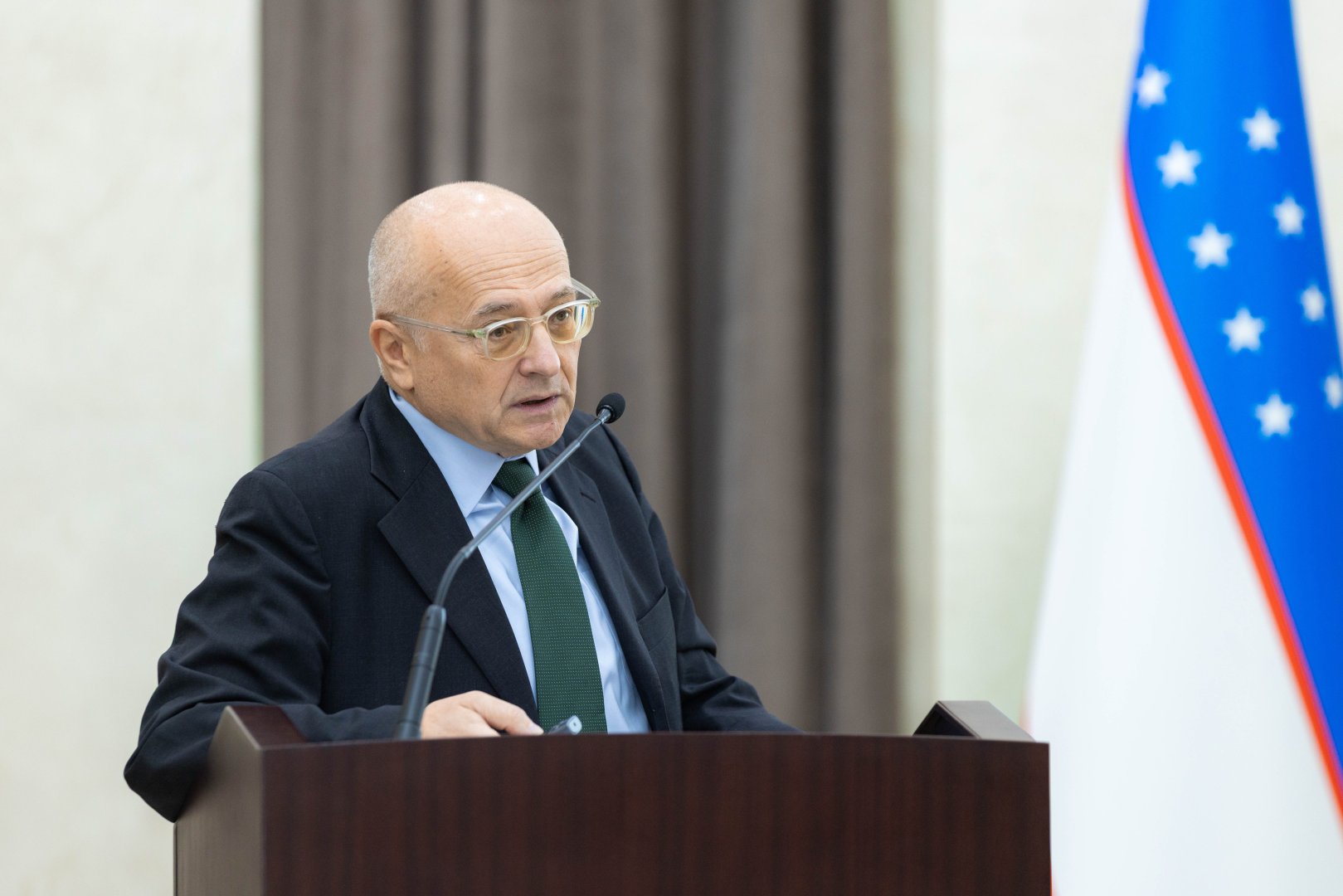

BAKU, Azerbaijan, November 16. Enhancing the role of the Middle Corridor requires not only investment in physical infrastructure but also the development of soft infrastructure - harmonization of customs and border procedures, simplification of paperwork, and digitalization, Roberto Cardarelli, Assistant Director of the International Monetary Fund's (IMF) Middle East and Central Asia Department, told Trend in an exclusive interview.
According to him, connectivity within the Middle Corridor is of great importance. Central Asia and the Caucasus occupy a strategic geographical position, serving as a bridge between East and West, connecting Europe with China and other parts of East Asia. The importance of this position has further increased amid the Russia-Ukraine war, which began in 2022, conflicts in the Middle East, trade wars, and other developments this year.
He noted that cargo volumes along the Middle Corridor had grown rapidly over the past four to five years, increasing more than threefold.
"There is potential to improve the Middle Corridor so that it becomes more significant alongside the Northern and Southern routes. This requires infrastructure - roads, railways, and pipelines," Cardarelli said.
At the same time, he said, physical infrastructure alone is not enough to fully realize the potential of the Middle Corridor. Countries in the region are interested not simply in becoming transit territories for cargo transportation. It is important to use the development of transport routes to reduce trade costs, facilitate trade, attract investment, and diversify economies.
"This requires what is known as soft infrastructure. To reduce trade costs, customs and border procedures need to be harmonized, the paperwork required to move goods from one country to another needs to be simplified, and the opportunities offered by digitalization and new technologies need to be utilized," Cardarelli said.
He also noted that structural reforms, which countries in the region need to implement regardless of developments in transport connectivity, could significantly increase the effectiveness of investment in logistics infrastructure.
"All reforms aimed at developing the private sector and improving public governance will help ensure returns on these investments. This applies to the China-Kyrgyzstan-Uzbekistan railway, as well as all infrastructure related to energy and electricity. All structural investments must be accompanied by appropriate structural reforms to deliver real benefits," Cardarelli said.
Speaking about Azerbaijan's economic diversification, Cardarelli noted that expanding exports through goods and services unrelated to the commodity sector is important for strengthening the economy's resilience to external shocks.
"We live in a world where supply shocks are becoming more frequent. In our report, we show that economies with more diversified export bases have been the least affected by such shocks.
As for specific areas, these include both goods and services, whose role in international trade is constantly growing. Much depends on the individual country. However, the overall conclusion is that trade diversification is important both for economic resilience and for long-term growth," he said.
At the same time, Cardarelli emphasized that structural reforms are necessary to secure the long-term benefits of trade diversification.
"Returning to what I mentioned earlier, reforms aimed, for example, at improving the quality of human capital and public governance are of great importance in ensuring that export diversification efforts deliver tangible results. Such efforts will be more successful if implemented alongside structural reforms," he said.
Commenting on Kazakhstan's monetary policy, Cardarelli noted that, despite slowing inflation and four cuts to the base rate since the beginning of the year, monetary policy should remain tight. According to him, if inflation continues to exceed the target, further tightening may be necessary.
"An IMF mission is currently in Kazakhstan, discussing this issue with the government and the country's central bank. However, this is not only about interest rates but also about the level of liquidity. For example, excess liquidity can be absorbed through adjustments to reserve requirements. This is another aspect of monetary policy," Cardarelli said.
Responding to a question about the potential contribution of the Rogun hydropower plant to Tajikistan's long-term economic growth, Cardarelli noted the scale of the project, whose cost is estimated at approximately 40% of the country's GDP.
"This is certainly an important project that will help address the electricity shortage, make electricity cheaper, and create opportunities for its export. A significant part of the Rogun hydropower plant's potential is specifically related to the possibility of selling and exporting electricity to neighboring countries. This highlights the importance of regional integration, particularly in the energy market, although it is necessary in many other areas as well," he said.
According to Cardarelli, realizing the project's export potential requires investment not only in generation capacity but also in electricity transmission and distribution infrastructure, including the interconnection of national power grids.
"Electricity generation is only the first part of the task. Transmission and distribution systems are then needed. Therefore, it is important to ensure the interconnection of national power grids. This will allow the project to become significant not only in the short term but also in the long term, providing the country with the opportunity to export electricity. This is one of Tajikistan's comparative advantages in hydropower," he noted.
Cardarelli added that the Rogun hydropower plant could help not only reduce electricity shortages in the region but also expand Tajikistan's export opportunities, supporting the country's long-term economic growth.
At the same time, he drew attention to the financial risks associated with the scale of the project. According to him, at a certain stage of its implementation, substantial imports of capital goods and increased financing, including through borrowing, will be required.
"From a financial perspective, the project needs to be properly monitored and managed. However, it is certainly capable of improving the country's long-term economic prospects," Cardarelli emphasized.


