


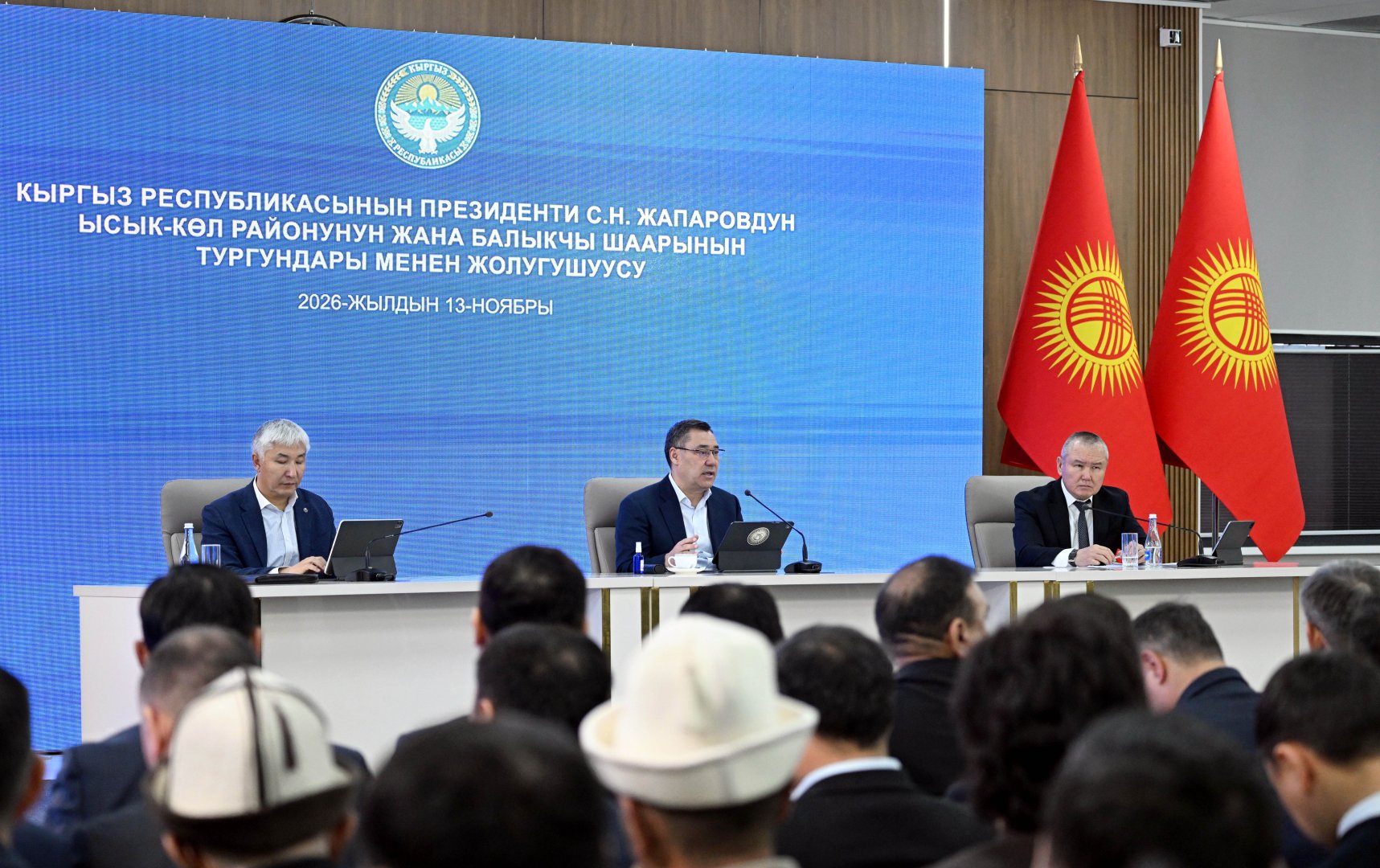
BAKU, Azerbaijan, November 16. Kyrgyz President Sadyr Japarov, during a working visit to Issyk-Kul region, reviewed the region’s socio-economic development results for 2021-2026 (with 2026 figures covering part of the year), including growth in industrial production, the implementation of infrastructure projects, and the expansion of tourism potential. The visit outlined the main priorities for the region’s further development, including attracting investment, creating new jobs, and modernizing transport and utility infrastructure.
The data presented to the president indicate a significant increase in budget funding and industrial activity. In Issyk-Kul district, for example, funding allocated from the republican budget increased from 142.5 million soms ($1.63 million) in 2021 to 1.8 billion soms ($20.58 million) in the first ten months of 2026. Over the past five years, 63 enterprises have been established in the district, creating 2,154 jobs. Industrial output reached 826.2 million soms ($9.45 million) in the first ten months of this year, six times the 2021 level.
Industrial development is also gaining momentum in other parts of the region. In Tyup district, 55 enterprises have been established and 900 jobs created over the past five years, while industrial output has more than doubled. Projects that could shape the region’s future economic specialization include the Kurmenty cement plant, the Tyup hydropower plant, and an agro-logistics center.
In Ak-Suu district, tourism is emerging as an additional driver of growth, with visitor numbers increasing more than eightfold over the period under review. Major prospective initiatives include the Ala-Too Resort national tourism complex. Separately, the construction of a ski resort worth 2.6 billion soms ($29.73 million) is under consideration in Cholpon-Ata.
In Karakol, the focus has been on expanding the industrial base and transport infrastructure. A total of 33 projects to establish production facilities, worth 349.6 million soms ($4 million), are being implemented and have reportedly created 1,155 jobs. Industrial output reached 4.6 billion soms ($52.6 million) in the first nine months of 2026. In addition, Karakol International Airport has been modernized at a cost of 2.1 billion soms ($24.01 million), 60 buses have been purchased, and 61.8 kilometers of new roads have been built.
At the same time, regional development extends beyond industry. In Balykchy, 2.2 billion soms ($25.16 million) has been allocated for the implementation of 65 infrastructure projects. The city has completed construction of a municipal fish market worth 140 million soms ($1.6 million), while construction of a new market worth 538 million soms ($6.15 million) is ongoing. A total of 270 million soms ($3.09 million) has been allocated to healthcare infrastructure. Following the launch of a catheterization laboratory, 235 patients have received cardiac stents there.
Tourism holds particular importance for the region. The development of winter tourism, including ski infrastructure, could help extend a tourist season that has traditionally depended largely on summer holidays along the shores of Lake Issyk-Kul.
However, the further development of tourism will depend not only on the construction of hotels, resorts, and transport facilities. During meetings with the president, local residents raised issues related to access to drinking water, the construction of a railway line, road network development, the settlement of land disputes, and the preservation of Lake Issyk-Kul’s ecosystem. Other topics included support for agricultural producers, infrastructure accessibility for people with disabilities, and the performance of law enforcement agencies.
At one of the meetings, Japarov said that Kyrgyzstan’s security image had improved significantly in recent years, which, according to him, had contributed to an increase in tourist arrivals and investment. The president also stressed the need to step up efforts to combat organized crime and instructed government agencies to review citizens’ appeals in accordance with the law.
These concerns indicate that, alongside attracting investment, the region will need to address challenges related to sustainable development. In particular, the construction of new tourism facilities and an increase in visitor numbers will require further investment in water supply systems, wastewater treatment facilities, and utility infrastructure. Plans to build wastewater treatment facilities in Cholpon-Ata, Bosteri, Baktuu-Dolonotu, and Kara-Oi have already been included among the projects being implemented.
Going forward, the pace of development will depend on how the announced projects progress. If they are implemented on schedule, the region could gain additional production capacity, create more jobs, and develop more diversified tourism infrastructure. Alternatively, major initiatives could be postponed due to financial, technical, or organizational constraints, while projects already at an advanced stage move ahead gradually. In either case, rising tourist numbers may require additional measures to safeguard the lake and its surrounding environment.
Overall, the future economic performance of Issyk-Kul region will depend on the pace of investment project implementation, the ability of infrastructure to accommodate growing tourist flows, and the resolution of issues raised by local residents. Industrial development, tourism growth, and higher living standards will remain among the region’s main priorities.


