


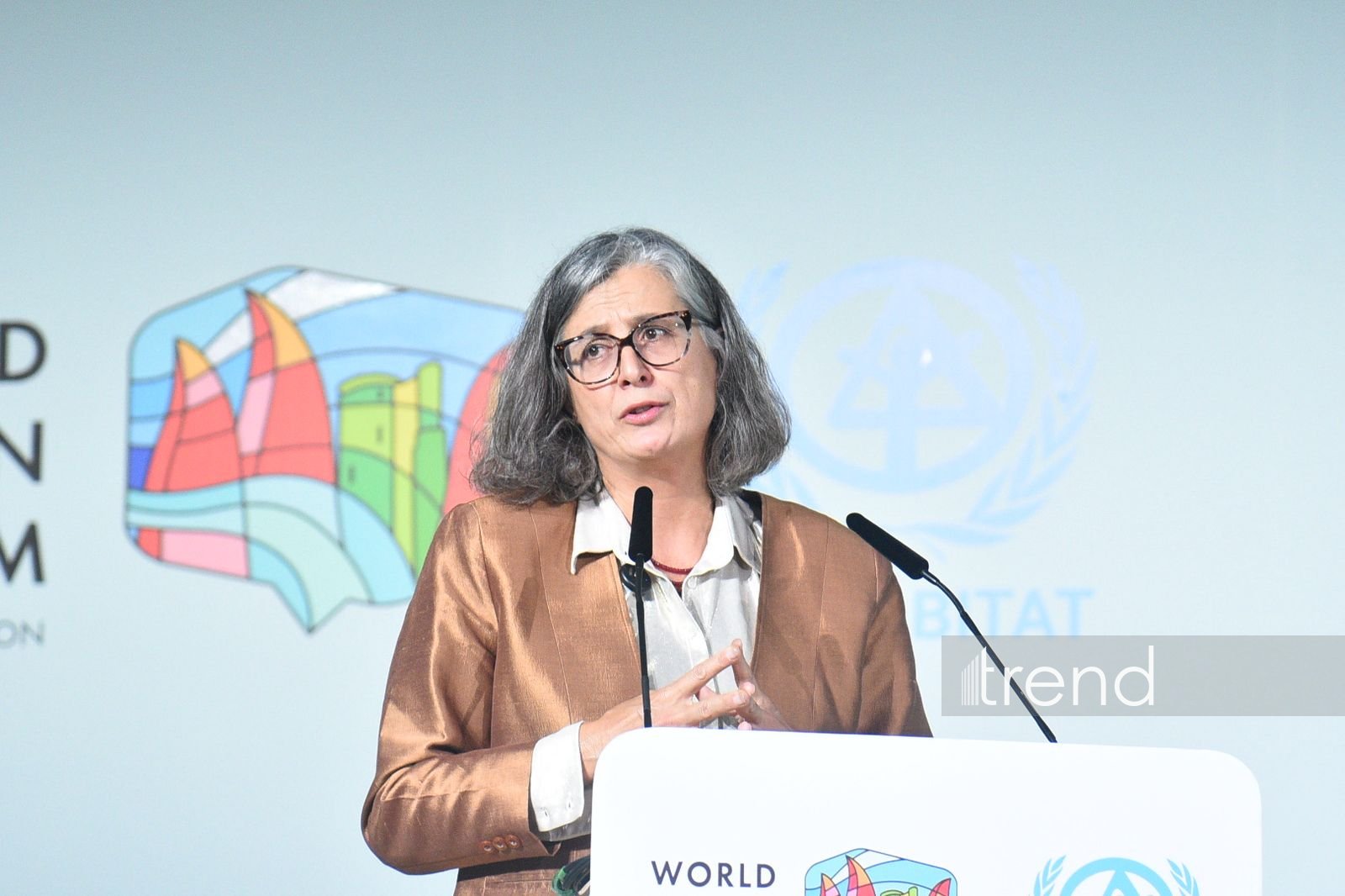

BAKU, Azerbaijan, May 17. Faster action is needed to implement the New Urban Agenda globally, Anaclaudia Rossbach, Executive Director of the United Nations Human Settlements Programme (UN-Habitat), said during the Ministerial Meeting on the New Urban Agenda held within the framework of WUF13 in Baku, Trend reports.
In her address, she expressed gratitude to the Government of Azerbaijan and the event organizers, emphasizing that 2026 represents a crucial milestone for the implementation of the New Urban Agenda.
"This year is not only a year for reporting, but also a year for defining new approaches. We must identify which steps have yielded results, where we are lagging behind, and what we need to do differently moving forward," she noted.
The head of UN-Habitat stated that the New Urban Agenda remains the core global framework for the sustainable development of human settlements and cities. According to her, cities are not just places where problems are concentrated, but are also the primary platforms where large-scale solutions can be deployed.
Rossbach noted that a number of significant achievements have been made over the past decade: "Currently, approximately 160 countries have adopted or are developing national urban policy frameworks. More than two-thirds of countries have approved national housing policies, and hundreds of cities have submitted voluntary local reviews."
According to her, urban priorities are also beginning to feature more prominently in climate policies: "Thus, the share of national climate commitments that include urban components has risen from 49 percent in 2021 to 80 percent in 2025.
However, the implementation of the New Urban Agenda is still uneven and, in many cases, not fast enough."
"Commitments often do not translate into sustained investments, real results at the local level, and measurable changes in people's lives," she emphasized.
Rossbach stated that housing remains one of the most serious challenges on a global scale. According to her, more than 1 billion people worldwide currently live in slums or informal settlements: "The problem of housing affordability is deepening in both developed and developing countries. People living in inadequate housing conditions are also more exposed to floods, heatwaves, landslides, and other climate risks. In the last two decades, a significant increase in temperature has been recorded in more than 80 percent of cities."
The UN-Habitat chief emphasized that the housing issue cannot be viewed merely as a construction sector.
"This issue is directly linked to land policy, infrastructure, finance, governance, climate action, and human rights," she said.
Rossbach noted that the coming decade must be a period of large-scale implementation. According to her, this requires strengthening inclusive housing policies, especially for people living in informal settlements and those at risk of homelessness.
She also stressed the importance of linking housing policy with land, transport, employment, public spaces, and basic services.
Concluding her speech, Rossbach stated that UN-Habitat stands ready to support member states, local and regional authorities, as well as partners in this direction.



