


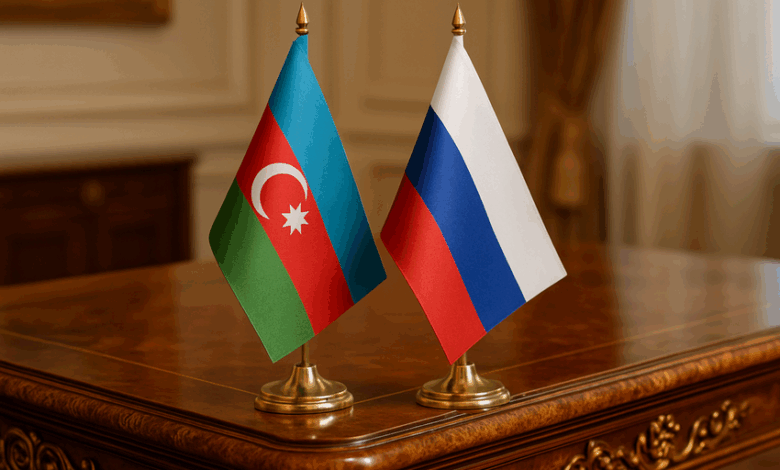
BAKU, Azerbaijan, October 9. As reported earlier, a one-on-one meeting between the President of the Republic of Azerbaijan, Ilham Aliyev, and the President of the Russian Federation, Vladimir Putin, took place in Dushanbe.
This meeting clearly demonstrated that bilateral relations are developing in a constructive and positive direction after the tensions observed in recent months. The content of the meeting and the views expressed by Russian President Vladimir Putin demonstrated that the parties intend to continue relations based on the principles of mutual respect, equality, and strategic partnership.
During the meeting, Vladimir Putin expressed his condolences over the crash of an Azerbaijan Airlines (AZAL) passenger plane.
Moreover, it was noted that the investigation into the incident is ongoing and will be completed in the near future. The Russian President stated that Russian airspace had been violated that day and that the Russian Air Force had opened fire. Although the plane was not shot at, it was hit by shrapnel. Compensation will be paid, and those responsible will be punished.
The fact that Russia presented the issue of the aircraft incident as a “resolved matter” indicates that the shadow of tension in diplomatic relations has dissipated. The Azerbaijani side, preferring to assess the incident logically and based on mutual understanding rather than emotionally, continued to defend the strategic nature of the relationship.
The meeting also demonstrated that attempts by third parties to undermine Azerbaijani-Russian relations had failed. In particular, some pro-Armenian figures in Russian public and political circles, such as Simonyan, Solovyov, Zatulin, and others, have long tried to cast a shadow on bilateral relations and create artificial tension. However, direct and sincere contacts between the heads of state have shown the futility of these attempts.
President Putin's statements to the media sent a clear signal about the need to prevent anti-Azerbaijani rhetoric and information provocations in Russia, which is also a cause for concern for Azerbaijan. This statement demonstrated the desire of official circles in Moscow to move away from destructive propaganda and maintain relations in a spirit of strategic cooperation.
In fact, this meeting proved that, against the backdrop of recent developments in the region, Azerbaijan and Russia continue to view each other as important partners and factors of regional stability. Cooperation between Baku and Moscow remains important in terms of promoting the peace process in the South Caucasus, opening transport and communication lines, and coordinating security issues.
Ultimately, this meeting can be seen as an important step towards practical cooperation, restoring mutual trust and resuming strategic dialogue in bilateral relations. The political will of the presidents of Azerbaijan and Russia has demonstrated that relations between the two countries are based not on provocations by third parties, but on the principles of mutual interest and cooperation in the name of regional stability.



