


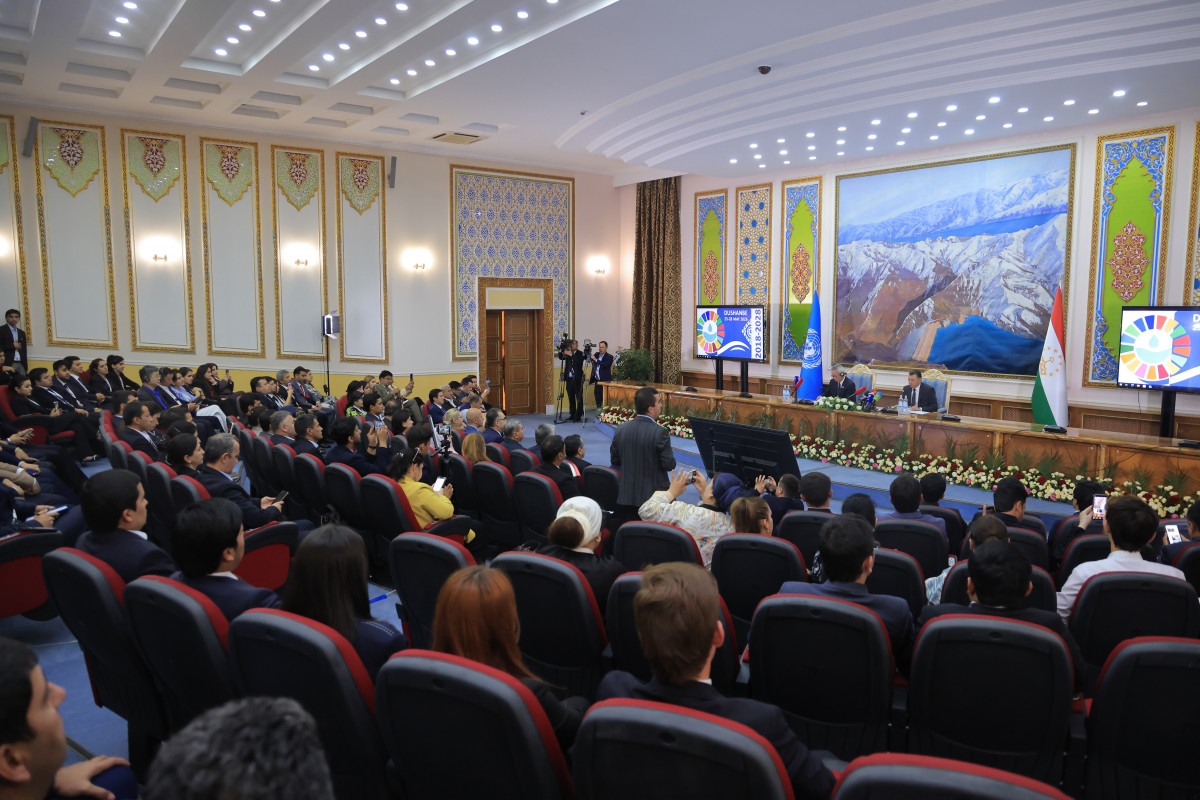

DUSHANBE, Tajikistan, May 27. The 4th High-Level International Conference on the International Decade for Action “Water for Sustainable Development” 2018–2028 has concluded in Dushanbe, bringing together around 2,500 participants from 110 countries, Trend reports via the Tajik MFA.
Speaking at a press conference summarizing the conference results, Prime Minister of Tajikistan and Chairman of the National Organizing Committee Kokhir Rasulzoda said that Dushanbe had served as a global platform for discussing key issues on the water and climate agenda, strengthening international cooperation, and promoting joint action in sustainable water resources management.
According to him, particular attention during the conference was given to advancing the goals of the International Decade for Action “Water for Sustainable Development” and accelerating progress toward Sustainable Development Goal 6 in preparation for the 2026 UN Water Conference.
Discussions focused on integrated water resources management, access to water and sanitation, regional and transboundary cooperation, as well as the expansion of partnerships aimed at implementing the global water agenda.
Participants also reviewed the implementation of voluntary commitments, financing mechanisms, the introduction of technologies and innovations, and the links between water issues, climate change, sustainable development, ecosystems, and UN multilateral processes.
Kokhir Rasulzoda noted that special emphasis was placed on inclusive approaches and broader participation of women, youth, the scientific community, the private sector, and other stakeholders in advancing the international water agenda.
The conference program included a youth forum, a women and water resources forum, and a private sector forum focused on Africa, alongside a special exhibition showcasing modern technologies, scientific developments, innovative solutions, and best practices in water management.
Furthermore, the conference brought together representatives of UN member states, UN agencies, international and regional organizations, financial institutions, civil society, academia, and the private sector.
According to the government, the event gathered around 1,100 foreign participants, representatives of 75 international and regional organizations, and 170 NGOs and academic institutions, highlighting strong international interest in the Dushanbe Water Process.
Following the conference, participants adopted the Dushanbe Declaration. In addition, a Co-Chairs’ Summary and the contribution of the Dushanbe Water Process to the 2026 UN Water Conference will be prepared and presented.
The documents contain recommendations and practical guidelines aimed at strengthening international cooperation, promoting partnerships, and accelerating commitments in the field of water resources.
Kokhir Rasulzoda stressed that Tajikistan would continue efforts to promote the global water and climate agenda and strengthen international cooperation to achieve sustainable development goals.



