


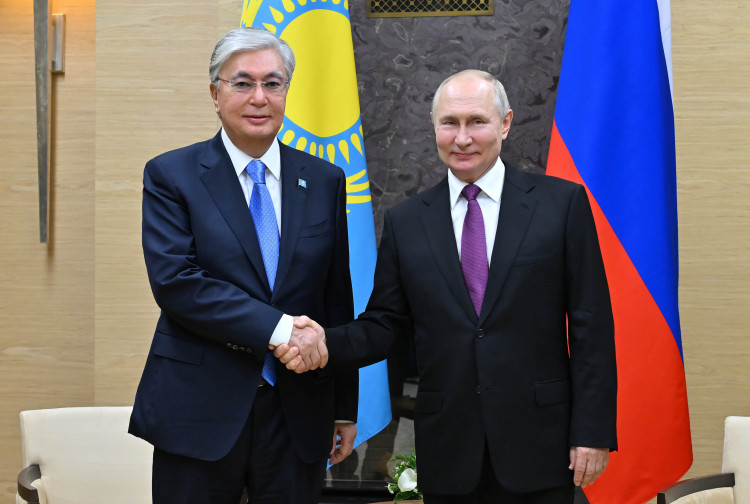

ASTANA, Kazakhstan, May 27. Russian President Vladimir Putin will pay a state visit to Kazakhstan on May 27–29. As part of the visit, the Eurasian Economic Forum, involving the heads of state of the Eurasian Economic Union (EAEU) member countries, as well as a meeting of the Supreme Eurasian Economic Council, will be held.
Relations between Kazakhstan and Russia in 2025–2026 have maintained their traditionally high level. In November 2025, the state visit of President of Kazakhstan Kassym-Jomart Tokayev to Russia concluded with the signing of a declaration on the transition to a comprehensive strategic partnership and alliance. In 2026, bilateral dialogue continued at a high level. A working visit by Russian Prime Minister Mikhail Mishustin to Kazakhstan took place, and Russian Foreign Minister Sergey Lavrov also paid an official visit to the country.
Economic cooperation between the two countries continues to expand. Russia ranks second among Kazakhstan’s trade partners after China. According to the Bureau of National Statistics of Kazakhstan, trade turnover between Kazakhstan and Russia amounted to $6.456 billion in January–March 2026, accounting for 19.6% of Kazakhstan’s total foreign trade turnover. This represented an increase of 16.2% compared to the corresponding period of the previous year. Russia also ranked first in imports to Kazakhstan with a share of 33.3% and third in Kazakhstan’s exports with a share of 8.3%. The parties intend to increase bilateral trade turnover to $30 billion annually. By the end of 2025, the figure had already reached $27.4 billion.
The investment partnership between the two countries also remains substantial. According to official data, Russian investments in Kazakhstan have exceeded $28 billion over the past 20 years, while Kazakh investments in Russia amounted to approximately $9 billion. This has contributed to the formation of a stable network of joint projects and business ties supporting trade and industrial cooperation.
Transport and logistics play a major role. The countries are developing the international “North–South” corridor, in particular its eastern route with the participation of Turkmenistan and Iran. By 2030, its throughput capacity is expected to reach 20 million tons per year. Routes such as “Western Europe – Western China” and border infrastructure are also being developed. In November 2025, a roadmap for the modernization of automobile checkpoints was signed. It provides for increased throughput capacity, reduced border crossing time, and simplified conditions for business. On the Kazakh side, 30 checkpoints are being modernized. In 2026, a memorandum of cooperation in the field of unmanned transport and digital technologies was also signed.
Energy remains a key element of relations. Up to 80% of Kazakhstan’s oil exports pass through the Caspian Pipeline Consortium, which goes through the territory of Russia to the port of Novorossiysk. The CPC remains the main oil export route and directly links Kazakhstan’s budget with Russian transit infrastructure. Russia is also building the first nuclear power plant in Kazakhstan on the shore of Lake Balkhash.
In May 2026, meetings were held in Moscow between the Minister of Energy of Kazakhstan and the Deputy Prime Minister of Russia and the Minister of Energy of the Russian Federation. Earlier, in October 2025, Gazprom and the Government of Kazakhstan signed a memorandum on the gasification of Kokshetau and Petropavlovsk through the expansion of the “Saryarka” gas pipeline.
Trade, energy, and logistics remain system-forming directions of economic cooperation between Kazakhstan and Russia. Their integration ensures the stability of bilateral ties, despite Kazakhstan’s development of alternative transport routes, including the Middle Corridor, aimed at diversifying logistics. State visits and regular high-level meetings confirm the stability of bilateral interaction.



