


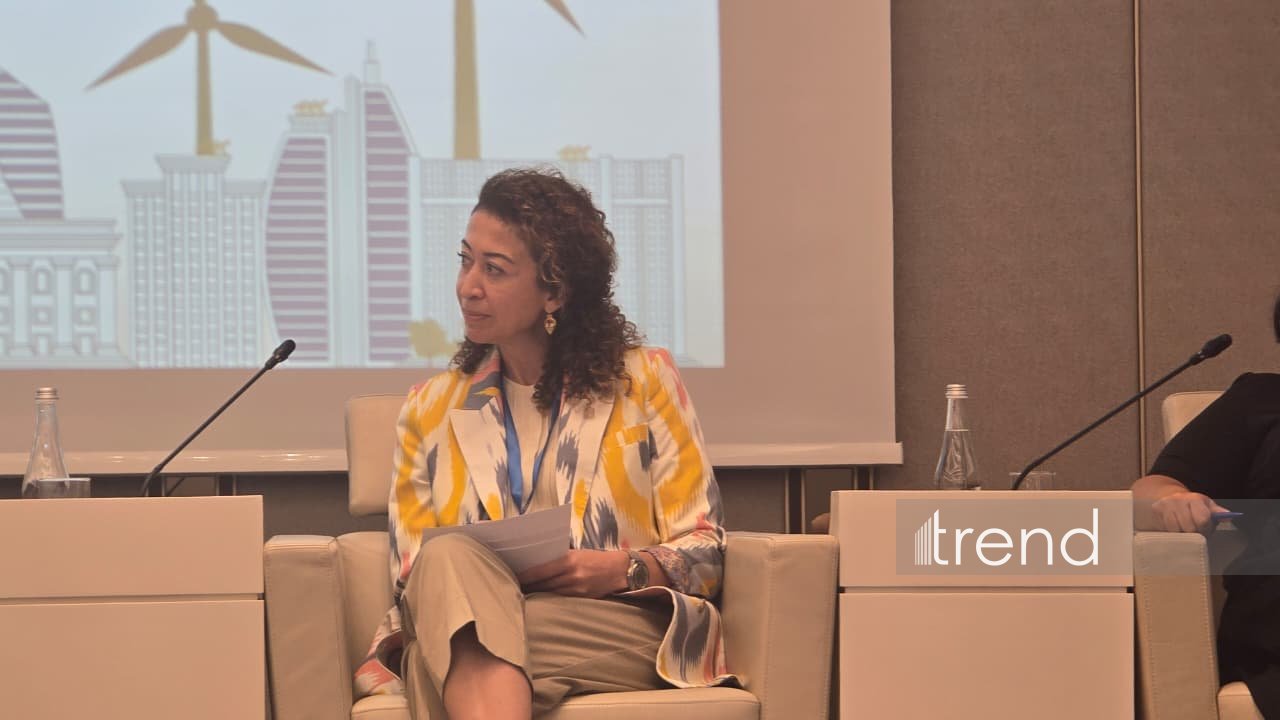
BAKU, Azerbaijan, September 7. Azerbaijan's energy transition has great opportunities for German companies, Executive Director of the German-Azerbaijani Chamber of Commerce (AHK Azerbaijan), Nargis Wieck, said during a discussion within the framework of the Baku Climate Action Week 2026 (BCAW 2026), Trend's correspondent reports from the event.
According to her, the participation of German companies in Azerbaijan's energy transition can cover mainly two directions: bringing technology and equipment to Azerbaijan, as well as attracting German investments to the country.
"Our main goal is to promote and support German companies in Azerbaijan. In terms of energy transition, we are talking about exporting technology and equipment for this sector, as well as attracting German investments to Azerbaijan," Wieck explained.
She noted that before talking about the obstacles in the market, it is necessary to pay attention to the opportunities.
"I would like to take a more positive approach. Although there are obstacles, there are also opportunities. First of all, as AHK, we must do our job. We must inform the German business community in more detail about the processes taking place in Azerbaijan and the region," the executive director stressed.
According to Wieck, there is a certain information gap in Germany regarding the processes taking place in the Caspian region, as well as in the field of connection with Central Asia.
"There is a lot happening in the region right now. That is why we, as AHK, are creating clusters by sector. We pay special attention to areas where we see the greatest opportunities for German companies. One of these areas is the energy transition," she said.
The head of AHK Azerbaijan pointed out that Germany has decades of experience in the field of energy transition.
"In Germany, we understand the energy transition as a bottom-up process, not a top-down one. This process starts with awareness, education, and people who are part of the transition. I think this is also very important for Azerbaijan," Wieck noted.
She recalled that during the COVID-19 pandemic, consulting services were provided in Azerbaijan on the use of renewable energy in decentralized heat and power generation.
"It was a very interesting experience. At that time, we were talking about market mechanisms. Now, when we look at Azerbaijan, we see how many processes are going on here. I am proud to have partners like Elmir Musayev and SOCAR Green, who actively contribute to the energy transition in Azerbaijan," she added.
Wieck mentioned that one of the main issues for foreign investors is the financial justification of investments and risk assessment.
"Investments in energy transition are long-term projects. Many issues need to be taken care of here. First of all, market transparency is important. Everyone should understand what the strategy and national concept of energy transition are," she said.
According to her, the possibility of financing projects and the correct assessment of risks are also important for investors.
"We need to determine how we can assess the financial risks of investors. We also need to demonstrate exemplary projects. We currently have a privately funded project with the Azerbaijan Renewable Energy Agency (AREA), and we need to present such projects to our partners in Germany," Wieck underscored.
The executive director of AHK Azerbaijan further said that standardization and certification are also important in the energy transition.
"Standards and certification are also necessary. It is also very important to have reliable local partners. I want to connect this with the activities of AHK. We need to create platforms where financial institutions, state institutions, and other partners can discuss specific projects," Wieck concluded.
The fourth Climate Week (CW4) of the UN Framework Convention on Climate Change is being held in Baku through September 11, hosted by the Republic of Azerbaijan and organized by the Azerbaijani Ministry of Foreign Affairs.
Baku, which has become an important international platform for the climate agenda, is hosting discussions on the practical implementation of climate decisions, the expansion of international cooperation, and further strengthening global climate action ahead of COP31.
Representatives of governments and international organizations, experts, financial institutions, the private sector, and civil society from various countries are expected to attend the events.
Baku Climate Week is designed as an international platform for discussions on combating climate change, the energy transition, renewable energy, sustainable development, and accelerating climate action.
The events will further strengthen Baku’s active role in the global climate agenda and make an important contribution to strengthening international climate cooperation ahead of COP31.



