


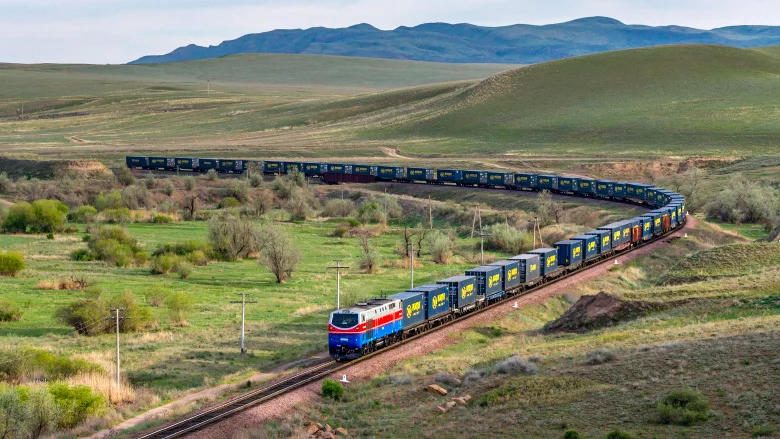

BAKU, Azerbaijan, April 6. The integration of the Persian Gulf region with the Middle Corridor may become one of the defining trade routes of the future, according to Azerbaijan Railways (ADY), Ziya Mammadov, Deputy Head of the Marketing Department at ADY, said in a post on his social media page, Trend reports.
The post noted that in recent years, shifts in global supply chains, rising geopolitical risks, and the need to optimize logistics costs have accelerated the search for alternative transport routes.
"In this context, the growing interest of Persian Gulf countries in accessing Eurasian markets through new corridors is becoming increasingly evident," the post said.
According to the information, countries such as Saudi Arabia, the United Arab Emirates, and Qatar are actively seeking more resilient and flexible logistics solutions to strengthen their position in global trade.
"As a significant share of global trade routes depends on the Strait of Hormuz, any disruption or instability in this chokepoint directly affects supply chains. Potential blockages can lead to prolonged and unpredictable delays, increasing operational costs and reducing reliability for both logistics providers and cargo owners.
Against this backdrop, the Middle Corridor via Azerbaijan is evolving from an alternative option into a strategic necessity. It connects the Gulf region with the Caucasus, Europe, and Central Asia, offering a flexible multimodal transport solution while diversifying geopolitical and logistical risks," he stated.
The post emphasized that the integration between the Gulf region and the Middle Corridor is therefore not merely an alternative route, but a transformation of Eurasia’s economic geography.
"It enables stronger interregional trade linkages and supports
the development of more balanced and resilient supply chains.
If effectively developed, Azerbaijan has the potential to evolve
from a transit country into a major global logistics hub. This
would significantly enhance its geoeconomic importance and create
new opportunities for long-term regional cooperation," he
noted.
Mammadov added that logistics is no longer just about distance, it is about resilience, flexibility, and effective risk management.
"In this regard, the integration of the #MiddleCorridor may become one of the defining trade routes of the future," he saiid.
The Middle Corridor is a transport trade route passing through several countries in the region and connecting Asia with Europe. It serves as an alternative to the traditional Northern and Southern corridors.
The route begins in China and passes through Central Asian countries such as Kazakhstan, Uzbekistan, and Turkmenistan. It then crosses the Caspian Sea, Azerbaijan, Georgia, and Türkiye before reaching Europe. The Middle Corridor is a land-based route that bypasses longer maritime paths, linking eastern parts of Asia, including China, with Europe.
Stay up-to-date with more news on Trend News Agency's WhatsApp channel



