

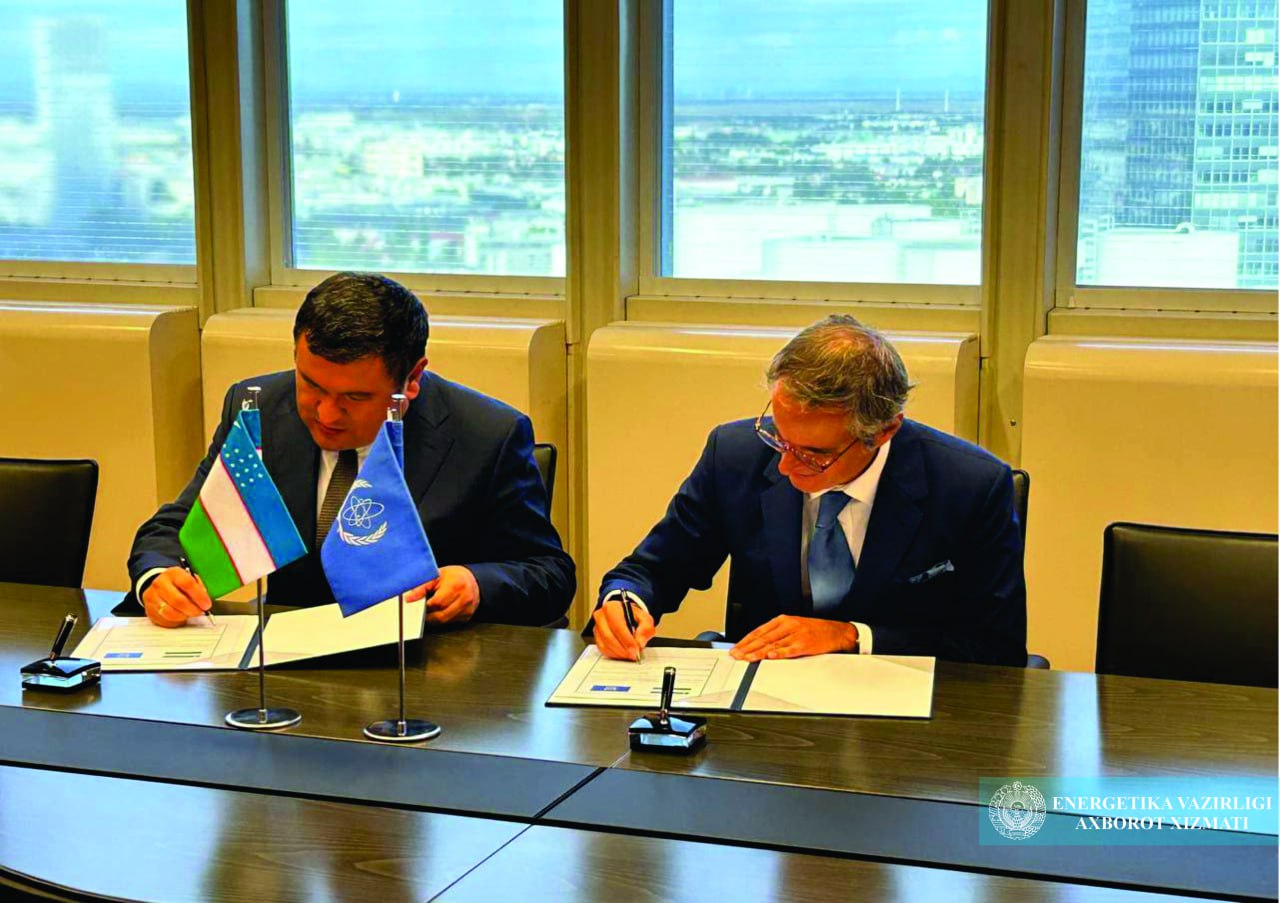




TASHKENT, Uzbekistan, September 16. Uzbek Minister of Energy Jurabek Mirzamahmudov signed a roadmap with IAEA Director General Rafael Grossi aimed at strengthening cooperation in the peaceful use of nuclear energy, Trend reports.
The agreement was signed during the 69th General Conference of the International Atomic Energy Agency (IAEA), held in Vienna, Austria, from September 15 through 19, 2025.
The IAEA General Conference is the leading international forum where member states set cooperation priorities and make key decisions in the fields of nuclear energy, science, technology, and safety.
Bringing together representatives from 180 member states, the conference defines the organization’s strategic direction for the coming year, ensuring its activities remain effective and responsive to contemporary global challenges.
On the sidelines of the conference, a meeting also took place between IAEA Deputy Director General Liu Hua and the Uzbek delegation, represented by leaders of the Uzatom Agency, the Ministry of Energy, and the Committee for Industrial, Radiation, and Nuclear Safety.
The parties discussed current results, ongoing work, and plans for applying nuclear technologies across various sectors of Uzbekistan’s economy, including energy, medicine, and agriculture.
IAEA representatives noted the significant progress Uzbekistan
has made in developing its nuclear program, highlighting the active
role of the government in creating a strong foundation for
expanding the peaceful use of atomic energy.
The discussion also emphasized the importance of Uzbekistan’s first
nuclear power plant project, a key element in ensuring the
country’s sustainable energy future. Uzbekistan expressed interest
in further technical collaboration with the IAEA to support the
implementation of this project.
The IAEA General Conference serves as the leading international forum where member states set cooperation priorities and make key decisions in the fields of nuclear energy, science, technology, and safety. Bringing together representatives from 180 member states, the conference defines the organization’s strategic direction for the coming year, ensuring its activities remain effective and responsive to contemporary global challenges.