


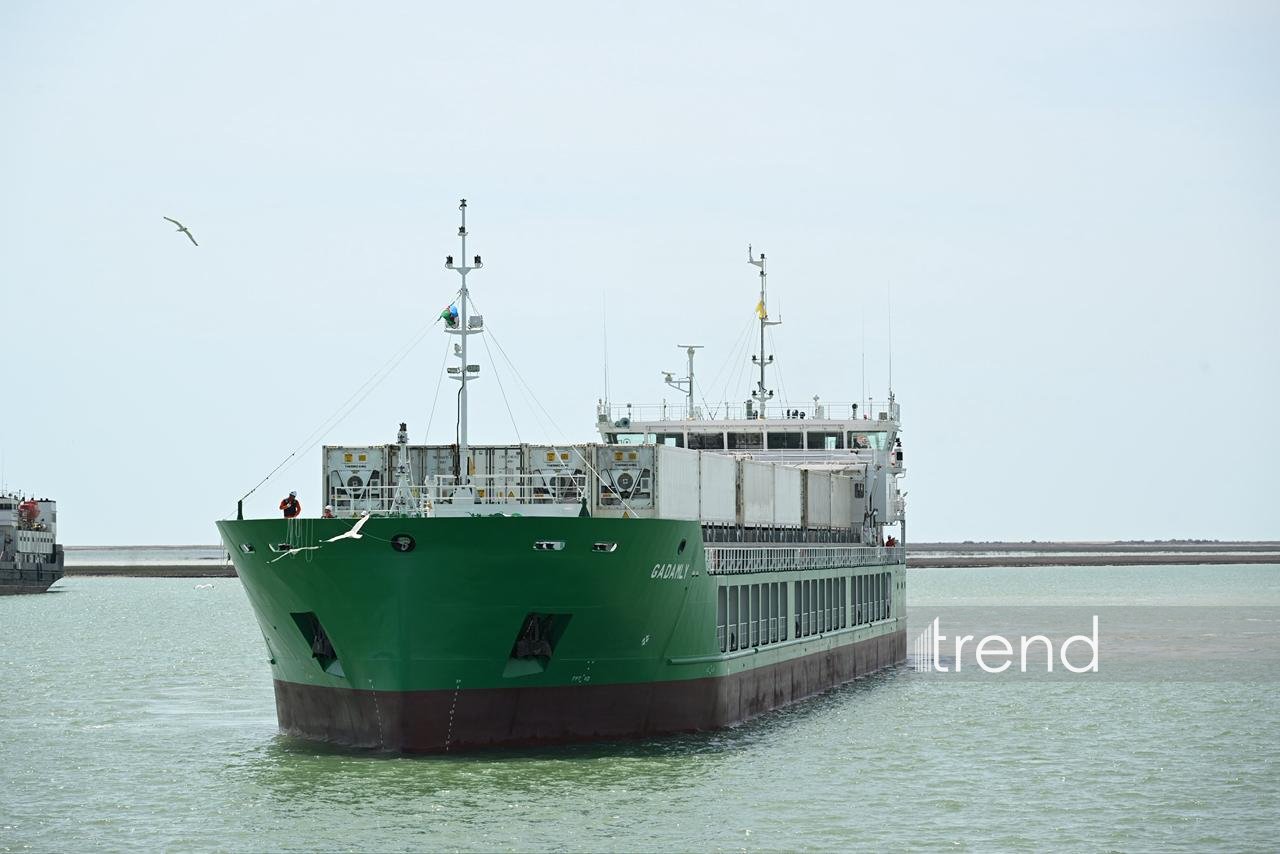

BAKU, Azerbaijan, May 14. The arrival of the dry cargo vessel Gadamly in Baku, constructed at the Balkan Shipbuilding and Repair Yard in Turkmenbashi, Turkmenistan, represents a significant operational advancement in the development of the Caspian transport corridor linking Turkmenistan and Azerbaijan. The operation, conducted as a regular service on the Baku–Turkmenbashi route with the vessel subsequently deployed for container transportation, reflects a broader trend of increasing the density of transport connections within the Caspian segment and underscores Turkmenistan’s growing logistical significance in the Middle Corridor.
The vessel, with a cargo capacity of up to 6,100 tons and the ability to carry 240 containers, arrived on May 12 at the Baku International Sea Trade Port, where an official reception ceremony was held, attended by transport officials and diplomatic representatives from both countries.
During the ceremony in Baku, Turkmenistan’s Ambassador to Azerbaijan, Gurbanmammed Elyasov, described the maiden voyage of the Gadamly as a tangible indicator of expanding transport and logistics cooperation between Ashgabat and Baku. The vessel will operate on the Baku–Turkmenbashi route, a key segment of the Trans-Caspian International Transport Route (TITR), also known as the Middle Corridor.
Deputy Chairman of Azerbaijan Railways CJSC, Arif Aghayev, emphasized that all countries along the corridor must enhance their infrastructure to accommodate increasing cargo volumes. He noted that while the current throughput capacity of the Baku International Sea Trade Port is 150,000 TEU, ongoing improvements, including dredging operations and the acquisition of new equipment, are expected to increase capacity to 260,000 TEU, representing an expansion of over 70%.
It is important that the appearance of the “Gadamly” is not isolated from the already established infrastructural logic of the Caspian region. The Baku-Turkmenbashi route has long been part of a broader trans-Caspian chain, where synchronization of ports, schedules, and capacity plays a key role. In this context, even a single vessel becomes an element of a system in which what matters is not the act of transportation itself, but its regularity and integration into a stable flow. According to Azerbaijani Prime Minister Ali Asadov, total transit volume along the Middle Corridor in 2025 amounted to about 5 million tons, increasing by approximately 11% year-on-year - a figure that directly adds pressure to the Caspian segment of the route.
A separate element in the development of Caspian logistics coordination was the working meeting between representatives of Azerbaijan and Turkmenistan held on April 1, 2026, at the Baku International Sea Trade Port in Alat. During the talks, the sides discussed practical issues of expanding port cooperation, including increasing throughput capacity, coordinating vessel schedules, and developing multimodal transportation between the ports of Baku and Turkmenbashi. Particular attention was paid to the digitalization of port operations and improved infrastructural synchronization within the growing trans-Caspian cargo flow, which is becoming more stable amid rising transportation volumes along the Middle Corridor.
In this context, the emergence of new cargo vessels in the Caspian Sea is already gaining infrastructural significance. In recent years, the development of the Middle Corridor has increasingly depended on practical factors such as port capacity, fleet availability, containerization, and the speed of multimodal transportation between Central Asia, the Caucasus, and Europe. This is why the expansion of transport capacity on the Caspian segment is becoming one of the key directions of regional logistics.
Particular attention is drawn to the fact that the “Gadamly” was built directly in Turkmenistan. The vessel is the first fully domestically constructed dry cargo ship in the country and was built at the Balkan shipyard in cooperation with the South Korean company Koryo Shipbuilding Industry Technology (KSIT). During the commissioning ceremony in Turkmenbashi on May 8, President Serdar Berdimuhamedov stated that the country attaches special importance to the development of international transport corridors East-West and North-South and continues to expand its transport and logistics system. The head of KSIT also attended the ceremony, presenting Turkmenistan with international quality and engineering certification for the project.
This model of cooperation reflects a broader approach: the localization of shipbuilding within Turkmenistan while maintaining technological participation of external partners. During the commissioning ceremony, it was emphasized that the project was the result of engineering cooperation and confirmation of the Balkan shipyard’s ability to handle more complex commercial vessels.
If viewed together, these processes show that the arrival of the “Gadamly” in Baku is part of a gradual but steady shift toward the formation of a more regular Caspian logistics system. In this configuration, Azerbaijan acts as a key transit hub where Caspian flows connect with the railway and port infrastructure of the South Caucasus, providing access to the Black Sea and further into Europe. In recent years, this has been accompanied by the expansion of Azerbaijan’s maritime infrastructure, including fleet and port terminal development.
According to ASCO, a total of 35 new vessels have been commissioned since 2013. Against this backdrop, the development of transport capacities in both Azerbaijan and Turkmenistan is effectively shaping a more stable and interconnected Caspian logistics system.
At the bilateral level, this is not recorded as a separate project or agreement - rather as a gradual densification of an existing transport fabric. In this sense, the “Gadamly” functions as another element of an emerging system of regular Caspian maritime communication, where what matters is not the event itself, but the repetition of routes and the stability of logistical links.



