


BAKU, Azerbaijan, February 3. Hakan Fidan, Minister of Foreign Affairs of Türkiye, and his Kazakh counterpart Yermek Kosherbayev have agreed to deepen cooperation on the Middle Corridor development during the 8th meeting of the Joint Strategic Planning Group (JSPG) on February 2, 2026, in Ankara, Trend reports via the Turkish Foreign Ministry.
At the meeting, the sides exchanged views on ways for further strengthening Türkiye-Kazakhstan relations in a wide range of areas, including trade and investments, culture and education, energy security, regional connectivity, health, environment, counterterrorism, defense, and the defense industry.
"Celebrating the 34th anniversary of the establishment of diplomatic relations between Türkiye and Kazakhstan, and highlighting the common history, language, and culture as the basis of their brotherly cooperation, the Foreign Ministers reiterated their commitment to further deepen the multifaceted Turkish-Kazakh cooperation in accordance with the Enhanced Strategic Partnership of the two countries.
The sides expressed their satisfaction with the frequency of high-level visits, which serve as a testament to the strong bilateral ties and mutual trust between Türkiye and Kazakhstan. They emphasized that such visits further deepen cooperation across various fields and reaffirmed their commitment to maintaining this dynamic momentum," the ministry said.
According to the ministry, the sides discussed priority areas for economic relations, including facilitating and diversifying trade and investment, encouraging technology transfer and joint investments in agriculture, enhancing cooperation in the field of environment, deepening cooperation in the health sector, and strengthening collaboration in the fields of science and technology, particularly cybersecurity, artificial intelligence, digitalization, and space.
The meeting also emphasized the importance of cooperating in the energy sector through energy trade and joint projects, including oil and natural gas infrastructure across the value chain, clean energy generation, electricity transmission, and joint exploration, development, and processing initiatives in the mining field, particularly focusing on critical minerals and rare earth elements.
"Recognizing the importance of the Trans-Caspian East-West Middle Corridor as a sustainable and reliable transport and energy route in connecting Central Asian countries to foreign markets through Türkiye, the Foreign Ministers reaffirmed their commitment to deepen cooperation in strengthening regional connectivity through cooperation and the trilateral mechanism of the Ministers of Foreign Affairs and Ministers in Charge of Transport of Türkiye, Kazakhstan, and Azerbaijan, as well as regional and international platforms, most particularly the Organization of Turkic States (OTS), the core multilateral platform of the Turkic World.
Emphasizing that Kazakhstan remains the largest trade partner of Türkiye in Central Asia, the foreign ministers noted with appreciation the progress made on the implementation of the Action Plan of the 13th meeting of the Joint Economic Commission, held on 25 April 2024 in Ankara.
The sides have decided to take coordinated action to address emerging threats to peace and security, including terrorism in all its forms and manifestations and other transnational organized crime and threats," the ministry explained.
The ministry noted that the Sides expressed their appreciation for the close collaboration on defense matters, the military-technical cooperation, and the ongoing Military Dialogue Meetings between the relevant authorities of the two countries. In this context, they also reaffirmed the importance of the modernization projects for Kazakhstan’s defense industry infrastructure through joint ventures.
"The ministers recognized people-to-people relations between the two countries as one of the solid pillars of the bilateral relationship. Akhmet Yassawi International Kazakh-Turkish University in Turkestan, Yunus Emre Turkish Cultural Center in Astana, and the Türkiye Scholarships program for Kazakh students are illustrative of this connection.
The ministers welcomed the progress regarding the establishment of Maarif Schools in Astana and Almaty in the upcoming period and agreed to continue supporting educational and cultural partnerships between the two brotherly nations.
The sides encouraged cooperation between the two countries in the field of education and science, especially between higher and secondary professional educational institutions, including the intensification of the exchange of researchers and specialists.
In collaboration with TIKA and KazAID, the sides encouraged the promotion of sustainable development in Central Asia and cooperation on development assistance towards third countries," the ministry said.
The ministry stressed that Fidan expressed appreciation for the solidarity shown by brotherly Kazakhstan in the face of the devastating earthquakes of 6 February 2023 and for the school construction in Nurdağı (Gaziantep) as a token of a brotherly gesture by Kazakh people.
"The Sides welcomed the close and constructive cooperation established in the field of health and expressed their intention to deepen this cooperation through enhanced institutional engagement, capacity-building efforts, and exchange of expertise.
The ministers commended the work of the Congress of Leaders of World and Traditional Religions in strengthening global stability and tolerance," the ministry pointed out.
According to the ministry, as founding members of the OTS, Türkiye and Kazakhstan reaffirmed the joint resolve to expand their collaboration with a view to further empower the OTS and other Turkic Cooperation Organizations.
"The sides also reaffirmed to further intensify their joint efforts to implement the 'Turkic World Vision—2040.'
As founding members of the Conference on Interaction and Confidence-Building Measures in Asia (CICA), the sides supported CICA’s transformation into a fully fledged international organization while preserving its Asian identity," the ministry added.
Besides, the ministry underscored that the sides noted the importance of deepening cooperation within international platforms such as the UN, OSCE, OIC, and ECO.
Fidan and Kosherbayev elaborated on current regional and international developments, including those in Afghanistan, Gaza, Ukraine, and Syria.
The ministers welcomed, in this regard, the launch of the second phase of the Comprehensive Peace Plan to end the war in Gaza. They underlined that the establishment of the Board of Peace, endorsed by United Nations Security Council Resolution 2803 and of which both countries are members, has created new momentum toward a permanent ceasefire and the reconstruction of Gaza, as well as for peace, stability, and prosperity in the region and the realization of the two-state solution.
The ministers emphasized the need to reach a negotiated, mutually acceptable, and viable settlement of the Cyprus issue and acknowledged the aspirations of the Turkish Cypriot people, being an integral part of the Turkic world, to realize their equal inherent rights," the ministry mentioned.
The ministry highlighted that the JSPG meeting provided a timely opportunity to discuss the calendar and preparation of the 6th meeting of the High-Level Strategic Council under the co-chairmanship of Recep Tayyip Erdoğan, President of the Republic of Türkiye, and Kassym-Jomart Tokayev, President of the Republic of Kazakhstan, to be held in Astana, as well as the organization of the upcoming Summits of the Heads of State of the OTS to be held in Kazakhstan (Turkistan) and Türkiye in 2026.
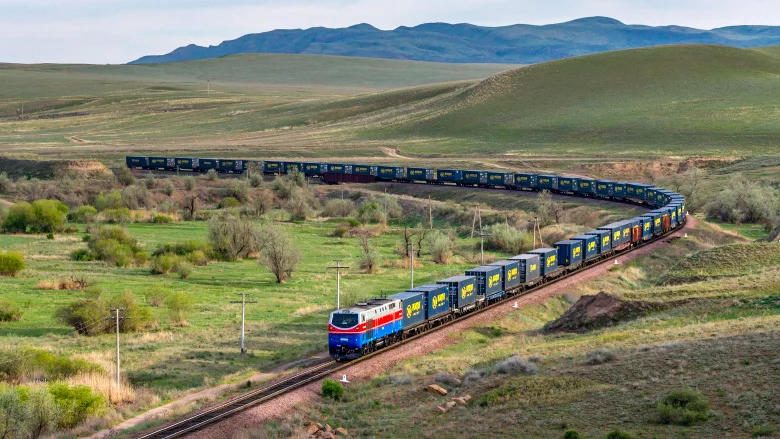
The Middle Corridor, also known as the Trans-Caspian International Transport Route (TITR), is a transport and trade route connecting Asia with Europe and serving as an alternative to the traditional Northern and Southern corridors. The route begins in China, passes through Central Asian countries such as Kazakhstan, Uzbekistan, and Turkmenistan, crosses the Caspian Sea via Azerbaijan, and continues through Georgia and Türkiye before reaching Europe. This overland route allows cargo to bypass longer maritime routes and provides a direct connection between East Asia, including China, and Europe.
Stay up-to-date with more news on Trend News Agency's WhatsApp channel



