


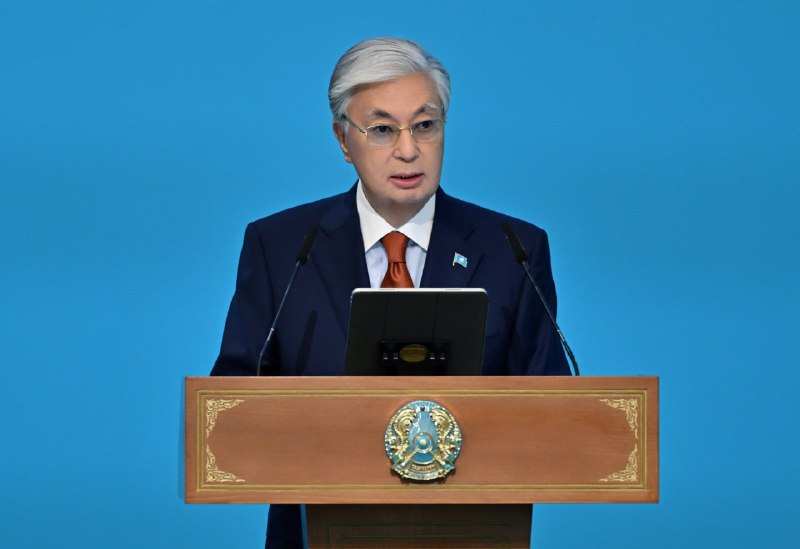

BAKU, Azerbaijan, September 7. A series of recent decisions by international credit rating agencies concerning Kazakhstan’s largest companies provides a further indication of how global investors assess the country’s economic environment. The upgrade of Kazakhstan’s sovereign credit rating, followed by revised assessments of major enterprises and the continued strong confidence in financial institutions, reflects not only the resilience of individual organizations but also broader developments in the country’s economic environment, which has remained one of the key priorities of the policy agenda of President of Kazakhstan Kassym-Jomart Tokayev.
In recent weeks, international rating agencies have consistently upgraded or affirmed the credit ratings of major Kazakh companies. S&P Global Ratings upgraded the ratings of KazMunayGas (KMG), Tengizchevroil (TCO), and several financial institutions following its revision of Kazakhstan’s sovereign rating. Fitch Ratings affirmed the strong credit profile of the national atomic company Kazatomprom, while Moody’s maintained the ratings of the country’s key development institutions.
This trend followed S&P Global Ratings’ decision on August 21, 2026, to upgrade Kazakhstan’s long-term sovereign rating from “BBB-” to “BBB” with a stable outlook. According to the agency, the decision was supported by the resilience of Kazakhstan’s economy, substantial foreign exchange reserves, and expectations of a further reduction in the non-oil deficit.
Against this backdrop, the improvement in the credit ratings of individual companies can be viewed as part of a broader process aimed at strengthening Kazakhstan’s position as a reliable borrower and an attractive destination for investment.
As noted by the Eurasian Development Bank (EDB) in its macroeconomic outlook, Kazakhstan’s sovereign rating upgrade came amid challenging conditions in global financial markets, where many countries are facing rising debt burdens and higher borrowing costs.
At the same time, Kazakhstan continues to maintain a more resilient position due to its moderate public debt level, significant reserves, and sustained economic growth. According to the EDB, Kazakhstan’s average government debt level in 2023–2025 stood at 24% of GDP. For comparison, the average figure among several “A” category countries - including Malaysia, Croatia, Chile, and Poland - was 55.9% of GDP. “Since Kazakhstan’s debt level is lower than that of several ‘A’-rated countries, the size of its debt itself is not a constraint for further rating upgrades. Sustained and high economic growth, the availability of liquid reserves, and a moderate level of liabilities provide the country with a competitive advantage,” the EDB said in its report.
According to the bank’s assessment, another factor supporting Kazakhstan’s resilience is the country’s substantial external assets. As of the end of July 2026, Kazakhstan’s gross international reserves amounted to 20.3% of GDP, covering 9.3 months of imports, while the assets of the National Fund stood at 20.8% of GDP.
These indicators have been among the reasons why international investors continue to demonstrate strong interest in Kazakh assets. In 2024, Kazakhstan issued 10-year Eurobonds worth $1.5 billion with a yield of 4.7%. Demand for the offering nearly quadrupled the amount issued, reaching $6 billion. In 2025, another five-year issue, also worth $1.5 billion, attracted orders exceeding $4.4 billion.
This dynamic reflects Kazakhstan’s broader economic strategy in recent years, aimed at strengthening resilience, developing infrastructure, attracting investment, and improving the quality of public governance.
Under President Kassym-Jomart Tokayev, improving institutional efficiency and enhancing the investment climate have become key elements of Kazakhstan’s economic policy. Back in 2022, he highlighted the need to improve the effectiveness of state financial institutions, including the Development Bank of Kazakhstan, and to strengthen their role in supporting the real sector of the economy.
Speaking at a meeting of the Council of Foreign Investors on July 2, 2026, President Tokayev said: “Despite unfavorable external conditions, Kazakhstan’s economy grew by 6.5% last year. The country’s GDP exceeded $300 billion. Kazakhstan intends to maintain its leadership position in Central Asia in terms of attracted investment. The accumulated volume of net foreign direct investment exceeded $150 billion, accounting for almost 70% of all investment in the region. The foundation of these economic achievements is our political stability. Following a historic nationwide referendum, we adopted a new Constitution of the Republic, which has already received recognition as a people’s Constitution. It is symbolic that our Basic Law entered into force literally on the eve of our meeting. The updated constitutional provisions ensure the highest possible level of protection for investors’ rights.”
Work on improving financial market regulation continued in August 2026. Tokayev signed the Law “On Credit Rating Activities,” which establishes requirements for transparency of rating procedures, the quality of assessment methodologies, prevention of conflicts of interest, and the operations of credit rating agencies.
The creation of such an institutional framework is particularly important for an economy seeking to further improve its credit quality. For international investors, financial indicators of companies are only one factor; equally important is the transparency of the rules governing the market.
One of the most visible outcomes of the improving economic environment has been the upgrade of ratings assigned to Kazakhstan’s largest industrial companies. S&P Global Ratings upgraded KazMunayGas’ long-term rating from “BBB-” to “BBB.” The agency also improved the company’s standalone credit profile, highlighting its strong position in the industry and conservative financial policy. According to S&P, KMG will be able to maintain funds from operations-to-debt above 45% on average despite an expected increase in capital expenditures. The company remains one of the key pillars of Kazakhstan’s energy sector, and its financial resilience contributes to the broader perception of the country’s oil and gas industry.
Another example is Tengizchevroil. S&P upgraded the company’s rating to “BBB,” citing its large-scale production, strong cost position, and low leverage. TCO’s operational performance further underscores its importance for Kazakhstan’s economy. In 2025, the company produced approximately 39 million tonnes of oil. Its strong operational profile and financial stability became among the factors behind the improved credit assessment.
Kazakhstan’s nuclear industry also plays an important role in the country’s evolving economic positioning. Fitch Ratings affirmed Kazatomprom’s long-term rating at “BBB” with a stable outlook. The agency noted that the company remains the world’s largest uranium producer, accounting for around 20% of global primary uranium production in 2025. Fitch expects Kazatomprom’s gross debt-to-EBITDA ratio to remain below 1.0x during the 2026–2029 period.
Thus, international ratings reflect not only the resilience of Kazakhstan’s traditional export sectors but also the country’s ability to maintain competitive positions in strategic industries of the global economy. At the same time, stronger confidence from international agencies is extending to Kazakhstan’s financial sector. S&P upgraded Bank CenterCredit’s standalone credit profile from “bb” to “bb+”, citing improvements in the bank’s capitalization. According to the agency’s forecast, the bank’s risk-adjusted capital ratio is expected to rise to 10.2–10.7% over the next 18–24 months, compared with 9.2% in 2025.
For Halyk Bank, the agency affirmed the “BBB-/A-3” rating and revised the outlook on its long-term rating to positive. The bank remains the largest financial institution in Central Asia, accounting for approximately 30% of Kazakhstan’s loan and deposit markets. Positive assessments also extend to Kazakhstan’s development institutions. Moody’s affirmed the rating of Baiterek Holding at “Baa1,” emphasizing its role as a government financial instrument and its contribution to the development of the non-resource sector.
International financial institutions are also continuing to expand cooperation with Kazakhstan. In April 2026, President Kassym-Jomart Tokayev discussed prospects for investment cooperation with Eurasian Development Bank (EDB) Chairman Nikolai Podguzov. During the implementation period of the bank’s 2022–2026 strategy, the EDB’s total investment volume reached $9.2 billion, of which $5.2 billion was directed to Kazakhstan.
The bank’s financing supported key areas of the economy: approximately $2.1 billion went to industry, $1 billion to the energy sector, $1 billion to transport infrastructure, and $1.1 billion to the financial sector. In July 2026, Tokayev also held a meeting with European Bank for Reconstruction and Development (EBRD) President Odile Renaud-Basso. According to her, the EBRD’s investments in Kazakhstan could reach €1.3 billion this year, which would be the highest annual figure in the bank’s entire history of operations in the country.
All these factors form a broader picture: the upgrading of Kazakhstan’s companies’ ratings is not an isolated event but rather a reflection of gradual changes in the country’s economic environment. International agencies evaluate not only the financial condition of individual enterprises but also the resilience of the economy, the quality of institutions, and the government’s ability to support long-term growth.
For Kazakhstan, achieving a sovereign rating of “BBB” and improved assessments for leading companies represent another step toward higher levels of credit quality. At the same time, future progress will depend on continued structural reforms, economic diversification, and maintaining the confidence of international investors.



