


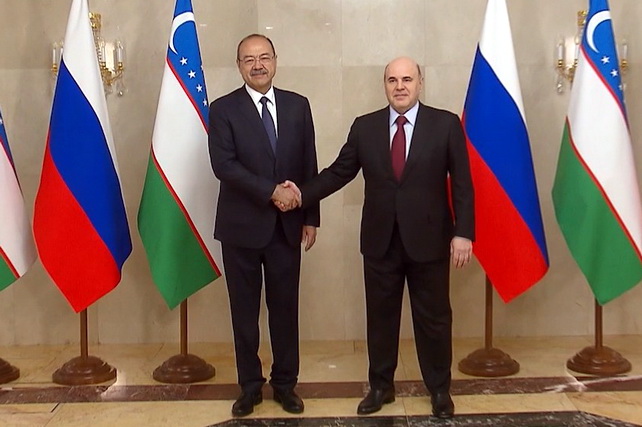

BAKU, Azerbaijan, April 14. On April 13, Moscow hosted the sixth meeting of the Joint Commission between Russia and Uzbekistan, underscoring the continued expansion of bilateral cooperation beyond traditional trade relations.
Founded in 2018 at the initiative of the two presidents, the commission has quickly evolved into a robust framework for coordinating economic activities. While it initially concentrated on trade, the scope of cooperation now spans multiple sectors, including energy, industry, logistics, technology, and human capital development.
Energy remains a central pillar of this collaboration, driving the broader trajectory of relations. A key project under this framework is the nuclear power plant in Uzbekistan's Jizzakh region, which involves Russia’s Rosatom and has already entered the implementation phase. Construction is actively progressing, and the industrial infrastructure is being developed. The project envisions an integrated nuclear power system with multiple units of varying capacities, rather than a single facility.
Early estimates suggest that the plant’s total output will reach approximately 17 billion kWh annually, accounting for 13-14% of Uzbekistan's current electricity consumption. Given the rising electricity demand, the project is expected to play a strategic role in enhancing the country's long-term energy security, adding significant weight to the ongoing cooperation between Russia and Uzbekistan.
“Implementation of this initiative will provide an additional boost to the economy and ensure a stable energy supply for decades,” Russian Prime Minister Mikhail Mishustin said during the meeting.
Cooperation in the oil and gas sector is also deepening. The parties confirmed their readiness to continue and expand supplies of Russian oil and natural gas. Particular emphasis is being placed on the modernization of Uzbekistan’s gas transportation and processing infrastructure with the involvement of Russian technologies and expertise. Drilling of new wells is already underway, while production facilities are being upgraded to improve overall efficiency.
At the same time, Uzbekistan’s energy strategy remains diversified. The country is actively expanding renewable energy capacity, particularly in solar and wind generation. However, base-load sources, including nuclear and gas, continue to play a critical role in ensuring grid stability and meeting peak demand, underscoring the importance of ongoing joint projects with Russia.
On the broader economic front, bilateral cooperation shows continued positive momentum. In 2025, trade turnover between Russia and Uzbekistan rose by 12.5%, approaching $13 billion. Russia’s exports to Uzbekistan expanded across key sectors, including mineral products, chemicals, and pharmaceuticals, while Uzbekistan strengthened its position in textiles and agricultural exports. Russia’s share in Uzbekistan’s total foreign trade turnover remains around 16%, reinforcing its role as one of Uzbekistan’s principal economic partners.
“Russia is among Uzbekistan’s leading foreign trade partners. Mutual trade turnover has grown by nearly 12.5 percent and approached one trillion rubles. In line with the agreements between the heads of state, we aim to multiply this figure by 2030,” Mishustin noted.
At the same time, the current stage of cooperation is increasingly defined not only by trade volumes but also by a shift toward industrial cooperation and large-scale investment projects. More than 3,000 enterprises with Russian participation operate in Uzbekistan, while around 150 joint projects worth approximately 4 trillion rubles are being implemented across various sectors.
A critical aspect of this cooperation is the development of joint industrial zones, which serve as key platforms for fostering deeper integration. Technoparks in Chirchik and Jizzakh are already yielding significant outcomes, with multiple residents and the creation of thousands of jobs. The expansion of these zones is expected to continue in the coming years, with new projects planned across various regions, enhancing both localization and production supply chains.
“These platforms demonstrate tangible results of industrial cooperation and form a solid foundation for further growth in mutual trade,” Alexey Mikhailov, Director of the Department for Economic Cooperation with CIS Countries at Russia’s Ministry of Economic Development, told Trend.
Logistics development further complements this framework. The parties are actively building a network of wholesale distribution centers and trade houses, improving supply chain efficiency and reducing transaction costs. These initiatives are already being implemented in several Russian regions and are gradually expanding in scale.
Overall, the outcomes of the meeting represent a broader trajectory of economic collaboration, marked by the convergence of energy, trade, investment, infrastructure, and technological development. Whether the two countries will achieve their ambitious goal of significantly increasing trade turnover by 2030 hinges on the continued success of this integrated model of cooperation. At present, Russia and Uzbekistan are making steady progress toward deeper economic integration, cementing their position as one of the most dynamic partnerships in the region.



